There’s a Dragon At the Bottom of the Garden

dscn2671

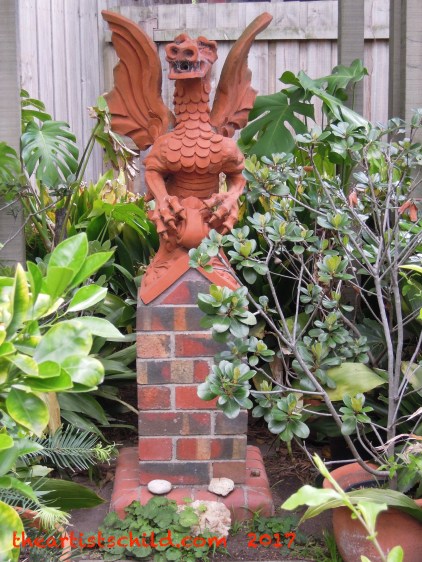
We have a dragon in our garden.  Not a real dragon like a type of frilled lizard, but the mythical kind found in old legends and fantasy tales.

Before we had any garden features our back yard looked rather boring.  Several years ago Ellie and I decided we needed some kind of focal point at the rear of the property.  We visited garden centres and couldn’t find anything we liked to suit our style of house.  It is a cross between the early 20th century Australian Federation and California bungalow styles with a modern red brick addition on the back.

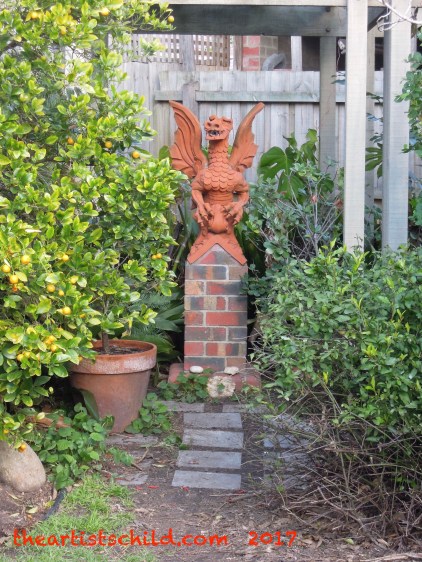
Looking in some books on how to renovate houses of these eras, we saw some terracotta roof dragons hand-made by the local architectural pottery.  Our roof has a couple of original terracotta finials but is not high enough to take a large dragon, so we decided to get one of these beautifully modeled terracotta sculptures to put in the garden.  We went to the pottery and looked at all the designs, chose a large French style dragon (actually a two-legged Wyvern) and placed our order.  After several weeks it was delivered in separate pieces to its new home.

The dragon needed some kind of plinth on which to sit so we cleaned a lot of old bricks left over when a front verandah was enclosed.  With the help of a friend, the brick plinth was constructed under a wooden pergola needed to protect the dragon from falling branches. The tree next door is an African Coral tree that sheds limbs in storms.  This structure has proved very effective, as we often find fallen branches that have been deflected by the framework.
dscn3174

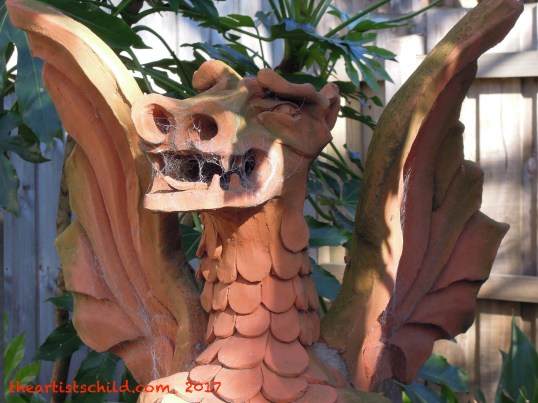
The foliage surrounding the dragon prevents it from being viewed from all parts of the garden, so it does not compete with other garden ornaments and retains its dramatic impact.  We named it after Ramoth, the dragon Queen in Anne McCaffrey’s wonderful books about the dragons of Pern.  Our dragon has gained a green patina of moss and lichens and has become a home for spiders, the kind that make interesting funnel like webs in the dragon’s mouth.  Every time I tried to remove the webs they kept returning because the spider lives inside the dragon.  Not a wise idea to put fingers into any crevices as I have since found Redback spiders in the garden so the webs can stay, no matter what made them.   For those unfamiliar with these spiders they are Australian native members of the deadly Black Widow family and like to live in damp and dark corners of the garden or shed.  Or maybe down a dragon’s throat.
dscn0576

The dragon is a wonderful symbol of both the creative and destructive forces of nature because it represents the four elements: earth, air, fire and water.  It lives in the earth, flies in the air, breathes fire and has the scales of a fish.  In western Myths and stories, dragons have often been seen as an evil serpent, like St George’s dragon and Tolkien’s cunning talking dragon, Smaug.  In Chinese culture usually they are lucky and are one of the 12 zodiac animals.  Also on the positive side, a dragon is the symbol of Wales and the magical friend of little Jackie Paper.   I was always sorry when Puff “sadly slipped into his cave”.  Dragons continue to inspire new works for children and adults, like the movie How to Train Your Dragon and the books and TV series of Game of Thrones, where they are dangerous but heroic creatures.  Never a wise idea to mock a Queen’s dragons.  Barbecue anyone?

It is great to have one of the architectural dragons at ground level because only birds would appreciate the sculptural detail when they are placed upon a roof.  To me Ramoth has a smiling face, but she looks quite powerful and ready to defend her territory so is a perfect garden guardian.

Kat

The Christmas Lilies are in Bloom Again

It is a hot, blustery Christmas Eve in Melbourne.  As we are about to have several hot days in a row, I thought I would photograph the lilies in our garden before they wilt.

Our white Christmas Lilies, also known as Day Lilies, are looking lovely at the moment.  It is quite windy and I had wait for lulls in between the gusts to avoid blurry photos.

Also some of the pink Calla Lilies are out, although not as many as last year, but they give a bit of colour.

It is going to be hot on Christmas day tomorrow.  35 degrees celsius is expected.  I hope that the Lilies survive a bit longer because they bring lushness to the garden in summer.

Enjoy the season, whether it is summer or winter.

Kat

Creative Summer Garden Decor

Now that it is summer I want to spend as much time as I can in the outdoors.   It is always lovely to sit outside and read or chat with friends.  It is good to have comfortable and sheltered places in the garden where you can do this and enjoy the fine sunny weather, so you need some suitable garden furniture.  You can buy items that look exactly like furniture found indoors, but these are not very bohemian, which is the style that I prefer.   I think that it is more fun and creative to do something with old furniture and use props to dress up your garden when called for.

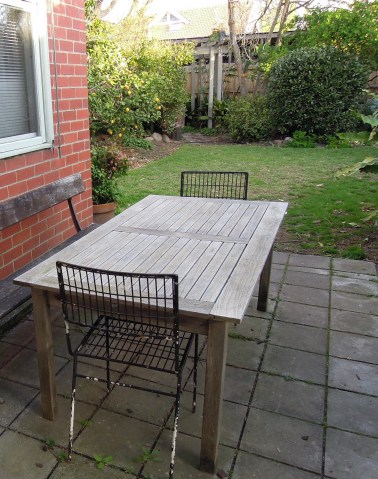
It would be nice to have a covered area where we could leave out cushions and less weather proof items and if you have such a structure make the most of it.  We have a very basic wooden garden table, an old railway bench that came from our grandparents and some old rusty metal kitchen chairs on our terrace.  I like the rustic look, but as a change I dress them up with interesting fabrics and other items for a more exotic feel.  Last summer I did this before entertaining some friends.

I covered the table with a painter’s canvas drop cloth.  You can buy these quite reasonably from hardware stores in various sizes.  Drop clothes are really useful as throws and tablecloths, especially outside, because they are heavy and will not blow around easily.  On top of this I put a gold Chinese style table runner and some colourful cloth tablemats, all found at an op shop.  Because it was breezy I anchored the ends of the runner with matching paperclips attached to the base cloth and placed straw mats along its edges.  These could be used as coasters.  On the tablemats I put some (op shop) candleholders and at the far end, an incense burner with lemongrass stick incense to repel flies and mosquitoes, but these weren’t a big problem because of the wind.

An old striped tablecloth was used to cover the railway bench, with some Indian cushions for comfort.  We have some black seat cushions that the fit seats of the metal chairs and a couple of striped Indian shawls were thrown over their backs, with cushions to rest against.  A large market umbrella shaded the table.  From it’s right side near the fernery I pegged up a colourful sarong to cut the glare of the sun.  This moved in the wind and was quite soothing.  From the wooden internal supports of the umbrella I hung a copper wind chime, found at an op shop and the musical notes also created a relaxing mood.   Everyone felt like they had been transported to a more tropical location rather than being in an urban setting and this was a great conversation starter.  Some good cocktails did not hurt either.   It is worth collecting interesting textiles and table accessories from places like op-shops and Oxfam, so that you can use them in imaginative ways outdoors.

I also like to sit and read or write songs in another sheltered and quiet part of the garden, where it is warmer when there is a cool breeze.  A couple of the metal kitchen chairs and an old white cast aluminum table sit in front of a pittosporum hedge and are flanked by a potted wisteria and a pot of thyme.  I can put a beach umbrella in the table for shade.  With a cool drink, some cushions and a good book, you can be perfectly comfortable in this spot.  What more do you need?  Well a nice view would help.  So opposite the table and chairs, against an old rusty gate, is a collection of bottles, ceramic pots, a statue of The Three Graces,  a mask of Pan and some found objects, together with pot plants, to form an interesting scene (referred to in 22 Oct post).   Behind this is the cool greenery of the fernery and hanging from the walnut tree above are some wind chimes.  This gives me something to look at and listen to when I need a break from reading or writing and I feel that I am in my own little oasis.

Don’t think that you need the latest décor to have an attractive garden for summer  entertaining and in which to enjoy the fine weather.  It is much more fun to do your own thing and your garden will not be the same as anyone else’s.

Kat

Embrace the Fun Side of Your Creativity

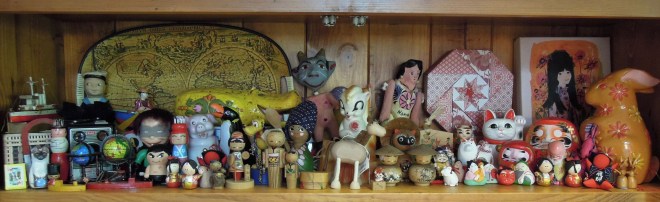
It would be a very boring world if we had to be serious all the time and to be creative you don’t have to always work with deep and meaningful concepts.  You can express yourself in any way you like and sometimes do things just for fun.  I like to play around and create amusing visual displays.  From retro toys, souvenirs and figures from other cultures to kitsch items and colourful ephemera, these are placed in the studio, as well as other rooms in the house and in the garden.  They are a source of inspiration and make me smile.

Some of these displays have grown into collections and others contain only a few items.  In the kitchen there is a large pine cabinet that mainly houses crockery and glass objects, but the top shelf is devoted to old and new toys, including a number bought on holiday in Japan.  Every time I look at this shelf, as well as being visually pleasing, each item has a story to tell that brings back many memories.

dscn2908

The most playful objects are in the studio as this is where I need a lot of visual stimulation. One of the seven dwarfs and a vintage Popeye toy sit on the computer desk and I can see them every time I sit down to work.  Across the room on a shelf, a child’s toy wardrobe holds a diorama with seaside souvenirs and related objects, while a trio of incongruous toy horses stand along side.  On the top of the wardrobe sits a miniature closet and dressing table in the same pale blue. Greeting cards with interesting and associated designs are often used in my groupings and I have a large number to choose from. I move items around in different combinations when the mood takes me.  For example, some resin figures that have at one time been in the old dollhouse (see 2nd post) or the wardrobe display, now sit on a pelmet in the studio.  Others may view these articles as clutter and dust collectors, but to me they are part of a whimsical realm where my imagination can wander.

Out in the garden a gnome peeps out from under a shrub and an owl, a failed possum scarer, sits on a metal post to become a quirky feature. A cast iron gecko crawls along a rock.  These things are purely for amusement and don’t pretend to be anything else.  For me, keeping a sense of fun is a necessary part of the creative process.

Many creative people have collecting and hoarding tendencies and sometimes it can be difficult to control.  I find that I have to be selective with what I keep and have given away countless objects because it was impossible to store them with the space available.  But there are no rules to this and you can be sparing or lavish with your chosen material.  If it is a house full of Star Wars figures that gives you a buzz or if you want a garden full of gnomes, go for it and don’t worry about what anyone else thinks.

The following links are to examples of homes and gardens where the residents have embraced the fun side of their creativity in a flamboyant and unconventional manner.

Sandra Eterovic – The Design Files

Bronwyn Barnett – ABC News

Sydney Garden Gnome House – Cool Hunting

Pensioner Robert Rae’s garden – Daily Mail UK

Kat

The Artist’s Child’s Symbol of Creativity

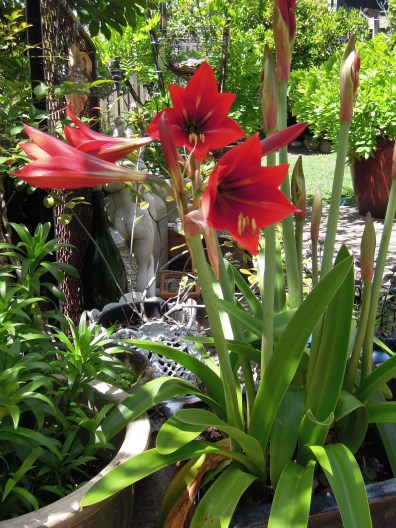
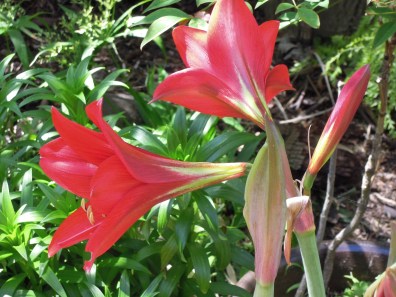
The Barbados Lilies in our garden are in flower again and are the symbol of creativity for this blog.  They always bloom at the end of October with the spring renewal and represent the full force of the creative spirit.  These dramatic red flowers burst into life to signal the coming of summer, the time of abundance.

dscn2880

dscn2871


Like all living things, the lilies are fragile and need to be fed and nurtured to reach their full potential.  We can enjoy them for a short time before they disappear for another twelve months.  These beautiful flowers remind us that to be creative we must seize each moment and enjoy our time in the sun.

Kat

Creative Spaces: The Garden

The house next door is going to be demolished next week. The neighbours are building a house that covers almost the entire block and there will be none of the original garden left.   Paved areas will replace it with a controlled minimal planting design reflecting the present obsession with low maintenance.  While everyone is entitled to build what they like on their own property, what makes me sad is that many people give little thought to their own and their children’s creativity when designing a new garden. A garden should be something that we treasure as a place to learn about the environment and use our imaginations.

Ellie and I have found that since childhood we have used our garden and those of our grandparents, as inspirational and creative spaces.  As children we built cubby houses out of whatever materials were available: old doors and corrugated iron from the woodshed; bamboo poles and old branches from the garden.  Ellie was the master builder and I was the interior decorator.  We learnt how to put things together and come up with our own solutions, as well as creating our own stories in play.  There was a wilder area at the end of the garden where we could imagine ourselves in a jungle or the bush and several shady trees to safely climb.  As we grew older we started to grow our own plants and contribute to the shape and nature of the garden.  We still have a reasonable sized garden and use it as a place to express ourselves and get ideas.

Our garden is constantly changing.  We need to pave an area outside our family room, add new plants to the garden beds and replace some trees.  It is not perfect but nor should it be.  The main thing is that it is a place where we can be experimental with ideas, just like in our studio.

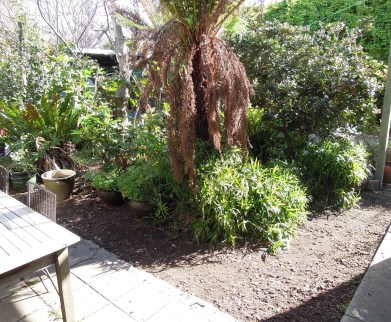
The fernery adjacent to the section that needs to be paved is our “wild” area.   It contains birds nest ferns, tree ferns, fish ferns, aralias (fatsia japonica) and some Japanese grasses and is shaded by a walnut tree and a large Yeddo hawthorn shrub.  The fernery is densely planted and sheltered and is the lowest point in the garden where the rain water runs.  It has coped with drought conditions in summer and the colder temperatures of winter.  It’s microclimate gives a cooling effect in the summer and the nearby table is a pleasant place to sit and a place to create.  I have often used the tropical looking foliage in my drawings and other artworks.  Having a variety of landscape areas in a garden can stimulate your imagination in many different ways.

Version 2


Version 2

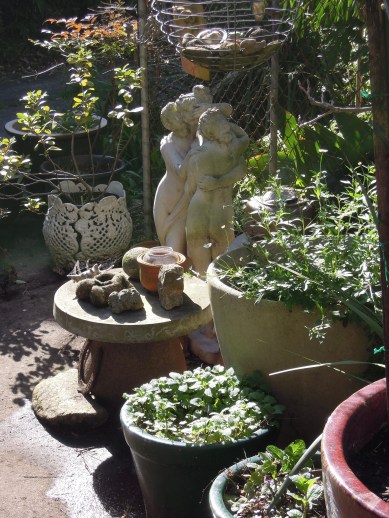
It is fun to be quirky with what you place in the garden.  As in the house I like to create found object arrangements.  For example, I made a small table out of an old upturned concrete pot with a circular concrete paving stone for the top.  On this are interesting rocks, a shell and a tea light holder made from a terracotta pot, with a glass insert that came from a broken hurricane lamp to keep out the wind.  Another still life of rocks and shells hangs above in a wire basket.  Together with an Italianate garden statue and lots of pot plants, this forms an attractive vignette that can only be seen when you turn a corner from the main lawn area of the garden. It is a contemplative quiet spot to sit on a sunny day.

dscn2648

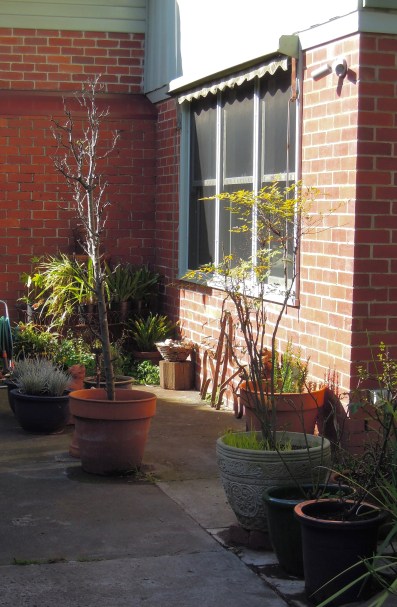
Having a variety of pots for plants can allow you to change an area of the garden and create interesting groupings and vistas.  Pots can be moved around depending on the season and the movement of sunlight.  For instance, we have a large concrete driveway in the back garden that was rather bleak.  To make this area more visually appealing we have used a variety of pot plants to break up the space.  We are not obsessed with having every pot matching, as this can look too “designed”.  Instead a mixture of sizes, colours and textures is more individualistic and repetition of shapes can link the pots together.  In this area there are a pair of low blue pots, a taller blue pot and two identical cream concrete pots, all of a similar rounded shape.  In addition there are several terracotta pots, most of which have an inverted conical shape.  Filling the pots with the same or similarly shaped plants also creates visual harmony.  We have used spikey plants that include a native silver grass with yellow flowers, prostrate and standard rosemary, some interesting bromeliads and a pointy apple tree.

Version 2

Sitting against a wall of the house near the driveway is an old rusty Victorian pot plant stand, one of a pair, which came from our great grandparents home.  It holds an orchid, some bromeliads and a spider plant amongst others.  The raised pot plants give colour and surface interest to an otherwise blank brick wall.  If you do not have a pot plant stand you don’t need to invest in an expensive plant wall feature.  You could fix inexpensive chain store metal brackets and shelves to hold light weight pots.  Or you could use old metal brackets and wood and paint them any colour you wish.

dscn2668

If you have limited outside space like a balcony or courtyard, it is still possible to use these outside areas creatively with pot plants and interesting objects.  Just use a smaller scale than in a garden.  If you have no outside space, some municipalities have community gardens where locals can contribute to the care of plants, grow vegetables and create sculptures and landscape features.  In contrast to the increased destruction of private gardens, community gardens reflect that there is a still strong need for gardens.  It makes you feel good to be out in the fresh air enjoying the greenery, digging around in the earth or making a new outdoor item.

With so many regulations and laws about what you can do in public spaces, it is wonderful to be able to create what you like in your garden.  Gardens keep us in touch with the natural cycles and foster our need for free self-expression.

Kat