Visual Inspiration: When it is OK to Hoard

Version 2

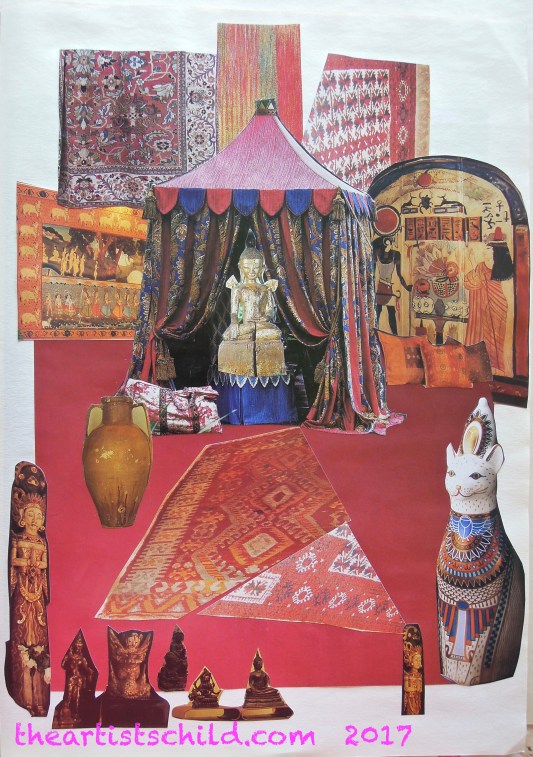
Shrine, Collage from Magazine Images by Kat

As artists and writers we get inspiration from many sources.  Being a visual person I find that I often need pictures, not to copy, but to stimulate my imagination for painting, drawing, poems or blogging.  I collect different types of images for this purpose and have amassed quite a collection.  To avoid hoarder chaos I have organized these so that they are easy to find.

Images of artworks, figures, nature, patterns and textures are all helpful resources and are good things for the creative person to have at hand when a bit of inspiration is needed.  It can be quite expensive to buy art and illustrated books, especially those that contain a lot of colour reproductions.  Ellie and I do have quite a good library but if we do not have a particular image it is easy to find an example on the Internet.  I download those that I like into my computer’s photo library so that I can refer to it at any time.

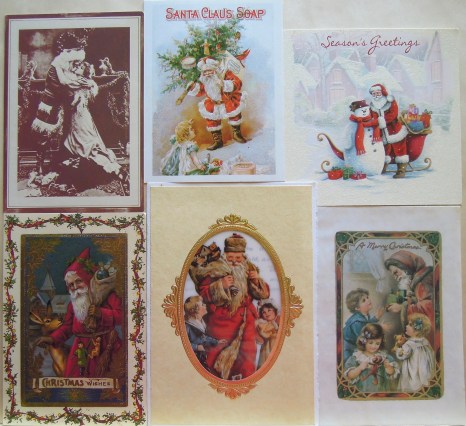
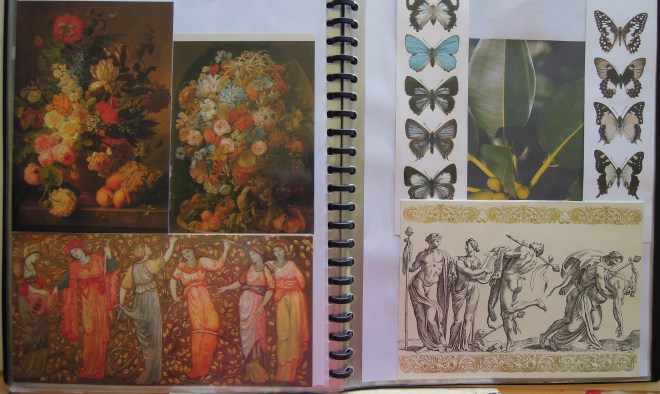
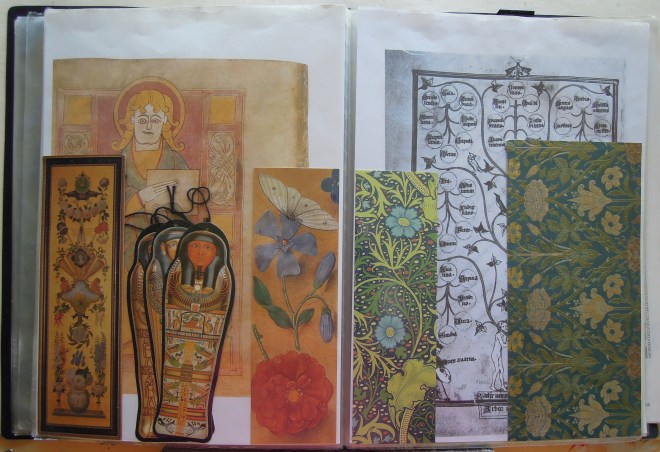
Many designers and artists pin paper copies of all kinds of images on pin boards in their workrooms for visual stimulus.  Printing out copies from the computer can use a lot of costly ink so for this purpose I have a large collection of postcards and greeting cards, either bought on holidays or from friends and relatives.  These are less expensive than buying books and are easy to find when travelling.  Advertising cards that are free in your letterbox, found at movie theatres, art galleries, museums and other public venues often have interesting depictions and are worth grabbing.  So that I can easily access these individual images I have put them into photo and postcard albums, display books, plastic pockets in ring binders and small boxes.  If you keep your reference material organized it is less likely to be accidentally thrown out by someone else.
Version 4DSCN3069

Version 2

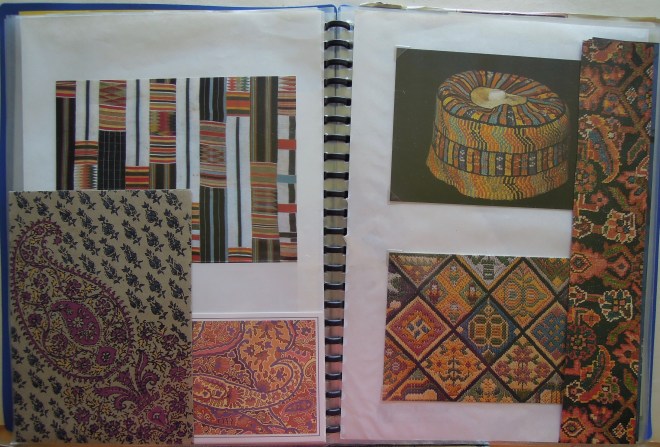
Display Books with Paintings, Decorative Arts, Nature and Textile Images

Inexpensive visual reference books can be found at op shops, garage sales, and markets. Vintage books that were designed for children often have clear, simple images of nature, science and other subjects that can be really helpful for creative work.  Second hand magazines are also invaluable for doing collages and for pin boards.   If you had to buy these new it would cost a fortune.  It also pays to ask your friends and relatives to pass any old magazines in your direction.  Good quality advertising catalogues can be used as well.

A creative person needs to learn to be a scrounger but be selective.  I do have favorite subjects and have quite a collection of the works of Australian women artists for motivation.  I love paintings from the Medieval to contemporary, all kinds of textile works and fairy tale illustrations and have a bit of an obsession with butterflies so will keep any image that possesses these.  Only store what really grabs you so that you do not end up suffocating under piles of paper.  You can add new images and discard others as your library evolves.
Version 2

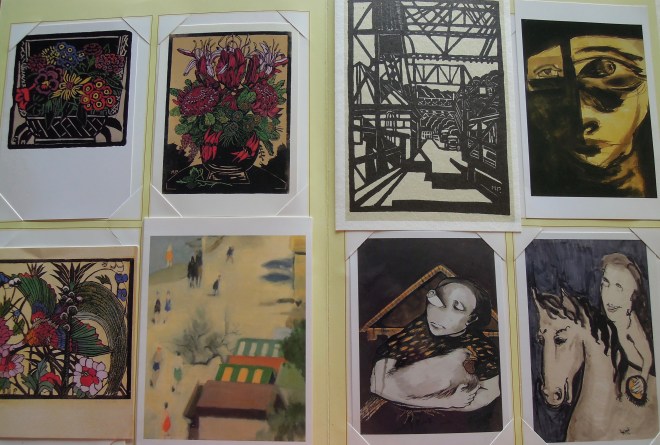
Post card Album with Australian Women Artist Cards (Margaret Preston Prints, Clarice Beckett Oil Painting and three Joy Hester Water Colour Paintings).

You will be surprised at how often you refer to these visual resources once you have your own personal collection. You can use them in many ways to trigger all kinds of original ideas and images.

Kat

I’ve been on a bit of a Paul Kelly binge lately.  He is such a great songwriter and I have his Memoir How To Make Gravy that is an inspirational book with all its helpful advice to songwriters.  The following live performance of his beautiful ballad Midnight Rain was recorded on his Stolen Apples Tour in 2007.  His nephew Dan Kelly (on the left of screen), a terrific guitarist and performer, plays lead guitar on this song.
A Window to the Past

DSCN4382

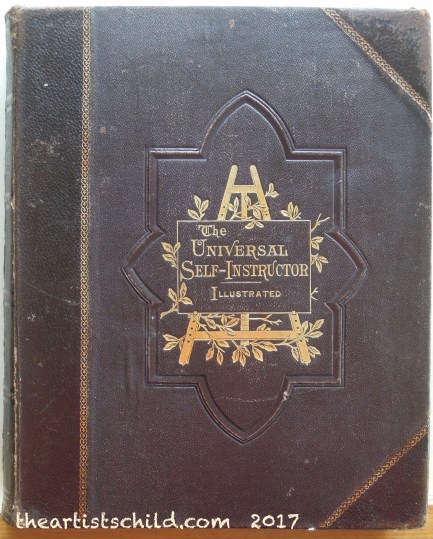
An old book can be seen as a window into the past and is a way to learn about the lives and interests of previous generations.  In our household library we have an original copy of The Universal Self Instructor (1883) that was a popular book for the home in the 19th century in Australia and America.  In it’s day this book would have given anyone who had basic schooling some kind of further education.  What I find fascinating about this book are the sections related the to the visual arts and crafts, particularly with regard to women.

The frontispiece depicts a goddess figure holding a torch with the words “knowledge is power.”  It was a way to improve your life whether you lived in a city or the country.  This book contains all kinds of information about business, law, agriculture, the domestic domains, leisure activities and general knowledge on many subjects, as well as social etiquette.  It is full of detailed black and white illustrations and is very much a depiction of the ideal life more than a century ago.

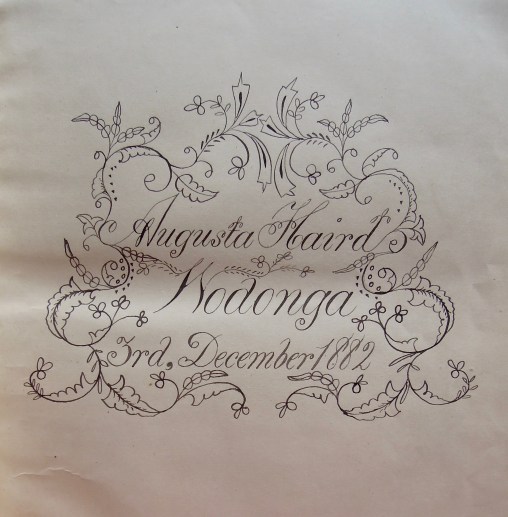
There is a whole section in The Universal Self Instructor devoted to handwriting.  It was considered important to be able to write well.  The cursive script is beautiful and would have taken pains to master.  Flourishes and images were added to documents so it was a real art.  Today, unless you are a calligrapher, many people’s handwriting has definitely deteriorated probably due to the constant use of keyboards and the ballpoint pen.  Inside the Self-Instructors cover is a beautiful example of handwriting done by it’s first owner.

DSCN4383

The book is all about rules and shows how restrictive it must have during that period. There are whole sections on social etiquette.  Life was a minefield of manners that included etiquette for introductions, visiting, conversation, public places, clothes, marriage, birth and death, the carriage trip, riding, debuts into society and entertaining. Nothing was relaxed.

DSCN4423

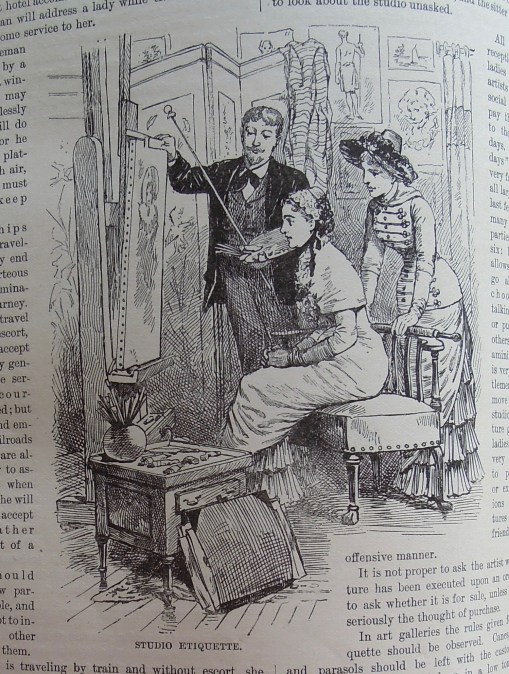
The situation that amused me was the visit to an artist’s studio or gallery exhibition. Artists had reception days when ladies could “pay their respects” to artist friends and were to be on their best behavior.  Pushing in front of others to view a work (something that is really annoying today), talking loudly and laughing were all considered extremely rude and you must never ask if a work is for sale unless you wish to buy it, which seems a bit stupid given that artists are not always great at selling their creations.  In galleries negative comments about the works should be kept to a low voice in case the artist is nearby and you should not linger in front of a work for too long.  Adherence to such etiquette today would make visits to crowded exhibitions a lot more enjoyable and artist’s would feel more comfortable if they did not have to listen to any uniformed criticism.  So not all etiquette is obsolete and without merit.
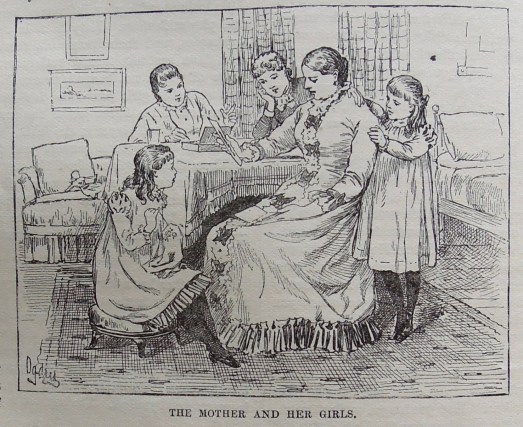
By the look of the accompanying illustration it was assumed that the professional artist was a man.  Women and girls were expected to keep to the domestic circle.  Girls were to be discouraged from being idle. To quote:

“Girls are very apt to fall into a habit of lounging about doing nothing, gaping out of the windows or napping on the sofas.”

Sounds a lot like teenage boy behavior as well but there is no mention of this.

DSCN4470

To keep them busy, Girls (and boys) were encouraged to learn drawing and painting for pleasure.  It was also a way to decorate the home.  Suitable activities for girls were to paint china, greeting cards, furniture, book covers, and silk for clothing.  Many ordinary women must have produced some beautiful creative artworks, often as a way to save money.

One of our female ancestors was a talented painter who took oil painting classes for young ladies at an artist’s studio in the 1880s.  She did some large paintings of landscapes.  I have included a photo of a small oil painting that she did on glass and a large seascape of Cape Schanck in Victoria (my photo does not do the latter justice as I was teetering on a ladder and kept wobbling).   Unfortunately after she was married and had children she did not continue with her art.   She was probably not taken seriously or encouraged to become a professional artist.  There are a couple of tiny painted china plates in the first photo that were probably considered a more acceptable pursuit for women in that era.

DSCN4452

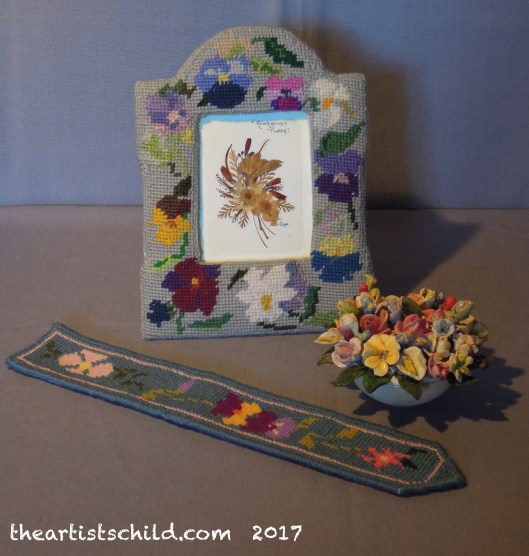
Needle point items, pressed flowers and moulded bread dough flowers would have been typical crafts of the period

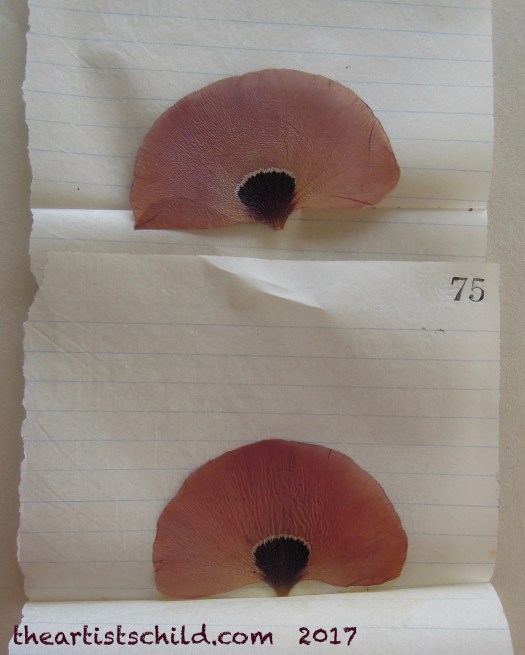
There are all kinds of suggestions for appropriate craft activities for women and girls. Of course there is embroidery, lace work, knitting, crotchet, patchwork and dressmaking, all  popular textile crafts.   There are also crafts such as creating scrapbooks, molding coloured wax flowers and fruit and the making of trifles (not the dessert).  Trifles were attractive but fairly useless little novelty gifts made to pass the time.  Inside the Self-Instructor, which is quite a tome, I found some dried flower petals pressed by a previous owner.  I wonder if they were for the creation of some “trifle.”

DSCN4432

Pressed flowers found in our copy of The Universal Self-Instructor

Another craft mentioned and probably long gone is “wall pockets,” decorative baskets lined with odds and ends of fabric, filled with dried flowers and foliage, tied with ribbons and attached to the wall (more like dust traps and spider homes to me).   Such gentille activities would have only been possible for middle class women and girls who were not forced by their circumstances to work long hours in underpaid jobs.

DSCN4429

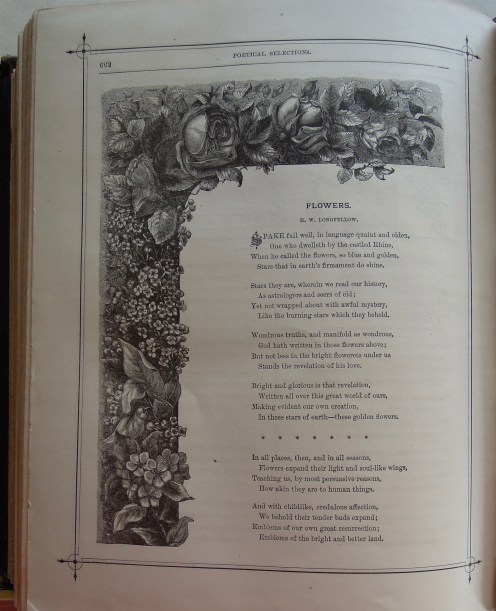
A beautifully illustrated poem by Longfellow

Poetry is included in the book.  There are a few by women poets, like American Magaret E Sangster, and this would have been an inspiration to young girls who loved to write poetry and demonstrated that they could also become writers.

The Universal Self-Instructor conveys an idealized view of the period, but for ordinary people who did not possess many books or have the means for further education, it would have been a valuable asset.   It was like having access to the Internet in its day and opened up a world of possibilities in all kinds of fields for many people.

It’s a fascinating book and I hope it inspired some girls, as well as boys, to pursue their dreams in the arts despite the social restrictions.   With all our modern freedoms, resources and technology there is nothing to prevent us from living an artistic life.

Kat

An Artist’s Best Friend

Version 2

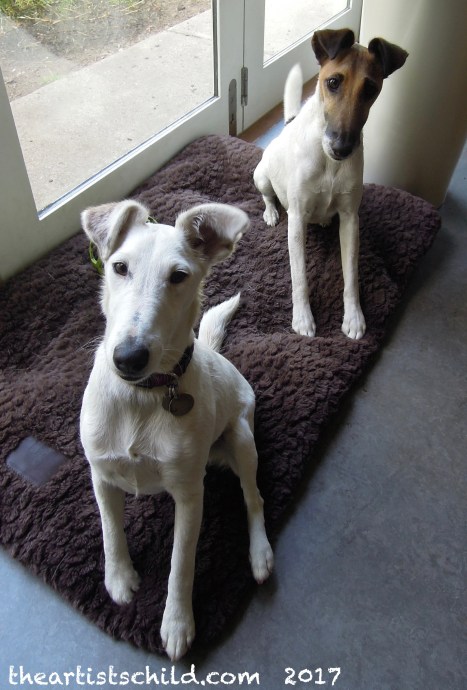
Our Two Fox Terriers

I had just written the first draft of this post and showed it to Ellie.  She read it and said, “no one wants to read about someone’s dog. It is too personal and boring.”  Of course she is right.  Anyone who has a dog thinks that theirs is the smartest, funniest dog in the world and they don’t want to hear about other people’s dogs unless it is an interesting story.  Taking on board what Ellie said I had a rethink and decided to write about dogs as a source of inspiration for artists and writers and how they have influenced my own creativity.
Dogs have inspired many works of fiction.  For example Jack London’s The Call of The Wild (1916), about the adventures of the Alaskan Klondike sled dog, Buck, Eric Knight’s 1940 novel, Lassie Come Home and Dodie Smith’s 1956 novel the 101 Dalmatians to name a few.  And who can forget one dog’s life story in Marley and Me (2005) by John Grogan.  These books were all made into popular and enjoyable movies.

Dogs as companions have produced entertaining characters like Scooby Doo from the cartoon TV series and Snowy in The Adventures of Tintin by Belgium cartoonist George Remi (Herge).  Generations of children have loved reading about the dog Timmy in Edith Blyton’s Famous Five books.  The French movie The Artist  (2011) benefited from the wonderful antics of the Jack Russell, Uggie and Eddie (Butch) provided many hilarious scenarios in the TV series, Frazier.

True stories about the incredible feats of dogs are also inspirational.  The Maremma Sheepdog used to trial their use for guarding Fairy Penguins against predatory foxes on the coast of the Victorian town of Warnambool, inspired the Australian film Oddball (2015).  There is also the successful Australian movie Red Dog (2011) based on a true story with a sequel in production.

Google songs about dogs and there is a long list.  Often they are used as metaphors that are not always flattering to dogs but more about human nature.  From old classics like Hound Dog (Elvis Presley) to anthems like Who Let the Dogs Out (Baha Men), these songs have kept our feet tapping.  Some beautiful songs have been written about dogs.  Cat Steven’s I Love My Dog, and Nick Drake’s Black Eyed Dog from the 1970s are just some of the many.  I have written a couple of songs about my dogs.  They are very personal and were a way of dealing with their loss.

There are so many stories, television shows, movies, songs and about dogs I could go on for pages and I have only mentioned a few.  But you get the point.  Dogs are popular subjects because they trigger strong emotions, whether in a story or as a symbol, that can generate creativity.

Our connections with dogs makes it hard to resist drawing and painting them.  Visual artists have created wonderful depictions of dogs to illustrate books.  I have a couple of early twentieth century children’s books with some lovely illustrations of dogs.  Tattine by Ruth Ogden (circa 1901) is full of sweet black and white paintings of a little girl, many with her puppy.  The frontispiece has a lovely watercolour of some puppies pulling at her night-clothes that has used typical behavior.  In Country Favorites (circa 1901) is a charming colour picture of two terriers watching a hedgehog.  As the owner of a terrier, I know this is in the realm of fantasy as they are hunting dogs and would not be leaving the poor thing alone.  But then again the hedgehog’s spines could be a deterrent and a realistic image would not be great in a children’s book.

DSCN4351

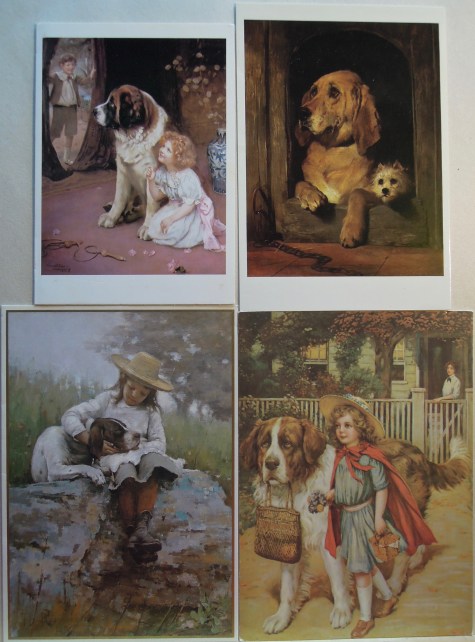
Greeting Cards Clockwise from top: Hide and Seek by Arthur Elsley (1869-1952); Dignity and Impudence by Edwin Landseer (1839); To School Well Fed on Grape Nuts, advertisement lithographed on tin (1917); The Girl With the Dog, Theodore Robinson (1852-1896).

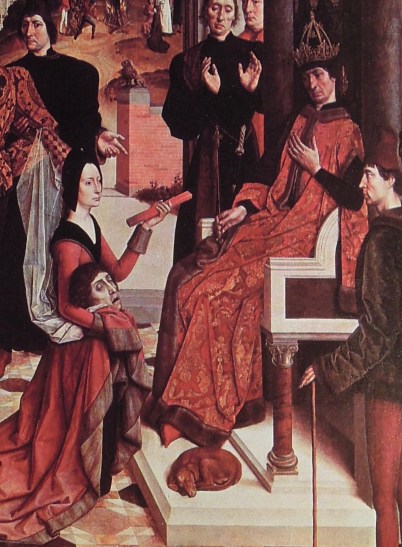
Amongst my greeting card collection, I have several with images of children and dogs from the nineteenth and early twentieth centuries.  A dog is a popular subject because anyone who has owned or loved dogs can relate to these works.  There is nothing like having the devotion and loyalty of a dog.  In fact in Medieval Flemish paintings dogs were included as symbols of faithfulness.

DSCN4370

Detail Justice of Emperor Otto III (1470-75) by Dirk Bouts

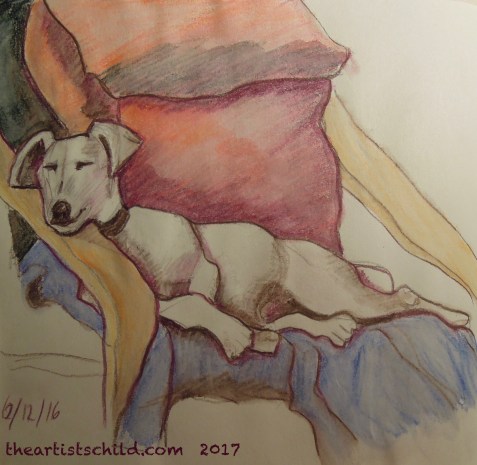
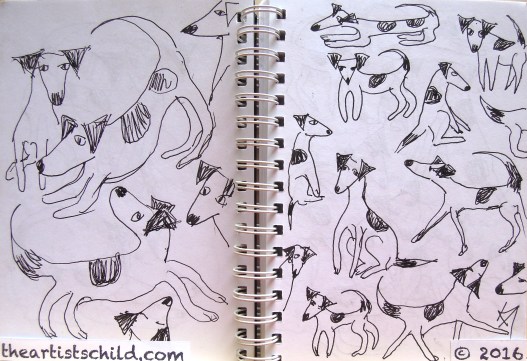
The actions of our own dogs have given both Ellie and me ideas for artworks.  We both like to do drawings of our two Fox Terriers.  Usually you can only get them to pose when they are asleep as they are in constant motion.  Ellie did a watercolour pencil sketch of her current dog that I really like and have included it below.

DSCN4378

Ellie’s Watercolour Pencil Sketch

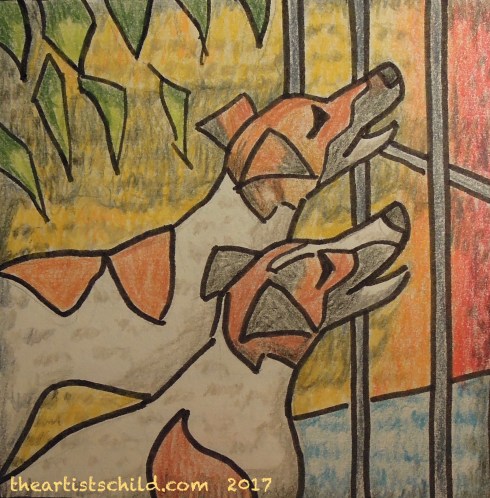
You hear all kinds of stories about dogs rescuing people from dangerous situations.  One day when I was upstairs, our previous two Foxies started barking furiously at the side gate.  I went down to have a look and got to the front of the house only to see that someone had broken a window and the door was ajar.  The intruder must have heard me coming.  I saw a leg disappearing around the corner and yelled some rather strong language before calling the police.  I had not heard the door knocker and if the dogs had not barked so loudly and in such an agitated manner I would not have known there someone was breaking in to our house.  This episode became a tapestry design and I have included one of the working drawings in this post.

DSCN4374

Drawing for Tapestry Design by Kat

It is obvious that I love dogs.  Dogs have always been important in my life and I could not be without one.  I think it is essential to have a dog (or cat) if you work at home. Talking to your pet is a good way to work through an idea.  Better than talking to yourself which can look strange if someone catches you doing this.  But with a dog it is perfectly normal because they listen intently. You just know when they think your idea is rubbish.  Dogs do sneering well.  But when your enthusiasm for something is conveyed to them they take up the good feelings and go with it.  You know you are on a winner when your dog smiles and wags his tail like crazy.

Dogs can be heroes, counsellors, entertainers and best friends amongst their many traits and this makes them perfect subject matter for creative work.  If you work at home and spend a lot of time on your own it is so easy to get caught up in your work and a dog keeps you connected to reality.  We benefit in so many ways from our relationship with our dogs and should never take them for granted.  Dogs are always an inspiration.

Kat

The following video shows a compilation of clips from 1930s films starring the wired-hair fox terrier Skippy.  Skippy starred as “Asta” in The Thin Man films with William Powell and Myrna Loy, as “George” in Bringing Up Baby with Cary Grant and Katherine Hepburn and as “Mr. Smith” in The Awful Truth with Cary Grant and Irene Dunne.  This delightful dog’s actions are put to the song Who Let the Dogs Out performed by Baha Men.

The Art of the Squiggle

A great way to free up your drawing and to think in an imaginative way is to do squiggles.  A squiggle is a random set of various lines drawn onto a page.  Either oneself or someone else then connects these lines to create an imaginative image.  This type of squiggle drawing originated in the Australian children’s Television program, Mr. Squiggle, which ran from 1959 to 1999 and was beloved by several generations.

Mr. Squiggle was a marionette with a pencil for a nose.  He came from the moon in a rocket and with the help of a grumpy blackboard and a presenter, created his drawings using the squiggles sent in by the child viewers.  It was a form of interactive drawing long before children had access to computer drawing programs.  Mr. Squiggle was the brainchild of puppeteer, Norman Hetherington.  He usually did the drawings upside down from the viewer’s perspective because that is the way he would see the page while operating Mr. Squiggle.  Then the finished drawing would be turned right side up and the image revealed.  Here is a five-minute episode of the program found on You Tube.  It is still delightful to watch.

As children, Mr. Squiggle and his clever drawings fascinated Ellie and me.  No squiggle was too difficult for him to transform.  It seemed like magic when the random lines became something recognizable and usually whimsical.  He must have done thousands of drawings over the 40 years that the show ran.

This drawing concept was so simple yet so inspiring for children.  It taught us how to use our imaginations with just a pencil and an eye for the image long before we learnt about great artists and their techniques.  There was no pressure to produce a great work of art. It was about the pure joy of the act of drawing.  And it was something you could do yourself.  We never sent in a drawing to the show but Ellie and I would do this type of drawing together, each transforming the other’s squiggles into a fun image.  It was a great game to play on rainy days.

I still like to do squiggles.  This type of drawing makes you come up with creative and often amusing ideas because you must use all the lines.  You can do it with someone else but usually I do these drawings for myself.  To make sure that the lines are completely random, I close my eyes and scribble on the page.  Then I look at what I have done and turn the drawing around and view it from different angles.  Sometimes it is possible to see an image immediately but at others it takes longer.  It is good to consider all the shapes and their relationship in space from various perspectives.  But eventually something is revealed.

It is not so much about doing a perfect drawing but more about stimulating the imagination and having fun.  If it turns out a bit wonky that does not matter.  And you can always do another one.  That is what is great about squiggles.  They are endless and you can use the simplest of drawing materials.

All drawing should be as enjoyable as a squiggle and it is a way of restoring your childhood creative spirit.

Happy squiggling.

Kat

All Tied up in Knots

DSCN4266

Have you ever found yourself getting really angry at everything and everyone at the drop of a hat?  You bite people’s heads off for no apparent reason and completely overreact to the slightest provocation.  I find this happens to me when I am prevented from doing my creative work, either because there are other things that must be done or someone else is impinging upon my time and space.

Anger is not good for anyone’s wellbeing and can definitely affect you physically.  I get really tight muscles in the shoulders and neck when I’m tense and sitting at the computer for long periods does not help it.  If it gets too painful and I’m all tied up in knots I can’t work at all and painkillers are not something I want to take all the time.   Some people like to punch a bag and scream when they are angry but I find this just revs me up and makes me more agitated.  Trying to relax is more effective.  So is Arnica cream and a hot pack to stop the shoulder tension.

I read in Julia Cameron’s wonderful book The Artist’s Way that creative people who are blocked or prevented from doing what they love become very angry.  I have had periods when I have been unable do any creative work and was unbearable to live with.  I was doing a job to please others and not myself and it was making me miserable.  Luckily I realized that this was not where I wanted to be and did something to correct the situation.  I find that I am happiest when I am drawing or writing or singing and less likely to turn into the viper from hell.  The only downside is that it is harder to make a living in the creative fields, but that is my choice and I’d rather be happy and fulfilled than rich and grumpy.

Daily life can also lead to a lot of unnecessary angst. Some people just don’t get it when you are in your creative zone.  Lately I have been doing a lot of writing and have been working on a fantasy story and a science fiction story.  I find that I go off into another world while I am doing this and any interruptions are very annoying.  When you don’t live alone it can be difficult to get others to respect your space.  Although I have told members of the family that I’m am busy with my writing, they still seem to think because I am on the premises that it is OK to get me to respond to any questions or to interact with them.

I am at my creative peak in the afternoon and early evening and that is often when people want my attention. There is no door on the studio and anyone can yell up the stairs because they know I am there.  It drives me insane and breaks the flow of my writing.  I become extremely grouchy and have to resist the urge to throw something at the source of my irritation.  This is not great for the creative process or household harmony.  I’m afraid I am talking about sibling squabbles that can often become entirely unreasonable on both sides if not dealt with sensibly.

How to resolve this situation?  It is better if you can deal with the problem in a calm manner.  I do try to work when no one is around and then I can give others more time when I have finished my writing for the day.  This can be difficult because when I am are on a roll it is hard to stop.  Sometimes you just have to pace yourself and impose some kind of time restrictions. Stopping before meals is important to prevent family arguments.

It is often the case that the other person becomes angry because they are also feeling creatively frustrated and resentful when you are obviously getting on with your work.  It makes them feel left out as they wish they could be doing something similar themselves.  At these times it is not a good idea to go on about your work or they can be quite dismissive and not receptive to your thoughts.

The old “take some deep breaths and count to three before opening your mouth” is a very wise course of action when things become heated.  Just keeping your mouth shut can also diffuse a lot of explosive situations and walking outside is a good idea.  When I’m fuming I find the most effective method is giving my dog a cuddle because it is impossible to stay angry when you are being licked.

Anger is a destructive force and it does not pay to give it any energy.  It is better to put this energy into your creative pursuits.  Why waste time getting all worked up when you could be enjoying yourself doing what you love.  And remember that other people may also be creatively blocked which causes them to lash out at you when provoked.

It is not easy to stay calm when you are feeling harassed and being hindered from doing what you are passionate about but it is also important to live in harmony with others.  So next time you are about to explode because something or someone drives you crazy consciously stop yourself from going down the anger route.  Life will be so much more pleasant and productive.

Kat

Doodle All The Day

Recently I found some of my old doodles that I’d  done on odd bits of cartridge paper.  From a young age I used to doodle all the time.  In front of the TV, when sick in bed, in school books, on scrap paper, in magazines, then later in sketch books, in a doctor’s waiting room.  They tended to be random doodles and had nothing to do with my more developed artwork.  Usually of figures, animals, insects, pixies, fairy tale characters.  Just silly little things.  Amongst my rediscovered drawings there was also a coloured illustration that was developed from the little pixie doodles.  I stuck them all into a visual diary so that they won’t get lost or accidentally thrown out.

Throughout history people have doodled on different surfaces.  Apparently people did them on the edges of clay tablets in antiquity and who knows what can be found on the odd Egyptian papyrus.  Probably doodling became more common with the availability of paper, given that the earlier vellum, made from animal hides, was expensive and took a lot of effort to produce.  You don’t see many doodles on the pages of medieval manuscripts.

Often we discount little flights of fantasy like doodles, but they are a good way of getting ideas for a poem, a story, a larger work of art or illustrations.  I’d forgotten what fun you could have with a pen just aimlessly drawing.  I think I will put a sketchbook and pens in our family room out of the reach of the dogs so that I can doodle when I’m watching TV like I used to.  As long as it is not a foreign film with subtitles, then I won’t get too distracted.

Recent studies have discovered that doodling can aid memory and concentration.  Colouring books for adults have similar benefits and are very popular, but creating you own imagery is so much better.  You are not restricted by boundaries and can go all over the page wherever you like.  Even if you don’t think that you can draw anyone can doodle.  It could be patterns, little cartoons, or stick figures.  The whole point of doodling is to make a mark of some kind in a free manner.  You could start in the middle of the page, at the top or the bottom. There aren’t any rules.

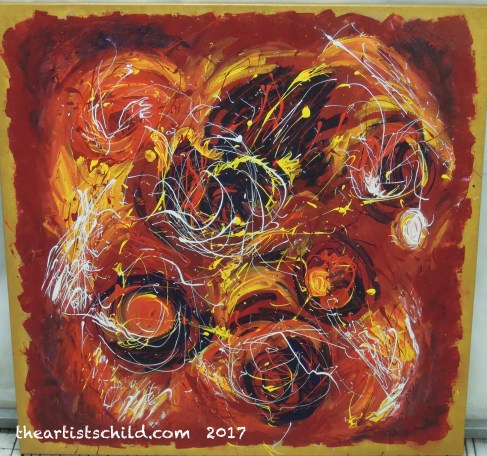
Version 2

You can also use paint on canvas and just play around with the paint in a figurative or non-figurative manner.  This is just doodling on a larger scale and is a good way to stop getting precious about your work.  I did a painting like this not so long ago.  On a 30 x 30 inch canvas placed flat of the floor, I swirled around the paint with a brush or dripped it off a wooden chopstick.  This is not my normal way of working and it was fun be free and spontaneous.  I found it totally involving and the painting just evolved.  I still had to use my head and stopped before the paint became muddy and ended up with a painting I would be happy to hang on the wall.

Not everyone has a spare canvas lying around but if you want to use real paint without going to too much expense, you could use masonite board (a thin fibre board) as a surface.  I know there is suitable painting software for a tablet or a computer but it’s a more tactile experience working with real paint where you can create actual textures.  It’s also messier like a lot of things in life.  I had to cover the floor with plastic before I started and still managed to get it on my shoes but they were old ones. The dogs also wanted to help and nearly put their noses in the painting.  Many animals seem to like doodling with paint (chimpanzees, elephants).

Doodling can be an end in itself. Some artist’s have taken doodling to a whole new level, from pages in sketchbooks to huge artworks. Here is a link to some great examples.

creativebloq.com – Doodle Art

Doodling is a form of drawing that can be done anywhere and anytime.  From now on I will remember to doodle. When I’m on the phone, watching TV or when I just want the feel of a pen in my hand.  It’s good to remember that all art starts from making a mark.

Kat

Memories: Your Own Creative Database

We all have memories of past experiences that give us pleasure or haunt our dreams.  Our memory is a wonderful resource that can inspire artwork.  It is a way to relive a happy moment in your life by transferring the feelings of joy and wonder into something new and tangible.  Or to use a bad experience and transform it into another form so it no longer has any power to cause too much grief, or at least lessens the impact.

Memories can provide inspiration for both realistic or fantasy works.  Some great literature and art has been created from artists and writers using memory as their starting point.  Just a few examples include Charles Dickens use of his early life as a basis for David Copperfield; Harper Lee’s To Kill a Mockingbird based upon her childhood experiences in a small southern town; and the painter Marc Chagall’s beautiful and dreamlike imagery inspired by the scenery of his childhood in Belarus, part of Russia at the time.  We all have our own memory vault full of unique episodes and images from life that can trigger the imagination and lead us in all kinds of directions.  You never know what will surface.

Sometimes unpleasant memories require a creative solution so that you can move on.  I had a bad experience with someone on a bushwalking trip who was a bully.  I effectively dealt with the situation at the time, but it still came back to give me some anxiety and put me off bushwalking with complete strangers.  I decided to turn the episode into a series of tapestry designs and have fun with my anxiety and fear.  I also wanted to create a sequence where the girl is no longer the victim, so I created a bogeyman who gets his comeuppance. My two favorite images of the series are where the girl is frozen with fear in a protective egg, while the masked bogeyman stands over her (Overcome by Fear) and then after he is reduced in size and she sprays him with insecticide (Overcoming Fear).  Creating these designs made me laugh and feel a lot better.  If you reduce you anxieties to a manageable size they can no longer affect you and you can stomp on them like a bug (that is in the series as well).

Happy memories are usually the ones you treasure the most, especially those relating to childhood.  When it is impossible to go back and visit people and places long gone, the only thing you can do is to recapture and bring them back to life through art or writing.  My grandparents lived on Melbourne’s Yarra River, with an orchard that stretched down to the river’s edge.  It was like visiting the bush with the eucalypts and wildlife, which were part of the river’s ecosystem.  Looking back with some nostalgia I wrote some short poems that try to capture a child’s uncomplicated memories of that place.

800px-dacelo_novaeguineae_waterworks

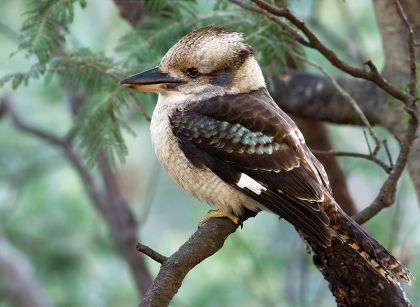
Kookaburra (photo by JJ Harrison, 2010,Wikimedia Commons )

By the River

Kingfisher by the Yarra

Watching the still water

Looking for fish

In a log by the river

Tiger snake likes to slither

Better not sit

© The Artist’s Child, 2017

800px-eastern_tiger_snake

Tiger Snake (photo by Teneche, 2010, Wikimedia Commons)

There were only two rules that Ellie and I had to obey when visiting our grandparents. Don’t go near the river’s edge and watch out for snakes.  A Tiger snake had been found asleep in the living room fireplace when my mother was a child. One was sleeping under a log near the river when we were children, and we were kept well away.  As these snakes are deadly, we did not ignore this rule, although I never actually saw one.  In fact I have never seen any snake in the bush at all, probably because I stomp and make some noise so they will hear me coming and disappear.  Or I have just been lucky.

The Laughing Kookaburra, a type of Kingfisher, would steal the goldfish from my grandfather’s fishpond, so he placed a removable steel grill over it.  We would hear them laughing in the trees and it always made you want to join in.

605px-tf_eos400_6318x800

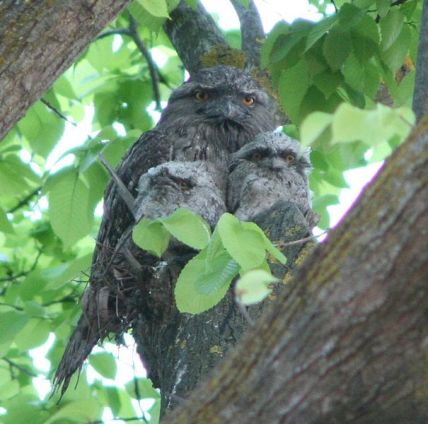
Tawny Frogmouth Mother and Chicks  (photo by Alan U Kennington, 2011, Wikimedia Commons)

Frogmouths

Three baby Frogmouths

Small bumps in a gum tree

Impossible to see

Then one blinks

Illusion broken

Unlike mother, frozen totem

© The Artist’s Child, 2017

The Tawny Frogmouth is a member of the Nightjar family.  Their tawny feathers act as camouflage in trees.  In one of the orchard eucalypts grandfather pointed out a delightful family of Frogmouths to us as children.  The babies had yet to learn the art of staying completely still like their mother, and would move their heads to look at us.

Bellbirds

Bellbirds ringing, singing

In the river valley of childhood

How they echo in my memory

© The Artist’s Child, 2017

This is probably what I remember and miss most about being down by the Yarra.  The constant calls of the Bellbirds or Bell Minors. Some people find their calls annoying but I find them soothing.  It was hard to believe you were in the middle of a city.

Here is a You Tube video that will give anyone unfamiliar with these birds a sense what it is like to be in their environment.

Everyone has a fantastic database full of memories and it is good to get that retrieval system working.  Once you start delving you will remember all kinds of things that can inspire, disturb or make you laugh and these can feed your creative work.

Kat

When We Believed in Fairies

fairy-card-design

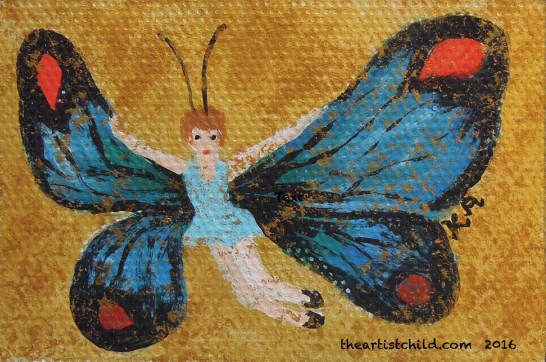
Fairy Design

Watching colourful butterflies in our garden the other day reminded me of our childhood obsession with fairies.  Ellie and I listened with fascination when our parents read stories from illustrated fairy tale books and we played make-believe fairy games in the garden.  In December we had the lovely, paradoxical combination of both the summer fairy world and the winter wonderland of Santa.  The belief in an enchanted world of fairies, elves and a magical being who brought gifts on Christmas night, helped to develop my love of imaginative imagery and fantasy.

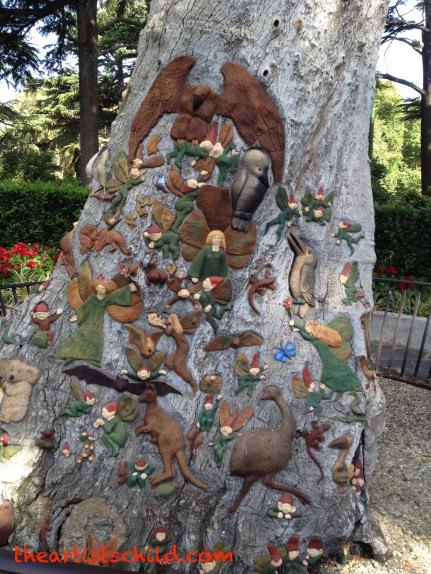
Fairies bring magic to the world of children and no wonder they are as popular as ever.  I remember visiting the Ola Cohn Fairy Tree in Melbourne’s Fitzroy gardens as a child and being fascinated by the carved fairies, elves and animals that I thought would move when no one was watching.  Our grandfather would take Ellie and I to the fern gully at the Royal Botanic Gardens.  We called it the Fairy Dell and grandfather would point out the fairies floating under the fronds.  We would see them because our belief was so strong.  Another time he gave us a rock that had a mushroom growing out of the moss on top and told us that this was a fairy house.  The mushroom and moss are long gone but I still have that rock. It was special.

ola-cohn-fairy-tree

The Ola Cohn Fairy Tree

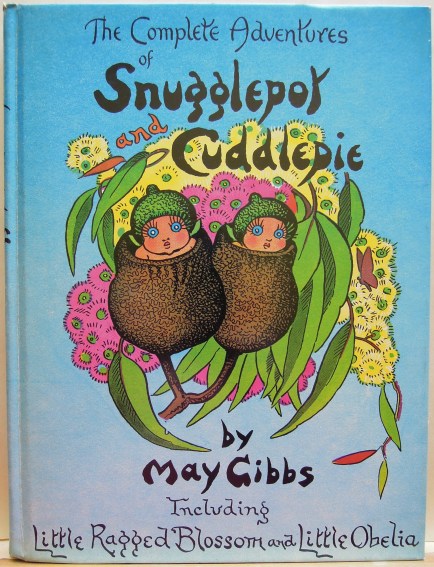
In my room hung a print of fairies trooping in a forest (The Fairy Way by Margaret Winifred Tarrant).  I loved that picture and I have it stored away as a memory of childhood.  One summer holiday Mum made us some wings out of wire coat hangers and pantyhose and we would dance around in our ballet leotards or swimsuits pretending we could fly.  I don’t know what happened to those wings.  They probably fell apart from repeated flapping.  If it were too hot outside we would create a fairy house by covering a table with a sheet and play underneath.  We found inspiration for our make-believe games in books.  My favorite Australian fairy books were about the gumnut babies, Snugglepot and Cuddlepie, by May Gibbs and The Little Green Road To Fairyland, beautifully illustrated by Ida Rentoul Outhwaite.  I loved the fact that the fairies were depicted in the Australian landscape with native animals and gum trees so it was easy to imagine them in our own environment.  The fantastic fairy tale illustrations by Arthur Rackham were other favorites.  We still have these books because they are timeless.

snugglepot-cuddlepie

It was fun being allowed to stay up late to watch the old 1930s version of A Midsummer Night’s Dream starring Mickey Rooney as Puck on TV.  Although it was in black & white, the film captured the dreamlike world of the fairies and brought Shakespeare alive.  I saw it again recently and it is both an ethereal and humorous version of Shakespeare’s play, despite the basic special effects.  We also enjoyed the 1951 British movie version of Dickens’s A Christmas Carol staring Alastair Sim as Scrooge, which usually screens around this time of the year.  The jovial “Ghost of Christmas Present” was a version of Santa Claus.

Like many children, we would visit Santa’s Grotto at a city department store, make our gift wishes and have our photo taken with a perspiring Santa, who always looked like they were about to collapse from heat exhaustion.  It can’t have been an easy summer job even with air-conditioning.  On Christmas night we would leave out a drink and a snack near the fireplace despite the fact it was unlit.  Because it was summer, dad said that Santa would prefer a beer, not milk, as delivering presents was thirsty work.  We were innocent children and it never occurred to us that if everyone did this Santa would have become inebriated.  He always drank his beer.  Waking up at 4 am to the presents hanging on the end post of the bed was always exciting.  We could never wait till daylight.  Ellie would come into my room and we’d unwrap everything together as this was much more fun.

santa-xmas-cards

Santa Xmas Cards

I think I was in the fourth grade at school and mentioned what I wanted from Father Christmas and another girl said, “you don’t still believe in Santa, it’s your parents”.  I was shocked and devastated.   She was not one of my friends and probably said it to be superior.  Because I did not want Ellie to have the same bad experience, I decided to let her down gently and told her that our parents handed out the presents on Santa’s behalf, because he could not get all the way to Australia in one night.  I wish that our parents had told us the truth rather than leaving it to chance.  It is always sad when childhood beliefs are destroyed by some unkind, thoughtless person.  I bet that girl is still a sourpuss.  But the world did not end and it was just a part of growing up.

I don’t remember when my belief in fairies ceased.  I think that it just gradually faded away.  Probably the Santa incident was the beginning of the end.  The tooth fairy vanished after I gained my second set of teeth.  Without that cash incentive she became redundant.  Maybe fairies start to disappear as we learn to cope with the realities of life, but it is hard to forget their magic.

As an adult Myths and Folklore are still important.  I find modern fantasy artists who depict the fairy realm very inspiring.  One of my favorite painters is the British artist Josephine Wall, who produces beautiful, incredibly detailed paintings of the world of fairies and other mythical creatures.  I also love to read fantasy novels and watch films that are based on old fairy tales.  Probably the first book that I read on this subject and still one of my favorites is Faerie Tale by Raymond E Feist, with its references to Celtic mythology.  Quite scary and definitely not a bedtime story for little children.  A masterpiece of the fairy tale genre is the 1940s French film La Belle et la Bete (Beauty and the Beast) directed by Jean Cocteau.  With its living statues, the Beast’s palace is deliciously creepy and surreal.

Fairy tales still capture my imagination and have been an inspiration for my songs and art.  I have made cards with fairy and Santa images to accompany gifts for friends and relatives and will continue to be influenced by these mythical beings and will try to bring them alive.

And hey, if the Irish and the Icelanders will not harm a fairy tree or move an elven rock because this will affect the fairies and elves who dwell there, who’s to say they are wrong. The natural world needs all the help it can get.

So if anyone asks, “do you still believe in fairies?” I will answer’ “Yes, I believe in the idea of Fairies” and that will be the truth.   And as for Santa, he is everywhere whether you believe in him or not.

Happy Holidays.

Kat

(There is a lot more to read and view if you click on the text links in this post, including the full version of the movie, A Christmas Carol).

Creative Blockages: Beginning Something New

For me the hardest part of a new project is beginning.  A blank page or canvas, a pile of new materials waiting to be transformed can sometimes be daunting.  Once I am over this hurdle and have begun I find it much easier to get on with my work, but making the first step is always the most difficult part of the process.  There is the danger of using delaying tactics, like spending time setting up the equipment and art materials so that everything is easy to reach, then being confronted by the task in hand and becoming paralysed.  So it is good to have several strategies that help get you going and the following have worked for me when I have become blocked.

You need to loosen up if you want to create freely and begin something new.  A few years ago I did some creativity classes at a local art group and learnt some helpful techniques. One method is to do a drawing based on how you are feeling at that particular moment. You take a large sheet of paper and some pastels and immediately draw on the paper without thinking about what you are doing, just how you feel.  It is not about creating a finished artwork but about freeing up your mind.  That said, it is never a good idea to use newsprint paper for drawings because if you do one that you want to keep it will disintegrate over time.

dscn3623

Free Spirits

The same freeing up method can be done with modeling clay, words, singing vowel sounds or losing yourself in dance movements.  Beat a drum and howl like a wolf if you wish. Whatever releases your ability to create.  Once you are feeling less constrained then it is easier to tackle a new project.

Sometimes a blank white page or canvas can put you off beginning a new work.  The solution is to use coloured paper or paint a coloured ground that harmonizes with your subject.  A mid range colour is good because you can add the highlights and shadows over this base.  Once the white blankness is gone you have already begun.

But what if your canvas is a blank screen.  Well the same system applies.  Write something, anything, even if it is just headings or ideas.  Get rid of that empty screen. Think while you write or write without thinking.  Whichever works at the time.  With the latter, I find that the words seem to appear out of nowhere and that my thoughts start to make sense on the page.  The subconscious often works things out before you are consciously aware of an idea.  Then the momentum carries you along.

It is difficult to start something new if you think you need to produce the whole work in one session.  Visualise where you are going but concentrate on what you are doing at that moment and take a break when you are starting to get bogged down with detail.  Agonising over every pencil mark, brush stroke or word never helps.  It will turn the whole thing into a chore and this will show in the final result.  You want you work to look effortless no matter how much time and energy went into its production.

Probably one of the most important things is to make what you are doing fun, then you will be raring to get on with your work.  I like to put on some music while I am working. Sometimes I need relaxing music, at other times good old stimulating rock and roll.  I find this gets you into the flow and also cuts outside distractions.  Music can give you energy and take you out of your everyday state of mind that makes creating easier and that much more enjoyable.

On my pin board is a cutting from an old calendar that says “all glory comes from daring to begin” (Eugene F Ware, “Ironquill”).  How true.  Without taking that first leap you will never get anywhere.

Kat

12 Reasons Why Dogs Make Us More Creative


dscn3562dscn3559

  1. Dog’s adventures are an endless source of inspiration
  2. Dogs love to watch you work so you are never lonely
  3. Dogs know how to pose for a portrait so you always have a subject
  4. Dogs never criticize your work
  5. Dogs let you take them for a walk when you have a creative block
  6. Dogs jump on and lick annoying people who interrupt your work
  7. Dogs know when your pencil or brush needs replacing – they eat it
  8. Dogs know when you should finish a drawing – they eat it
  9. Dogs like to taste Still Life subjects so you learn how to work quickly
  10. Dogs show you how to paint with nose and paw – on the floor and on the walls
  11. Dogs show you how to select found objects from the beach, the park, the bedroom, your friends’ handbags …
  12. Dogs make you laugh and are an artist’s best friend

Kat