Ecstatic about Eggs

DSCN4252

I love all types of decorative eggs.  You could say I’m eggstatic about them just like “Egghead” from Batman (aka Vincent Price) with all his bad puns.  Ellie and I have a small collection.  None of our eggs cost very much and many of them were gifts, as well as some being family heirlooms.  I have also decorated some and created one from scratch.

For many people the egg is a major symbol of Easter, of spring fertility and rebirth.  For kids it is about chocolate.  In many cultures it is also the cosmic egg in creation myths.  The egg is the ultimate symbol of creativity and has inspired many artist’s and crafts people to create beautiful objects.

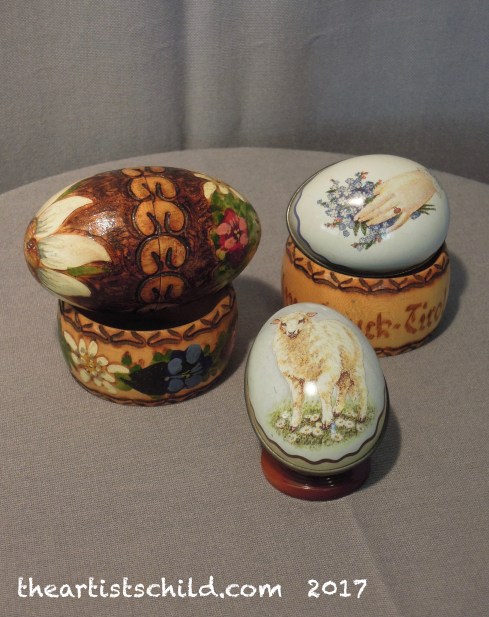
A collection usually begins with one object.  My parents had a Austrian poker work egg brought back from an overseas trip.  It opens up to form two egg cups and has matching napkins rings.  I was always fascinated by it’s decoration and shape so when I saw other interesting eggs on holiday or in op shops I would snap them up.
DSCN4216

Austrian poker work egg and Swiss tin eggs

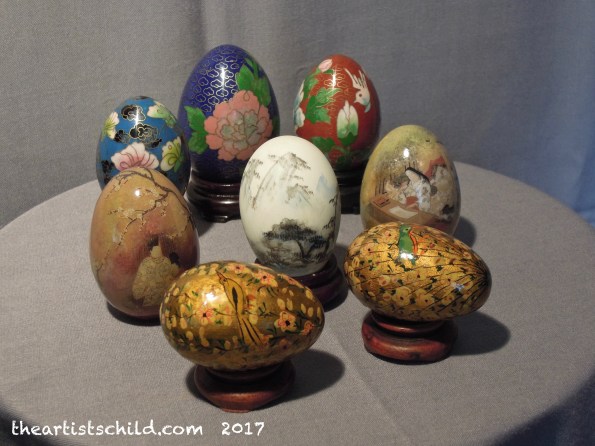
Some of our eggs have been brought back by family members from holidays overseas as gifts.  Our aunt gave us some cloisonné eggs from China and they came with little wooden stands.  I also had some old ones from a relative that are good for displaying eggs.  On a trip to Japan several years ago we also found some lovely decoupage eggs when visiting an exhibition at the Tokyo Museum that depict images from some medieval narrative scrolls.
DSCN4198

Chinese cloisonné eggs (back row),  Chinese painted real egg (centre),  Japanese decoupage eggs (left and right centre row) Chinese painted wooden eggs (front row).

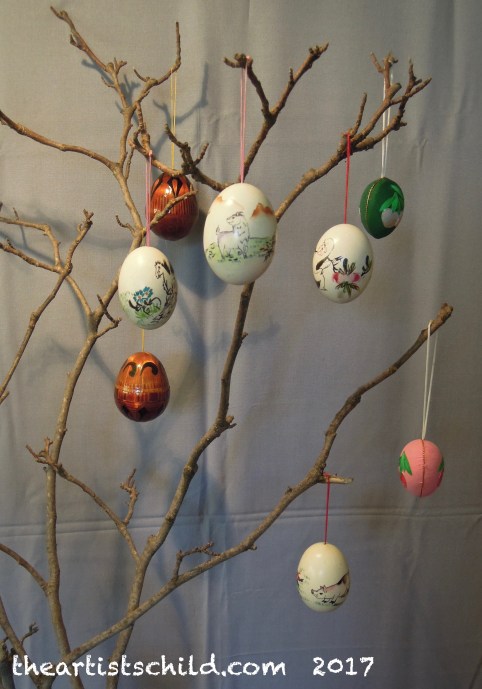
Because Australia is so close to Asia it is easy to get Chinese eggs here.  Locally we found some real eggs that were painted with the Animals of the Chinese zodiac, like the horse and monkey.  These are quite fragile and need to be stored carefully.

There are also some Asian plant fibre eggs but I have forgotten where they come from as they were a gift.  Shows you should write things down at the time.

Old egg cups are good for displaying eggs.   We have a couple of vintage majolica ones from Italy: a turkey and a duck, as well as a later goose, all found at op shops.  These are quite fun and painted wooden eggs look great in them.

DSCN4213

Polish wooden eggs and Russian painted egg at back

DSCN4209

Russian wooden eggs

Old napkin rings are also good for displaying eggs.  They come in all sorts of shapes and materials and make an interesting collection of their own.  I also find large vintage buttons good for stopping eggs from rolling around.

Eggs come in so many different materials and can be an example of various crafts.  You can find interesting ones at local craft markets or specialist craft stores.
DSCN4224

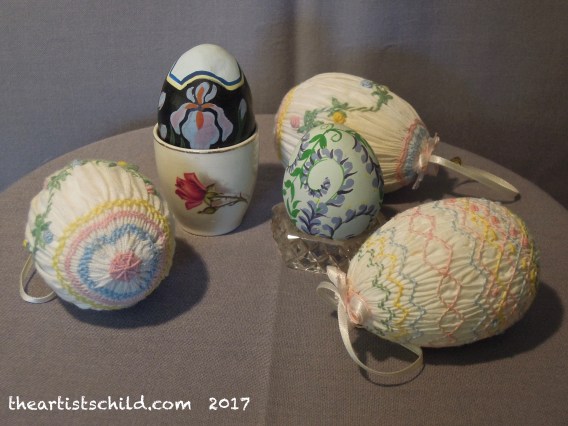
Australian painted real eggs and Philippines embroidered fabric eggs

DSCN4231

Hand blown glass eggs

DSCN4206

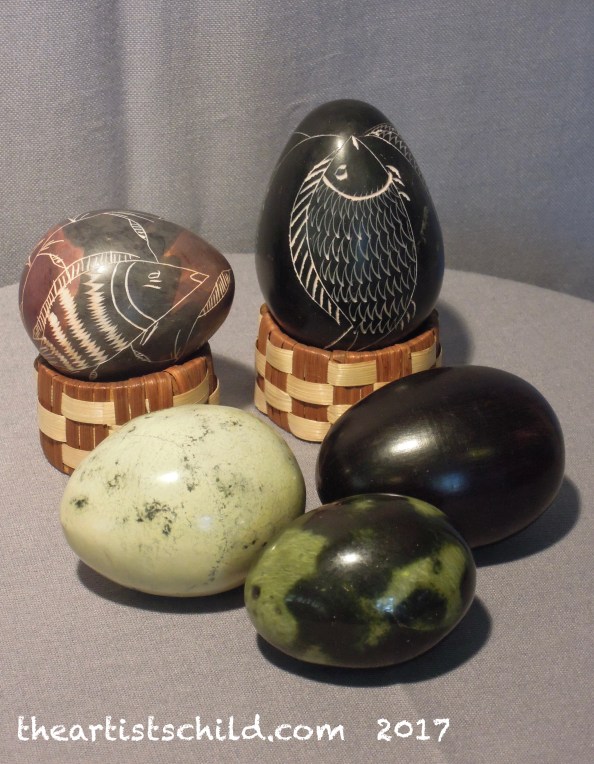
African stone eggs, two painted and hand engraved and a black wooden ebony egg

DSCN4227

Taiwanese Sodalite egg (left), orange simulated marble egg (centre back), Italian marble egg (right), my talc stone egg (front).

I had a go at sculpting my own talc stone egg.  This caused a great deal of dust and took a lot of sand paper to get the right shape.  I now appreciate how much effort it must take to shape and polish very hard stones.

One year I decided to paint some eggs as table decorations.  The most difficult part was blowing out the white and yolks.  Because I thought I would run out of breath, I used an air brush compressor with a syringe needle attached to the end of the tube.  With too much pressure the egg exploded so it was very tricky and messy.  The blown eggs were then coated with layers of acrylic paint and stippled with another colour to make a textured effect.  I added some gold dust left over from gold leaf that someone had given me and applied it with the varnish.  I think that the aqua ones look like real eggs.  The layers of paint has made them less fragile.

I have a real ostrich egg that I bought at the Melbourne Zoo shop ages ago.  There must have been an excess of eggs in their breeding programs.  Wonder if they made huge omelets.  There were holes in each end of the egg where they had blown out the innards.  These were rather large and not very attractive so I glued in some enamel flower earrings that I did not wear.  This is probably the closest I will get to anything like a Faberge enamel egg and the ostrich did most of the work.  It has such a beautiful creamy shell and is quite heavy.

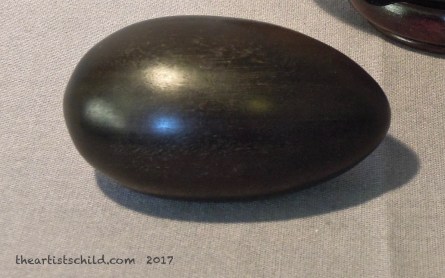
The following black egg is made from Australian post ice age river red gum found buried in the flood plains of the Murray River.  It is very much like Irish bog oak.  These ancient trees stopped growing about 5,000 years ago and the ancestors of todays indigenous Australians would have been around to see them growing.  This was a gift from a friend who knows the maker.
Version 2

The oldest manufactured egg in the collection is tiny.  It is a novelty made in Germany and sold in Melbourne in the late part of the 19th century.  The egg contains the “smallest doll in the world,” a little peg wooden doll that we inherited from a relative.  Unfortunately some long ago child had broken one of the arms because these are movable.  The limb was long gone.  I had to give it an arm transplant using a tiny piece of matchstick and glue (click on the pictures for detailed close ups).  This was really fiddly and I nearly glued it to my finger.  The doll looks a lot happier.

That’s our egg collection.  It is amazing how many creative ways there are to make decorative eggs and these are only a small sample.  It seems appropriate that a major symbol for creation should inspire all sorts of creative, eggceptional ideas.  Sorry, couldn’t help myself.

Kat

Autumn in the Garden

Daylight saving has just ended and we have turned back our clocks, but nature does things to its own schedule.  Our garden is in transition.  It is still quite green but the autumn colours and flowers, fruit and seeds are becoming more prominent as the temperature cools.  Today I took some photos because I wanted to record the seasonal changes.

The Japanese Nandina is now a lovely shade of red.  This came from our grandparents and we have had it in a pot for years.  It is a slow grower and has remained this size for ages.  Maybe it is now like a bonsai because the roots have nowhere to go.

We have two varieties of Plumbago, blue and white, and the flowers are still hanging in there.  They are very delicate and have a sweet nectar.  Because the flowers are so sticky the sometimes get all over the dogs, over your pants and sleeves and anything else that comes in contact.

There is a last bud on the Iceberg rose.  These hardy white roses do well in pots.  Unfortunately there is no fragrance.  Our Elephant Ears are looking very lush and have spread to other parts of the garden.  As long as it is shady they survive the summer.  Because we have a mild climate they usually don’t completely die down in winter and bring a bit of the tropics down south.

The Clivia now has wonderful red seed pods (photo left).  We need to watch that our young dog does not eat these.  Ellie planted some in pots so it will be interesting to see if these shoot.

The Chinese walnut tree is also covered in green walnuts (photo right).  When they start to split and the nuts fall to the ground it is a battle to see who gets to them first.  The dogs love to crack open the hard shells and make a mess inside.  I’m constantly yelling at them to go “outside” with the nuts.  Last year the dogs ate more nuts than were saved to dry.

I love the spiky red flowers on the bromeliads.  I think that they look like some creature from another planet.  You can almost imagine that they will suddenly extend from the plant and try to whack you like a type of creepy carnivorous plant.  These flowers last for a long time.

Although Aralia plants are evergreen (photo top left), in autumn some leaves turn a bright yellow then to brown before they fall.  You can see the seasonal transitions on one plant.

Because we do not often get frosts, a long time ago we put our potted Maranta (prayer plant) outside in a very sheltered spot behind some large pots (above photos bottom).  It has thrived although sometimes the purple spots fade in the brighter light of summer.

We also have a Wollemi pine in a large terracotta pot (photo top right).  It is one of the most ancient species of evergreen trees on the planet.  It a pine that also has characteristics of a fern.  We call ours “Wolly” because it is so special.  We plan to plant it in the ground so that it will reach its full height and will be protected by a large Melaleuca tree.  At the moment the tree has bent a bit so will need to put a stake to straighten the trunk.

After I took these photos the sun disappeared and it is now quite gloomy.  I think there is rain on the way and it really feels like autumn.  I’m glad that I made the most of the sun while it lasted, something that we should always remember.

Kat

Away with the Fairies

Often when I am creating I go into another imaginative place. I feel that I am in a world of my own creation, the place of daydreams.  It is a great space to be in when you are writing or doing some visual art.  But at times this ability to put myself into a story or travel with my mind has not been appreciated by others.

As a child I became easily lost in the world of make-believe.  I remember going to a scary play when I was about 5 and became very distressed because one of the characters terrified me.  I thought it was real.  I had to be taken out of the theatre.  It was on a school excursion and the head teacher was not impressed. She obviously had no imagination and could not understand why a little child might be frightened.  I also found the MGM lion very terrifying because it was so big and loud. I thought he was going to eat me and hid behind my hands.

In kindergarten another girl and I were totally involved in a game we were playing and decided not to go inside when the bell rang.  We went to an area where there was an empty water feature with rock formations and continued our game.  Then the drama started.  The teacher started calling our names and we knew we were in trouble and hid behind the rocks and did not come out.  Things started to escalate and more people were looking for us.  Eventually we reluctantly decided to face the music and got into a whole lot of trouble.  Our mothers had been called and as punishment we had to spend the rest of the afternoon in the principle’s office nervously giggling.  We were only little kids acting out our fantasies but the reaction of the adults was totally out of proportion because of their fears.

As I became older I spent a lot of time in school daydreaming through classes or dreary assemblies.  I think that I missed lots of vital information by drifting off into my own little world.  Luckily there was always art class.  I could always concentrate on my artwork or a good book or anything that engaged me.  My early school reports often had remarks like needs to make more of an effort or would do better if she paid attention and concentrated on the work.  Any tendency to let your mind wander was to be discouraged.

All my day dreaming never did me any harm.  In fact without it I never would have persisted at any art form.  Ideas don’t just fall into your lap without time spent musing.  You can’t change reality without first imagining something different.  The world probably would not have many inventions or great works of art and literature without lots of daydreaming on the part of their creators.   Questions like “What if I do this? What would happen if? How can I do that?” are often answered by daydreaming.

Nowadays I tend to daydream in the garden, watching TV or gazing out the window when I’m in the studio.  For this reason it is good to have some kind of view, especially if there is a bit of nature.  It is also easy to daydream under the shower or in the bath because the hot water is very relaxing.  The only problem is that you can’t write anything down and have to quickly dry yourself and find a notebook before forgetting the idea.  Often when you are in this state your mind flits around from one topic to another so it can be difficult to keep track of your thoughts. If I am in that frame of mind I take a notebook into the bathroom just in case.

For those of us who have chosen to follow the creative path, daydreaming is an essential part of the creative process and losing oneself in some imaginative place is not something to discourage.  Being able to transport yourself somewhere else mentally or transform yourself into another character is really helpful.  A moment flight of fancy can develop into a story or a series of paintings.  Never stop your mind from wandering or as my parents used to say, being away with the fairies.

Version 2

Away with the Fairies

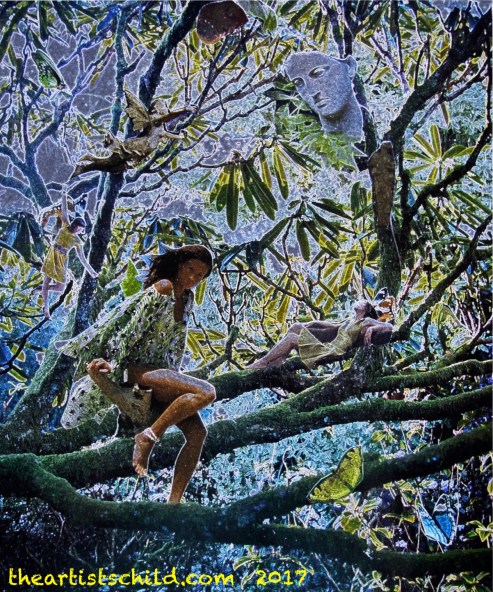
One midsummer night I dreamed

I’m in a tree far away

Visible in full moon light

I lie on branches with the fey

Faces glimpsed amongst the leaves

Figures hide behind the limbs

Bright beings with fragile wings

Stir the air and fan my skin

Some drift around me as I gaze

A whispered spell upon me cast

I finally slip out of the haze

To find my bliss at last

© theartistschild.com 2017

Daydreams can become reality so let yourself fly.

Kat

Here is one of my favorite day dreaming songs from the 70s.

Doodle All The Day

Recently I found some of my old doodles that I’d  done on odd bits of cartridge paper.  From a young age I used to doodle all the time.  In front of the TV, when sick in bed, in school books, on scrap paper, in magazines, then later in sketch books, in a doctor’s waiting room.  They tended to be random doodles and had nothing to do with my more developed artwork.  Usually of figures, animals, insects, pixies, fairy tale characters.  Just silly little things.  Amongst my rediscovered drawings there was also a coloured illustration that was developed from the little pixie doodles.  I stuck them all into a visual diary so that they won’t get lost or accidentally thrown out.

Throughout history people have doodled on different surfaces.  Apparently people did them on the edges of clay tablets in antiquity and who knows what can be found on the odd Egyptian papyrus.  Probably doodling became more common with the availability of paper, given that the earlier vellum, made from animal hides, was expensive and took a lot of effort to produce.  You don’t see many doodles on the pages of medieval manuscripts.

Often we discount little flights of fantasy like doodles, but they are a good way of getting ideas for a poem, a story, a larger work of art or illustrations.  I’d forgotten what fun you could have with a pen just aimlessly drawing.  I think I will put a sketchbook and pens in our family room out of the reach of the dogs so that I can doodle when I’m watching TV like I used to.  As long as it is not a foreign film with subtitles, then I won’t get too distracted.

Recent studies have discovered that doodling can aid memory and concentration.  Colouring books for adults have similar benefits and are very popular, but creating you own imagery is so much better.  You are not restricted by boundaries and can go all over the page wherever you like.  Even if you don’t think that you can draw anyone can doodle.  It could be patterns, little cartoons, or stick figures.  The whole point of doodling is to make a mark of some kind in a free manner.  You could start in the middle of the page, at the top or the bottom. There aren’t any rules.

Version 2

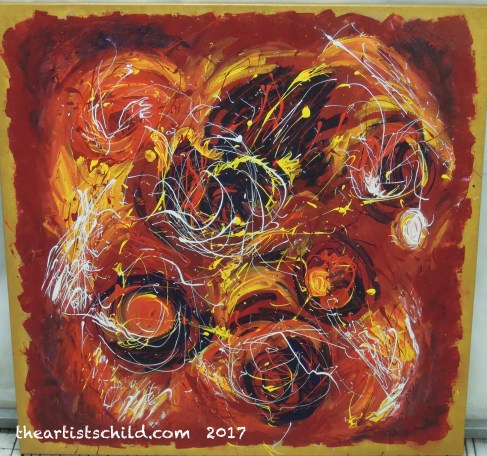
You can also use paint on canvas and just play around with the paint in a figurative or non-figurative manner.  This is just doodling on a larger scale and is a good way to stop getting precious about your work.  I did a painting like this not so long ago.  On a 30 x 30 inch canvas placed flat of the floor, I swirled around the paint with a brush or dripped it off a wooden chopstick.  This is not my normal way of working and it was fun be free and spontaneous.  I found it totally involving and the painting just evolved.  I still had to use my head and stopped before the paint became muddy and ended up with a painting I would be happy to hang on the wall.

Not everyone has a spare canvas lying around but if you want to use real paint without going to too much expense, you could use masonite board (a thin fibre board) as a surface.  I know there is suitable painting software for a tablet or a computer but it’s a more tactile experience working with real paint where you can create actual textures.  It’s also messier like a lot of things in life.  I had to cover the floor with plastic before I started and still managed to get it on my shoes but they were old ones. The dogs also wanted to help and nearly put their noses in the painting.  Many animals seem to like doodling with paint (chimpanzees, elephants).

Doodling can be an end in itself. Some artist’s have taken doodling to a whole new level, from pages in sketchbooks to huge artworks. Here is a link to some great examples.

creativebloq.com – Doodle Art

Doodling is a form of drawing that can be done anywhere and anytime.  From now on I will remember to doodle. When I’m on the phone, watching TV or when I just want the feel of a pen in my hand.  It’s good to remember that all art starts from making a mark.

Kat
Keys and Locks

The world is full of keys and locks.  Having the right key is important if you want to be able to do something creative.   Without this key or keys you can find yourself locked out and unable to progress.  This can be very frustrating and not good for your creative spirit. Finding the key to achieving your aims is never easy.   I hope that the following suggestions may help.
Sometimes the key is learning a new skill.   If you don’t know how to do something that is vital to your creative area you will never progress.   I found this with tapestry weaving.  As I have mentioned in a previous post, there were certain tricks that had to be learned to be able to do weave anything I wanted so I did all I could to master these skills.  It always pays to keep acquiring knowledge in your field, as learning is a key to excellence.
Often the key is finding the right person or persons to help you and for joint or group collaborations.  It is often difficult to get anywhere without connections and support.  “No man (or woman) is an island”, as the saying goes so don’t isolate yourself.  In any creative field working with others can expand your opportunities and is much more enjoyable. With music Ellie and I belong to a ukulele group.  It is a place where we can play and learn together, as well to gain support for each other’s song writing and performance.  This type of help is very important for anyone working in a creative field and it is good to join industry support organizations where you can get advice and assistance.

Another key to doing well in your creative field is gaining experience.  There are many ways to do this.  Volunteering for a local community group.  This will probably mean working for free, but it also means that if you are new to the field, organizations are less likely to turn you away.  Our ukulele group has performed for community groups and at a festival for free and it has helped us gain experience with live performance. I also volunteered before getting a job in a creative field.  I paid my dues by working voluntarily for over a year in various organizations before I gained a full time job.  The work experience made the difference.

I think that a major key is to make sure that you enjoy what you are doing. Without that element of fun it is harder to be produce fresh and innovative work.  Maintaining enjoyment may sound easy but when you are doing something all the time it can sometimes become repetitive and lose the fun aspect that attracted you in the first place.  So you need a way to keep feeling excited.

In this regard other committed, enthusiastic people are invaluable.  Talking with your fellow creatives can give you more motivation. Looking at the work of creative bloggers is also very inspirational.  So is doing a blog of your own.  Taking some creative classes to get out and mix with others can revive your interest.  I have been thinking about doing some life drawing in the winter because I am a bit rusty in this area.  It is something I don’t do all the time and will improve my skills, as well as get me out with other artists and stop me from stagnating.

DSCN4092

So don’t feel like you’re stuck and getting nowhere. There is a key for every lock. You just need to find it.

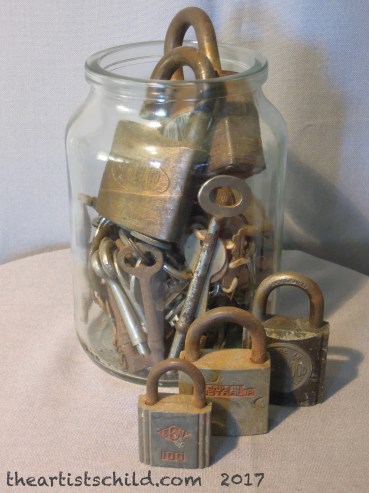
Keys without locks

Locks without keys

Not meant to stay closed

Forever to freeze

Work out the secret

Find the right key

Open the door

A new world, a fresh breeze

(©theartistschild.com 2017)

Kat

Bags of Creativity

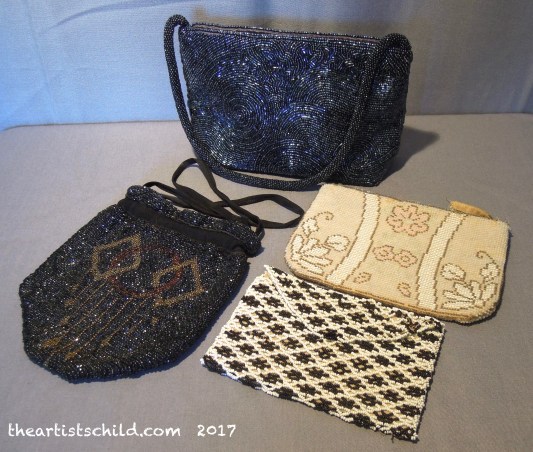
DSCN4035

In this world of mass production I love handmade things.  They tell the story of their creation and continue the skills and traditions valued by the people who made them.  I have a collection of handmade bags and purses from the past and the present.  They are examples of textile crafts that require time and effort to produce and reveal the various ways different cultures embellish utilitarian objects.

Some of my little bags came from ancestors and old family friends.  They were produced in the early part of the 20th century when ordinary women had more time to make their own clothes and accessories and they learnt various crafts that are now usually practiced by artisans and keen hobbyists.  Other more recent bags and purses in my collection are examples of the textile crafts of other countries that are still being created in villages and towns today.

The black beaded evening bag and two rectangular purses were made in the 1920s and 30s by an old family friend.  She must have spent hours sewing or weaving the tiny beads into art deco style designs that were fixed to the fabric backing.  Women’s eveningwear would have been an added expense in those days, especially around the time of the Great Depression and many women made their own party clothes and accessories.  They probably got ideas from overseas fashion magazines.  When I look at these I can hear the sound of jazz bands and the clinking of martini glasses and see couples dancing in their finery.  Such objects remind us that the owners were once young and enjoyed going out to parties and other celebrations.

DSCN4061

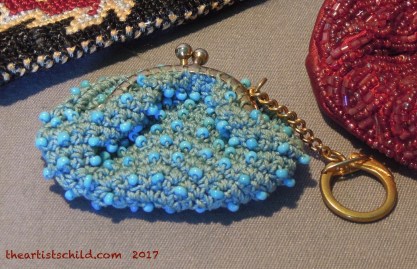
Japanese Crochet Beaded Purse, 1960s

I also have a small vintage 60s beaded crotchet purse from Japan.  This type of Japanese beadwork was popular in the 50s and 60s for bags and purses.  You can find lots of examples for sale on the web. It seems to have been a common Japanese style of beading and purse shape. These tiny purses were widely produced and are still being made today. I like its miniature size and design. It must take a lot of patience to do such fine, fiddly work and to fit on the small beads while working with a crotchet hook.

Beaded bags are still admired in the 21st century and new ones are readily available.   I have a grey beaded evening bag made in china and a small red beaded purse from India, where handicrafts are still common and are created for a wider market.  There are also many obsessed independent crafts people who create their own beaded purses for sale online.  It is good that this time-consuming craft has not disappeared.  There is something magical about the way light catches on the surface of the beads.  It is like miniature mosaic.

Another popular craft of the past and present is needlepoint.  I have had a go at this with cushion and picture kits and it is a slow and relaxing pastime.  Before these kits became commonplace women would use unmarked canvas to create their own designs or could purchase graph style patterns to copy.  Of the two bags that I possess one is a combination of petit point and standard needlepoint and the other consists entirely of petit point.  An ancestor created the former in the 1930s and the latter is an example of Austrian petit point, possibly from the 1950s.  One can only imagine the eyestrain caused in stitching such fine needlework, especially before the availability of magnifiers with lights.  Austrian bags like this are still made today but are extremely expensive because they are so detailed and slow to produce.  Anyone who does this painstaking work deserves to be paid well. Luckily there are still plenty of vintage bags available for a reasonable price for those of us with limited means.  I sometimes wonder where the owners took these bags; from the theatre in the 30s to concerts in Vienna in the 50s, it seems a world away from our modern life today.

DSCN4045

Hand Embroidered Silk Evening Bag, 1950s

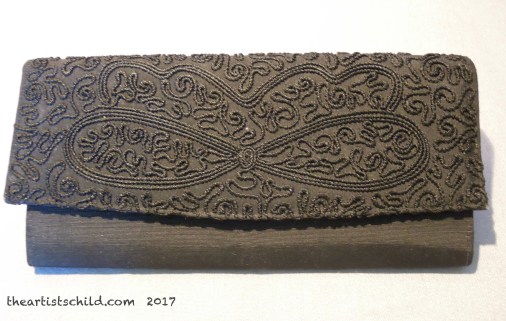
Other types of embroidery were applied by hand to mid-century bags.  The stylish 1950s black silk clutch in my collection has very fine couching embroidery on the top flap. Nowadays a soulless machine would be employed do this type of detailed embroidery.  This purse reminds me of Audrey Hepburn’s elegant style in a Breakfast At Tiffany’s.

DSCN4051

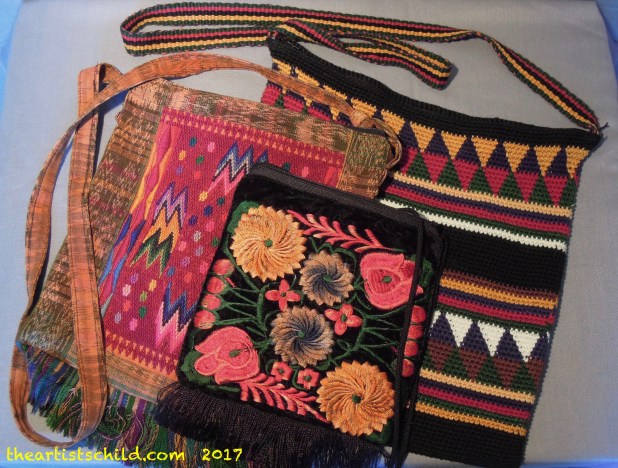
Embroidered and Crocheted Guatemalan Bags

Buying craft items made in another culture helps to keep the local textile traditions alive.  I have three bags from Guatemala that demonstrate examples of different textile crafts. From woven fabric and rich embroidery to crotchet, these decorative bags represent the work of individual Guatemalan women.  An ordinary bag is turned into a joyous expression of their creativity.  I love their use of color and texture and when I carry these bags, they make me feel happy.

DSCN4060

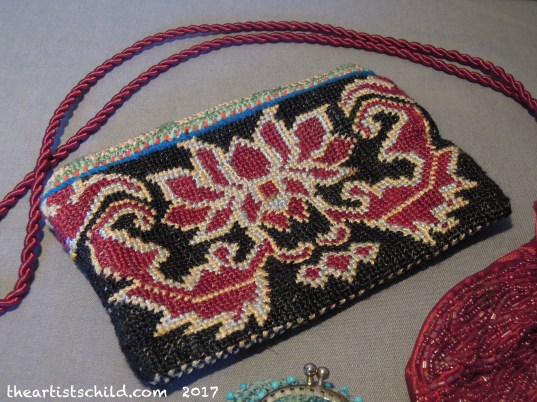
Iroqui Uzbek Cross Stitch, Uzbekistan

A small handmade cosmetic purse that I use all the time comes from Uzbekistan in central Asia.  It is an example of Iroqui cross stitch, a traditional craft of the Uzbek tribe which uses silk thread.  Equally colorful yet so different from the Guatemalan textiles, this purse belongs to the stylized aesthetic you associate with the central Asian communities along the legendary Silk Road.

At a time when computer technology is giving humans less to do manually in the workplace, it is good that there are still some things where a machine does not produce the best result.  Automated textiles just don’t have the same character as those created by hand.  It is the imperfections that make them unique and visually pleasing.  No wonder so many people are rediscovering old crafts for their own pleasure or to sell on-line.

My small collection of handmade bags and purses display craft traditions from several continents that span nearly a century.  It is wonderful to see the varied methods that have been employed in their creation and decoration. I really admire the patience and ability of the makers of these objects. They have transformed what is just a receptacle for carrying around ones possessions into expressions of their creativity and concepts of beauty.

Kat

The More You Know The Less You Know

dscn3987

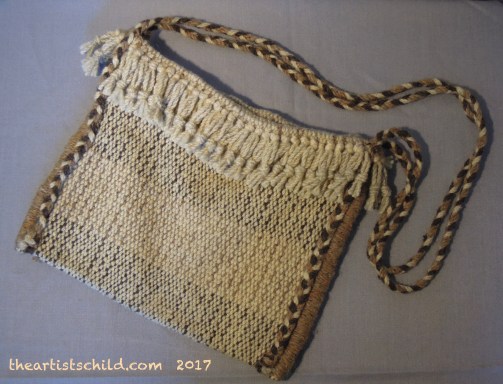
Woven bag: My first weaving project

You see an art or craft that looks relatively easy and fun to do so you give it a go.  Then you get into it and soon discover that there is so much more to learn and various avenues to pursue to gain more knowledge.   It’s a continual learning process and as with most art forms, it is usually a case of 10% inspiration and 90% perspiration to become really proficient at any creative discipline.

I was reminded of my creative journey into tapestry recently when I received a craft catalogue in the mail.  One of the products was an easy weaving kit.  This brought back the memory of how I started learning to weave that ultimately led me to study tapestry design.

In an old set of 1970s magazines called Golden Hands I saw instructions on how to make a frame loom to do simple weaving projects.  It peaked my interest enough to want to make the loom, which I did.  My fist project was a woolen Greek style bag, made by folding the woven fabric, sewing up the sides and knotting the warp threads to form a fringe at the top.  I attached plated shoulder straps.  It turned out quite well for a first project, but because I drew and painted, I wanted to learn how to do my own imagery in woven tapestries.

This involved more research and I bought a basic book to learn how to weave tapestries.  I modified the loom so that it was now a simple frame that I could use vertically with a clamp, rather than horizontally and bought a metal dog comb to beat down the weft threads, as recommended by the book.  At first my attempts were quite amateur because I was using a very basic technique and needed to learn more sophisticated methods if I was going to improve.

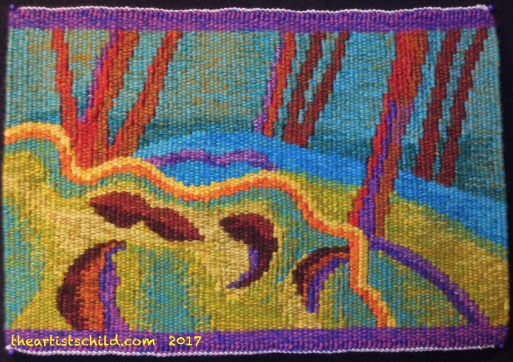
Luckily I saw an advertisement for classes at a local tapestry workshop and enrolled in a short course.  This was really helpful as it taught the methods used by the workshop and my weaving improved greatly.  I ended up doing a more advanced course there and I was hooked.  I was now able to weave from my own designs and the final results were much more proficient.

dscn3974

Tropical Rhythms: My first tapestry after completing the short courses

Ellie was also interested in textiles and I taught her what I had learned and she also got the tapestry bug.

But I still wasn’t satisfied and felt that I needed to learn much more to become highly skilled in tapestry design and production so, as previously mentioned in this blog, Ellie and I both enrolled in an Art course where we could major in tapestry.  It was a very practical course and we were constantly challenged to develop our skills and learn many new techniques.

From textures to interpreting complex designs, we had to continually stretch ourselves so that nothing was impossible to weave and were encouraged to develop as visual artists.  We took part in workshops with master tapestry weavers, both local and from overseas.  We learnt textile technology and how to dye wool, as well as occupational health and safety so that we did not poison or injure ourselves.  The only downside of doing a course is that sometimes you must do projects that do not always interest you creatively and this can take away some of the enjoyment.  But if you want to do this professionally you must learn that there are times when you might need to make compromises.

The course was quite intensive and after I graduated, I had to take a break from weaving. So did Ellie.  I have been doing other creative things, like drawing and painting, as well as music, but now I feel that I want to get back to creating small-scale woven tapestries and rediscover my love for the medium.  All because I received that catalogue in the mail.

What begins as a simple creative pastime can turn into a complex adventure.  To become really good at any creative discipline takes a lot of hard work and dedication.  It helps to have a never-ending thirst for knowledge, as there is always more to learn.  And even if, like me, you take a break and do other things, you can always return to your earlier passion with a fresh viewpoint.

Kat

Travel to the Past

dscn4027

When I need a holiday but haven’t the funds or enough time for a long trip, I like l to take a journey back to another time when life was slower and people enjoyed simple pleasures.  How to do this without a time machine?  Well I deploy our collection of vintage items and use them to create a fantasy of a long gone period.

As I have mentioned before in this blog, I love going on picnics.  But sitting on the uncomfortable ground fighting off ants is not always pleasant.  Why not go back to the mid 20th century, when you could sit in style anywhere with your folding picnic furniture to enjoy the great outdoors.  Back then a family or group of friends would load up the station wagon with all kinds of goodies and equipment and would go off to spend the day in the country.  It would have been a bit like a mini expedition without the dangers (if you exclude potential bushfires or snakes).

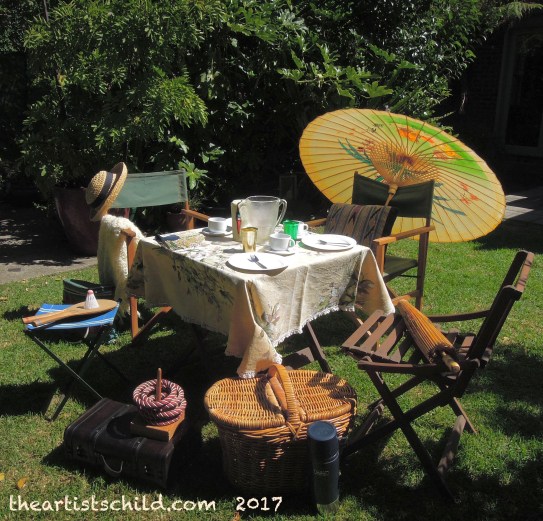
This type of picnic is something that I would like to recreate when the weather is not too hot.  Anyone can do this with a bit of imagination and not too much expense.  I set up our vintage picnic furniture and equipment on our back lawn to illustrate my idea for a mid 20th century picnic.  We have some old deck chairs, a folding stool; a folding wooden table and chair; a vintage linen table-cloth, old thermos and wine cooler; shuttlecock and quoits sets, all of which came from relatives.  The glass jug; aluminum beaker set; picnic basket and small wooden case were found at op shops (thrift or charity stores).  The umbrellas came from an Asian shop.

Just imagine a lovely country landscape with lots of trees (and nearby parking).  You set up your furniture and unpack your picnic basket in the shade.  It is a beautiful day with a slight breeze.  After a delicious lunch of gourmet sandwiches and salads served with cold wine or craft beer and delightful conversation with friends, you can indulge in a short walk or play a novel old-fashioned game of shuttlecock or quoits (or whatever game takes you fancy) or take a nap after reading a good book.  Then you have afternoon tea or coffee and cakes before you pack up for the journey home.

This is how I would like it to be, but it always pays to take the insect repellant, mobile phones and other mod cons just in case.  Resist the temptation to start Googling or checking your emails.  The whole point is to get away from 21st century stress and slow down a bit.

In Australia there are picnic race events in the country and you could attend one of these and have this type of picnic in style.  Appropriate clothing would complete the vintage feel.

There are even some people in Australia who live their whole lives in another era (Pia Anderson).  They dress in vintage clothes and live with objects and furniture from their favored period.  I think that this would take a lot of effort to do all the time and would not seem like a holiday after a while.  But whatever turns you on.

You could probably travel to other past times for a picnic theme.  Think medieval spit roast.  For this you would need a group of hungry people and no total fire bans.  A Roman banquet would be a bit more difficult.  Hard to find folding Roman couches but maybe a banana lounge would make a good substitute and there are always those portable shade cabanas or gazebos for a Roman tent if you have access to one.  These themes could be hilarious with a group of friends.

So next time you plan a picnic try something different.  Forget the modern minimalism of backpack convenience and go for a historical production for a fun way to visit the past.  There is nothing like a bit of escapist fantasy as a restorative.

Kat

When You Need To Laugh

These days we need to laugh more than ever.  When the state of the world starts to get me down I go out of my way to find something that will make me laugh and feel better.  Then I can get on with creative things in a much better mood.

Yesterday there was a hilarious post on The Age Newspaper website.  It has a game where you can type in your own name or any other and it will be Spicer-ized.  For example, I typed in Mother Teresa and the Spicer version was “Mothershead Tereza”; William Shakespeare became Willibald Shaky; Richard Nixon became Richelieu No-Nose; Alec Baldwin became Aledore Balestrero.  You get the idea. Lot’s of fun at Sean Spicer’s expense.  Have a go.  Here is the link – Spicer-ize My Name

Another fun on-line pursuit is the Oracle of Bacon.  This has been going since 1999 and started as a university study into the concept of “Six Degrees of Separation.”  You type in any actor’s name and it will tell you how they are connected and how many degrees they are from Kevin Bacon, who has been in so many films and TV shows he was chosen as the test subject.  I typed in Alicia Vikander and she is only two degrees from Kevin.  Try and beat the system with obscure actors.  It is very difficult as he has links in film all over the world.  You might even find yourself connected.

Searching You Tube for comedy videos is a good way to get you laughing.  Comedians are great value.  Amongst the many wonderful choices, I love looking at ones with Dame Edna (aka Barry Humphries).  Ellie and I went to one of his farewell shows in Melbourne in 2012. Dame Edna is such an Australian Icon that it is good that we can still laugh at her antics on You Tube.  Those in the know would never sit in the front few rows to prevent becoming a a participant in the show.  Here is a performance she did in Montreal in 2005.  Part of the enjoyment of Dame Edna’s sharp wit was that, while you felt sympathy for a hapless audience victim, you were glad it wasn’t you.

Political satire can certainly turn around a depressing situation.  Australian satirist Huw Parkinson, of the scarily prophetic “Winter is Trumping” Game of Thrones video parody, continues to make us laugh at our political leaders.  His recent Trumpocalypse Now video starring Australian Prime Minister Malcolm Turnbull and “you know who” is a hoot. Watch out for a young Harrison Ford in a minor role.

Musical comedy performances are also good for stimulating laughter.  The Australian band Axis of Awesome write and perform hilarious songs poking fun at contemporary song writing and modern culture.  One of my favorites is How to Write a Love Song, which deals with all the clichés in love songs, a must to avoid if you write songs.  Yes and one of them does look like Jack Black.

I know that these pursuits are silly time wasters, but when you need a good laugh, a bit of fun web surfing at lunchtime or in the evening can release those endorphins and give you a boost.

Keep laughing,

Kat

Sleepless Zombie Kills Creativity

dscn3957

No.  I haven’t started writing a horror story but about the dangers of ignoring your bodies natural rhythms.  During the holiday period I was staying up very late every night, writing and working on this blog.  I got away with it for a while because I could sleep in, but then when I had to get up earlier this behaviour started to have a bad impact.  And especially when on top of this my dog had a vomiting attack after midnight and I had to keep letting him outside every 10 minutes.  The next morning I looked and felt like the zombie from hell, walking around in a daze.  Not good for the creative mind.

You can’t cheat on sleep for long as it will catch up with you sooner rather than later.  Sleep study experts say that losing too much sleep can make your IQ drop and it becomes difficult to think clearly and perform physical tasks like driving (Alarming Number of Drowsy Drivers).  I’d have to agree because I’ve not been firing on all levels.  This means that everything takes me longer than it should which leads to more wasted hours and a later bedtime.  It’s a vicious circle.

My quick solution is to indulge myself on a day off and recharge my energy levels.  For relaxation I started reading a new book (The Good People by Australian author, Hannah Kent).   Then I had a nap in my favorite chair and woke up because the washing machine kept beeping.  I have been eating all kinds of treats, like Greek dips, fresh raspberries and dark chocolate.  I don’t usually drink wine so I had a couple of glasses of white wine before dinner then watched a silly movie comedy that I’d recorded.  I am starting to feel more rested.   I would not do this every day but it is good way to break the sleep deprivation cycle before it gets to be the norm.

It’s 10.30 pm and I am going to stop what I am doing and get ready for bed.  I will start this again tomorrow otherwise I will be negating the whole point of this post……

Had a good night’s sleep. It really makes a big difference and I have some more ideas.

Version 2

For maintaining long-term healthy sleep patterns, having hobbies different from your usual creative pastimes can be revitalizing.  I have tried various things like aerobics, bushwalking, and belly dancing.  My favorite recreational pursuit is going for a picnic in the hills or countryside around Melbourne and having walks in a forest.  There is nothing like being out in nature to make you feel calm and rested.  Any type of physical activity will take you away from being too sedentary and make you feel refreshed.  You sleep soundly and have more energy during the day.

Doing things with friends will give you a boost.  Having conversation and laughs with like-minded people will stop you from taking yourself too seriously.  Everyone has their own problems and it is good to put them in perspective.  You are not the centre of the universe. Time with friends is what is needed when you are going overboard with your own obsessions and not getting enough rest.

dscn0875

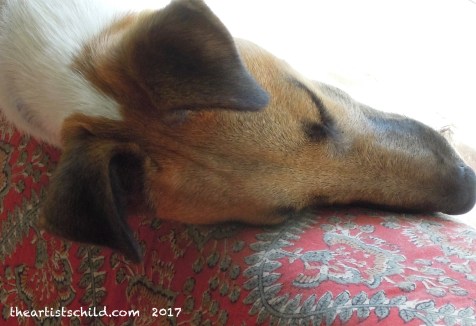
Dogs and cats have the right idea.  When they are feeling tired they take a nap.  Some places of business have a room where employees can do this when feeling tired.  Kind of like the afternoon siesta still practiced in some countries.  This prevents accumulated fatigue that can hinder work and in some cases is quite dangerous, especially when driving or operating any type of machine.  If you can’t do this during the day have a short nap when you get home.

If you do not want to spend you life in a constant zombie state then sleep is a necessity. This means that you might need to limit the amount of extra work that you do at night.  For your own health and to feed your creative mind, look after yourself and you will find it a lot easier to come up with inspiring new work.  And when you are feeling really tired have a nap and take time out to do something invigorating.  I know that’s what I should be doing.

Kat