Creative Summer Garden Decor

Now that it is summer I want to spend as much time as I can in the outdoors.   It is always lovely to sit outside and read or chat with friends.  It is good to have comfortable and sheltered places in the garden where you can do this and enjoy the fine sunny weather, so you need some suitable garden furniture.  You can buy items that look exactly like furniture found indoors, but these are not very bohemian, which is the style that I prefer.   I think that it is more fun and creative to do something with old furniture and use props to dress up your garden when called for.

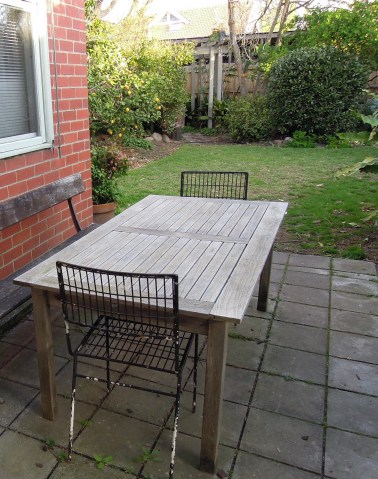
It would be nice to have a covered area where we could leave out cushions and less weather proof items and if you have such a structure make the most of it.  We have a very basic wooden garden table, an old railway bench that came from our grandparents and some old rusty metal kitchen chairs on our terrace.  I like the rustic look, but as a change I dress them up with interesting fabrics and other items for a more exotic feel.  Last summer I did this before entertaining some friends.

I covered the table with a painter’s canvas drop cloth.  You can buy these quite reasonably from hardware stores in various sizes.  Drop clothes are really useful as throws and tablecloths, especially outside, because they are heavy and will not blow around easily.  On top of this I put a gold Chinese style table runner and some colourful cloth tablemats, all found at an op shop.  Because it was breezy I anchored the ends of the runner with matching paperclips attached to the base cloth and placed straw mats along its edges.  These could be used as coasters.  On the tablemats I put some (op shop) candleholders and at the far end, an incense burner with lemongrass stick incense to repel flies and mosquitoes, but these weren’t a big problem because of the wind.

An old striped tablecloth was used to cover the railway bench, with some Indian cushions for comfort.  We have some black seat cushions that the fit seats of the metal chairs and a couple of striped Indian shawls were thrown over their backs, with cushions to rest against.  A large market umbrella shaded the table.  From it’s right side near the fernery I pegged up a colourful sarong to cut the glare of the sun.  This moved in the wind and was quite soothing.  From the wooden internal supports of the umbrella I hung a copper wind chime, found at an op shop and the musical notes also created a relaxing mood.   Everyone felt like they had been transported to a more tropical location rather than being in an urban setting and this was a great conversation starter.  Some good cocktails did not hurt either.   It is worth collecting interesting textiles and table accessories from places like op-shops and Oxfam, so that you can use them in imaginative ways outdoors.

I also like to sit and read or write songs in another sheltered and quiet part of the garden, where it is warmer when there is a cool breeze.  A couple of the metal kitchen chairs and an old white cast aluminum table sit in front of a pittosporum hedge and are flanked by a potted wisteria and a pot of thyme.  I can put a beach umbrella in the table for shade.  With a cool drink, some cushions and a good book, you can be perfectly comfortable in this spot.  What more do you need?  Well a nice view would help.  So opposite the table and chairs, against an old rusty gate, is a collection of bottles, ceramic pots, a statue of The Three Graces,  a mask of Pan and some found objects, together with pot plants, to form an interesting scene (referred to in 22 Oct post).   Behind this is the cool greenery of the fernery and hanging from the walnut tree above are some wind chimes.  This gives me something to look at and listen to when I need a break from reading or writing and I feel that I am in my own little oasis.

Don’t think that you need the latest décor to have an attractive garden for summer  entertaining and in which to enjoy the fine weather.  It is much more fun to do your own thing and your garden will not be the same as anyone else’s.

Kat
Creative Overload: Getting Back Your Focus

dscn3381

Overloaded

Lately I have been finding it difficult to focus on one thing at a time and my mind has been leaping all over the place.  It is not that I haven’t any ideas.  It’s more of a case of too many, while at the same time being busy with other outside commitments.

Take this blog for example.  I have had lots of ideas for posts and have been jumping from one to the next, trying to do everything at the same time and taking forever to settle on a particular theme which is not an efficient way of working.  It has not helped that I have been a bit sleep deprived and that is bad for clarity of thought.  Here is another example of an interruption to the creative process, but it is one that is self-inflicted rather than coming from something beyond your control.  How can you resolve this type of situation?  I have a few thoughts that might resonate with others in the same boat.

When you find that your brain is overloaded with ideas, you need to write them all down so that they do not disappear into the realm of lost thoughts.  Then at least you can go back and look at what you have written when your mind is clearer.  Since Art School I have always kept a notebook handy on my desk and beside my bed for such a purpose, because I always seem to have ideas at any time of the day.  Before bed can be particularly productive because things that were swirling around your brain can suddenly come together at the day’s end or when you wake up in the morning.

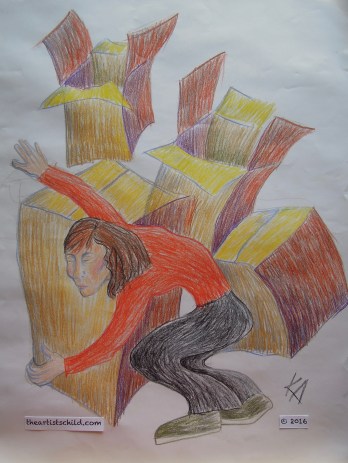
Having lot’s of ideas is good but not if they become confused and unmanageable.  You can’t create if you are in a mental muddle and your work will suffer as a consequence.  You need to separate all your ideas into small, separate boxes, rather than trying to do everything at once.  Use the old task management technique where you break things down into smaller steps.  Once you have focused upon a particular creative concept it is probably better to just jump in and do something, and not worry about the final result.  The “one small step at a time” method usually works.  Then, before you know it, you find that it is finished.  If it is not to your satisfaction you can always do something different or rework the idea.

Too much creative stimulus can sometimes hinder you from getting anything done at all.  You need to pace yourself and reward yourself with other diversions so that you do not expend all of your energy and then get bogged down from exhaustion.   It is ok to have some time out.    Last weekend Ellie and I went to the Gangster themed birthday party.  We spent some time during the week on finding accessories for our Bonnie Parker and Blanche Barrow Costumes, including me making a diamante hair clip, buying some plastic revolvers and a fake cigar at a party shop.  Incidentally the party was terrific and we had a great time, so it was well worth the effort.  After having a fun and distracting weekend of dress-ups and celebration I feel more refreshed, less stressed and have been able to get back to some creative work.

From now on I will take my own advice and work on one idea at a time, make sure that I have breaks and get some more sleep.  I hope that this works for you as well.

Kat

Be Creative with Your Old Festive Decorations.

dscn1198

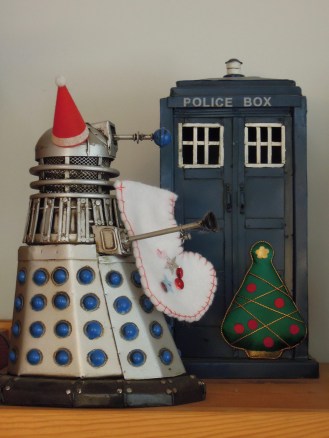
Each December I give a Dalek figure a Santa hat and a stocking and decorate a Tardis money box with a magnetic tree, because Time Lords and their evil nemeses deserve a bit of festive joy, as do we all.  Decorations for the festive season put you in the mood for fun holidays and family get-togethers.  Every year it is nice to add a few new pieces to your collection, but the advertising catalogues we receive in the letterbox seem to be full of ever more expensive or unoriginal items.  If you like doing craft you can make your own, but if, like me you do not have the time to do this in a big way, you can remake and repurpose your existing decorations.  In our household we reuse items from our decorations box every year, but try to give them a new spin, with the latest catalogues providing inspiration.  It is so much more imaginative and satisfying than just going out and buying new baubles.

In Australia it is also summer and I like to limit the amount of northern winter decorations, because the days are long and there are hot days to enjoy.   A reference to the snow is ok because it can make you feel cooler, but it is good to celebrate the summer time.

Sometimes broken decorations can be given a new purpose.  A few years ago I reused the round metal frame of an old wreathe that had lost its foliage and hung this by a chain from the ceiling above our stair banister.  From curtain hooks I hung metal silver butterflies and white, gold and silver papier-mâché stars to form a mobile.  In the centre was a hanging red bird candle holder.  To match this I attached a long silver chain on the left side of the stairs decorated with silver and red hearts and a white peace dove.  To the right of the mobile I hung a white glittery horse, a larger silver heart and to reflect the summer,  a red mobile with natural shells.  It was a look that suited our modern living room and did not clash with the African artifacts and the black bamboo pole on the stairs.

Over the years we have done the real and the artificial tree thing, but a couple of years ago I decided to do my own original take on this iconic item.  We have an old silver music stand, and the base forms a pyramidal shape like a pine tree when the top half is removed.  Once placed on the TV console, I wound the silver metal chain around the outside held with a couple of curtain hooks and voila, I could hang decorations from the links.  The same star decorations from the mobile, some silver trees and musical instruments, together with a metal angel, were attached to the chain with small wire hooks.  I fitted a metal skewer into the hole in the top of the central pole and blue tacked one of the stars to it.  A silver metal reindeer, a couple of silver summer insects and a tea light sat under the tree to give it interest.  At the other end of the console our grandmother’s 60s wooden leaf-shaped dish held some silver fruit decorations.

Last year I went for more of a Scandinavian effect.  The horse and the peace dove were now on the tree.  I added a reindeer themed card on a stand and next to the tree the silver reindeer sat beside a couple of small logs, offcuts from some tree pruning.  On top of the flat log was a little rabbit blowing a trumpet that we have had for years.  Just a little bit of change is often all that is needed to update your theme.

We had some old Ikea straw decorations in storage and one of the mobiles was a bit tatty, so I cut off the straw angels and stars and tied these to the stair banisters so they sat against the wall.  Some were also hung from the ceiling above the stairs, together with another Ikea straw mobile and the red bird.  In the wooden leaf dish now sat three Ikea woven straw pinecones.  I assembled an abstract snowman figure from an alabaster ball that came from a broken lamp, topped with a porcelain ball from a broken salad dressing shaker and sat it next to a gold star.  On the bookshelves opposite I put some more traditional wooden ornaments; small white angels, musicians and Santas next to a glittery tree card.  The whole scheme was very modern with references to northern traditions, yet did not look out of place in our warm climate.

I have not decided what I will do this year because I usually decorate spontaneously.  Maybe I will dig out some of the less used items in the storage box for a change.  I have noticed that traditional wooden toy decorations are making a comeback so I might play around with some that we have tucked away.

You may prefer a more traditional festive scheme, but whatever your style, have fun and use your imagination to rework what you already possess.  It is possible to come up with interesting ways to decorate you home without spending a great deal, if at all.

Kat

Party Costumes: When at First You Don’t Succeed

As you have already heard from this blog, Kat and I have been invited to a “Gangster and Moll” birthday party.  My character will be Blanche Barrow, the sister-in-law of Clyde Barrow of Bonnie and Clyde fame, and her style dress shall be different from that of Bonnie Parker, Kat’s character.

Now like my sister I do not want to go in the expected costume of a 1920s “flapper”, dressed in masses of fringing or sequins.  It is just not my style.  Instead of going out to hire or buy a party costume, I have created a unique costume by combining key pieces from my wardrobe in a way that reinterprets the silhouette of the period.
The Costume

For this occasion I have combined a blue, floral patterned velvet cardigan over a plain maroon ankle length skirt.  To accentuate the skirt and hips I have wrapped an Indian velvet scarf, around the top of the skirt and pinned it together with an oval brooch at the front to form an overskirt with two overlapping floral panels.   For my jacket I have been inspired to select one from my collection of Japanese haori.  It is a soft pink/violet with a small, stylised floral pattern of white and grey flowers.  The kimono shape was fashionable during the 1920s and early 1930s.  To bring it all together I have accessorised with a violet, embroidered floral shoulder bag to match the skirt.  I have also made a headpiece using ribbon, diamantes and feathers to truly get the look of the period.

The Headpiece, Plan A & B

It seemed like such a simple task. Make a small headpiece to look like a 1930s lady dressed for a night in a speakeasy.  This was my chance to be creative.  I could make the headpiece from materials that I already had and would not need to spend a lot of money.  Just in case I did not have the correct fixings at home I went to a large chain store specialising in sewing and haberdashery items to buy some basic construction materials.  I was playing with the idea of making a small rosette or panel on which I could fit some sequins or beading and feathers.

I purchased a headband with a woven straw disc, a fancy diamante trim to make the headpiece “sparkle”, 2 packets of white feathers, some circular fabric discs to fix the feathers to my selected base and some metal hair clips to fix it to my hair.  At home I found some pieces of scrap material, blue taffeta silk and a patterned floral silk in blue, pink, green and white.  These would match my costume.  I also had some interfacing and Tacky Glue.

I soon realised that the headband and the round straw disc were the wrong shape for the diamante trim and too big for my hair.  I decided to move to Plan B.  Six layers of interfacing were ironed together and cut in an oval shape slightly wider than the diamante trim.  The floral silk was cut larger than the oval base, centred and glued to the back of the interfacing.  I then sewed a line of stitches around the outer edge of the loose fabric and gathered it in the centre to form a ruche on the front of the disc.  Decorative ruching was popular during this period.  Next I stitched a metal hair clip to the back of the oval panel.  I glued the white feathers together using between two of the white fabric discs as I planned to glue them to the front of the fabric then attach the diamante trim on top.  Before doing these final steps I experimented with how it would look in my hair.  It did not work.  It looked terrible.  My hair is too curly and wild and it would not stay in place.  I decided I needed another solution and not waste any more time on this idea.

The Headpiece, Plan C

Back to the notions box in the studio and with much rummaging I found two violet satin ribbons in a paper bag.  They were good quality and already were tied in bows.  I think I must have saved them from packaging, where sheets or linens were tied up in pretty bows.  After trying one ribbon on my head to see if it would fit, it did, I found the size of the bow was perfect to fit the feathers and the diamante trim.  I first sewed the fabric disc holding the feathers to the front of the bow, with the diamante trim sewed over both the feathers and the bow.  Voila!  Finally I had the perfect headpiece for my costume.

Making this headpiece reminded me that there is more than one way to be creative.  You can carefully plan your project from the start, so that you have everything worked out so that you save time, money and effort.  You can also work more freely as I did and make it up as you go along.  The important point with both methods is to recognize when an idea is not working and that you sometimes need to go through the design and construction process and fail before you can find the right solution.

My costume is now complete.

Ellie

Coping with Interruptions to your Creative Flow

Version 2

Boxed and Nailed

You’re happily doing some creating, painting, playing an instrument, writing or whatever your passion may be, when someone or something disruptive happens along that stops your flow.  How do you calm yourself and get back into that zone where you can freely create?

I was getting ready to do some drawing when a neighbor, who I had never met, rang the doorbell to complain about our dogs barking.  Admittedly they were being annoying but not as much as this person was suggesting.  Anyway I said that we would try to do something about the problem and he went away.  But I was irritated by the experience and found it hard to relax to do some drawing.

Dealing with interruptions is a reality of life for creative people and you just need to find a way to cope with these situations that works for you.  I find it best to do something completely different to calm myself.  After that complaint I went and played guitar in the garden and practiced some new songs.  Getting some sunshine really helps.  Other methods include taking the dog for a walk; doing some housework or the thing that you have been putting off; doing some physical exercise to get rid of angst or writing about the situation in a journal (or a blog).  Having a cup of tea or coffee is good and there is always chocolate.  In other words do whatever makes you feel better.

As there are more demands on our time these days any moments we can set aside for our creative work are precious.  To avoid being interrupted in the first place, try to minimize the likelihood of this occurring. You need to make sure that your relatives, housemates and friends respect your personal space.  Many people turn off the phone and tell others not to disturb them between certain hours.  A “do not knock” sticker on the front door should discourage salespeople but does not work for other types of callers (like grumpy neighbors).

Circumstances beyond your control can be disruptive and it is a good idea to find a way to adapt to the situation so that you do not lose inspiration.  I have had to put up with the extreme sound of demolition machines next door on my days off over the last couple of weeks and this has made it difficult to relax.  It was probably not the time to do something that required my undivided attention.  Instead I undertook less demanding tasks that did not depend upon intense concentration, like sorting out my photo library, research on the Internet and other activities that would trigger my imagination.

If you are prevented from doing your usual creative pursuits for a lengthy period try to find some other outlet until things return to normal.  During a house renovation several years ago I was sleeping in a caravan at the rear of the property and did not have enough space for any major artwork. I did small collages and drawings in a visual diary, played guitar and wrote some songs. It got me through the stress and noise and I made the most of the experience.  It was actually a very productive time.

Don’t let negative situations and interruptions get you down.  Turn them into a positive and let them feed your creativity.  You might come up with your best work.

Kat

Embrace the Fun Side of Your Creativity

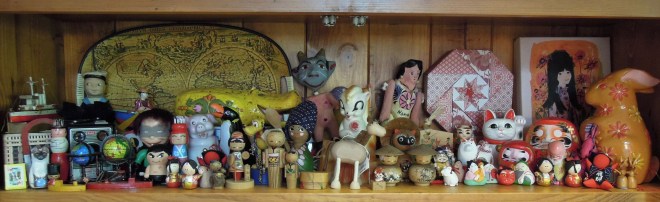
It would be a very boring world if we had to be serious all the time and to be creative you don’t have to always work with deep and meaningful concepts.  You can express yourself in any way you like and sometimes do things just for fun.  I like to play around and create amusing visual displays.  From retro toys, souvenirs and figures from other cultures to kitsch items and colourful ephemera, these are placed in the studio, as well as other rooms in the house and in the garden.  They are a source of inspiration and make me smile.

Some of these displays have grown into collections and others contain only a few items.  In the kitchen there is a large pine cabinet that mainly houses crockery and glass objects, but the top shelf is devoted to old and new toys, including a number bought on holiday in Japan.  Every time I look at this shelf, as well as being visually pleasing, each item has a story to tell that brings back many memories.

dscn2908

The most playful objects are in the studio as this is where I need a lot of visual stimulation. One of the seven dwarfs and a vintage Popeye toy sit on the computer desk and I can see them every time I sit down to work.  Across the room on a shelf, a child’s toy wardrobe holds a diorama with seaside souvenirs and related objects, while a trio of incongruous toy horses stand along side.  On the top of the wardrobe sits a miniature closet and dressing table in the same pale blue. Greeting cards with interesting and associated designs are often used in my groupings and I have a large number to choose from. I move items around in different combinations when the mood takes me.  For example, some resin figures that have at one time been in the old dollhouse (see 2nd post) or the wardrobe display, now sit on a pelmet in the studio.  Others may view these articles as clutter and dust collectors, but to me they are part of a whimsical realm where my imagination can wander.

Out in the garden a gnome peeps out from under a shrub and an owl, a failed possum scarer, sits on a metal post to become a quirky feature. A cast iron gecko crawls along a rock.  These things are purely for amusement and don’t pretend to be anything else.  For me, keeping a sense of fun is a necessary part of the creative process.

Many creative people have collecting and hoarding tendencies and sometimes it can be difficult to control.  I find that I have to be selective with what I keep and have given away countless objects because it was impossible to store them with the space available.  But there are no rules to this and you can be sparing or lavish with your chosen material.  If it is a house full of Star Wars figures that gives you a buzz or if you want a garden full of gnomes, go for it and don’t worry about what anyone else thinks.

The following links are to examples of homes and gardens where the residents have embraced the fun side of their creativity in a flamboyant and unconventional manner.

Sandra Eterovic – The Design Files

Bronwyn Barnett – ABC News

Sydney Garden Gnome House – Cool Hunting

Pensioner Robert Rae’s garden – Daily Mail UK

Kat

Creative Spaces: The Garden

The house next door is going to be demolished next week. The neighbours are building a house that covers almost the entire block and there will be none of the original garden left.   Paved areas will replace it with a controlled minimal planting design reflecting the present obsession with low maintenance.  While everyone is entitled to build what they like on their own property, what makes me sad is that many people give little thought to their own and their children’s creativity when designing a new garden. A garden should be something that we treasure as a place to learn about the environment and use our imaginations.

Ellie and I have found that since childhood we have used our garden and those of our grandparents, as inspirational and creative spaces.  As children we built cubby houses out of whatever materials were available: old doors and corrugated iron from the woodshed; bamboo poles and old branches from the garden.  Ellie was the master builder and I was the interior decorator.  We learnt how to put things together and come up with our own solutions, as well as creating our own stories in play.  There was a wilder area at the end of the garden where we could imagine ourselves in a jungle or the bush and several shady trees to safely climb.  As we grew older we started to grow our own plants and contribute to the shape and nature of the garden.  We still have a reasonable sized garden and use it as a place to express ourselves and get ideas.

Our garden is constantly changing.  We need to pave an area outside our family room, add new plants to the garden beds and replace some trees.  It is not perfect but nor should it be.  The main thing is that it is a place where we can be experimental with ideas, just like in our studio.

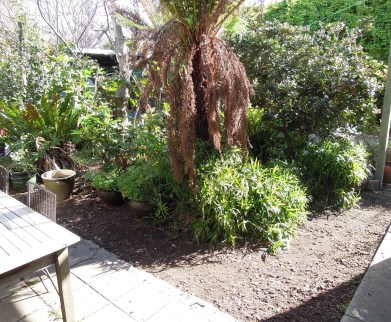
The fernery adjacent to the section that needs to be paved is our “wild” area.   It contains birds nest ferns, tree ferns, fish ferns, aralias (fatsia japonica) and some Japanese grasses and is shaded by a walnut tree and a large Yeddo hawthorn shrub.  The fernery is densely planted and sheltered and is the lowest point in the garden where the rain water runs.  It has coped with drought conditions in summer and the colder temperatures of winter.  It’s microclimate gives a cooling effect in the summer and the nearby table is a pleasant place to sit and a place to create.  I have often used the tropical looking foliage in my drawings and other artworks.  Having a variety of landscape areas in a garden can stimulate your imagination in many different ways.

Version 2


Version 2

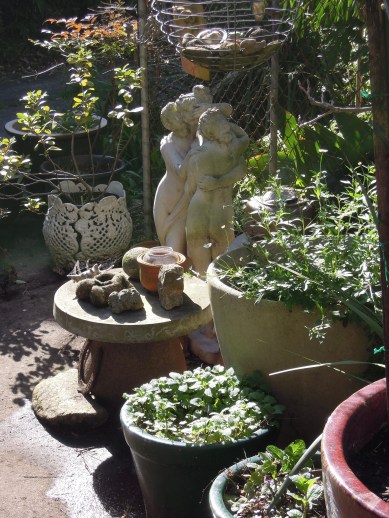
It is fun to be quirky with what you place in the garden.  As in the house I like to create found object arrangements.  For example, I made a small table out of an old upturned concrete pot with a circular concrete paving stone for the top.  On this are interesting rocks, a shell and a tea light holder made from a terracotta pot, with a glass insert that came from a broken hurricane lamp to keep out the wind.  Another still life of rocks and shells hangs above in a wire basket.  Together with an Italianate garden statue and lots of pot plants, this forms an attractive vignette that can only be seen when you turn a corner from the main lawn area of the garden. It is a contemplative quiet spot to sit on a sunny day.

dscn2648

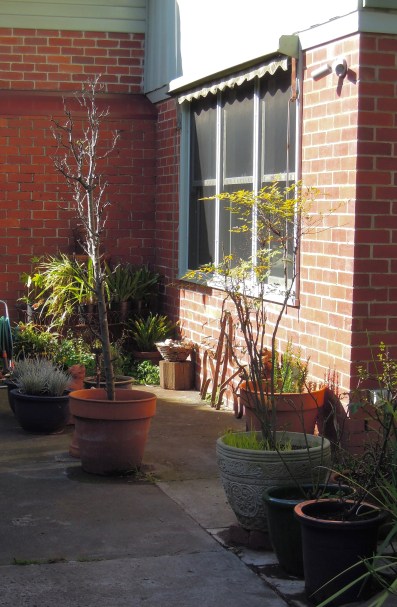
Having a variety of pots for plants can allow you to change an area of the garden and create interesting groupings and vistas.  Pots can be moved around depending on the season and the movement of sunlight.  For instance, we have a large concrete driveway in the back garden that was rather bleak.  To make this area more visually appealing we have used a variety of pot plants to break up the space.  We are not obsessed with having every pot matching, as this can look too “designed”.  Instead a mixture of sizes, colours and textures is more individualistic and repetition of shapes can link the pots together.  In this area there are a pair of low blue pots, a taller blue pot and two identical cream concrete pots, all of a similar rounded shape.  In addition there are several terracotta pots, most of which have an inverted conical shape.  Filling the pots with the same or similarly shaped plants also creates visual harmony.  We have used spikey plants that include a native silver grass with yellow flowers, prostrate and standard rosemary, some interesting bromeliads and a pointy apple tree.

Version 2

Sitting against a wall of the house near the driveway is an old rusty Victorian pot plant stand, one of a pair, which came from our great grandparents home.  It holds an orchid, some bromeliads and a spider plant amongst others.  The raised pot plants give colour and surface interest to an otherwise blank brick wall.  If you do not have a pot plant stand you don’t need to invest in an expensive plant wall feature.  You could fix inexpensive chain store metal brackets and shelves to hold light weight pots.  Or you could use old metal brackets and wood and paint them any colour you wish.

dscn2668

If you have limited outside space like a balcony or courtyard, it is still possible to use these outside areas creatively with pot plants and interesting objects.  Just use a smaller scale than in a garden.  If you have no outside space, some municipalities have community gardens where locals can contribute to the care of plants, grow vegetables and create sculptures and landscape features.  In contrast to the increased destruction of private gardens, community gardens reflect that there is a still strong need for gardens.  It makes you feel good to be out in the fresh air enjoying the greenery, digging around in the earth or making a new outdoor item.

With so many regulations and laws about what you can do in public spaces, it is wonderful to be able to create what you like in your garden.  Gardens keep us in touch with the natural cycles and foster our need for free self-expression.

Kat

Imagination is Free

In the last few years the cost of living has skyrocketed.  This has really impacted on the price of art and craft materials, as well as hardware items.  After paying for life’s essentials there are often inadequate funds available for expensive creative projects. It is necessary to find a cheaper solution and sometimes having limited means leads to more interesting and original ideas.

We are lucky to have had three generations of hoarders in our family.  Not the extreme kind, but those who kept old furniture and junk items under their houses, in their sheds, garages or storage areas.  While we had to get rid of a lot of this stuff when our relatives died, we managed to keep some interesting things stored in the attic and shed of our family home.  We have been able to use such found objects around our house and garden in a creative and fun way without spending a cent.

It helps if you like the naturally distressed look, objects that have genuine flaking paint and real rust.  Sometimes all a thing needs is a gentle clean or a minor repair.  This saves on time and materials, like paint and sandpaper.  The age of an item shows its history and over restoring would destroy any authentic character.

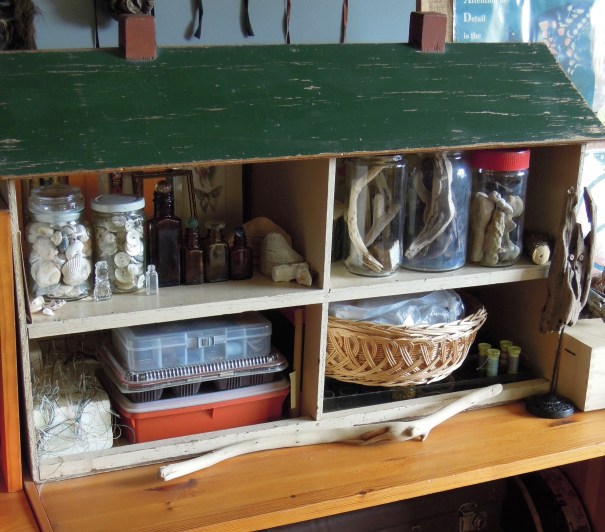
For example, an old distressed dolls house in our studio is used to display a collection of bottles dug up from our garden, as well as glass jars, that are filled with interesting old buttons from our grandmother and driftwood, flotsam and shells found at the beach. It also holds some sewing and craft materials.  I find it fun to change the objects every now and then, as these give me inspiration and are visually pleasing.  This is a case of using things found around the place in a new manner that costs absolutely nothing, as well as requiring little time and effort to produce.

Version 2

Version 2

dscn2775

It really pays to look in your close relatives’ sheds, attics, garages and basements to see if there is anything useful. Best to ask permission before rummaging around these places and appropriating objects to prevent any family arguments.  If you do not have your own source of free stuff you can find things in curbside hard rubbish collections and skips (dumpsters), but to avoid breaking local council laws you should ask the homeowners if it is ok to take something from their pile.  Also there are plenty of free recycling websites around Australia and the world where people give away unwanted items or get stuff for free.  Probably the next most inexpensive places are garage/yard/car boot sales; then op shops/thrift stores/ charity shops, weekend markets and of course on line auction sites.

It definitely is satisfying to look at any old piece of so-called junk from a different angle and then create something new.  Often this tells a story about your family history and is also a way of recycling things that would otherwise be trashed. You will have something unique that reflects your personal vision.  So play around and use your imagination.  It will make you feel good without breaking the bank.

Kat