The Art of the Squiggle

A great way to free up your drawing and to think in an imaginative way is to do squiggles.  A squiggle is a random set of various lines drawn onto a page.  Either oneself or someone else then connects these lines to create an imaginative image.  This type of squiggle drawing originated in the Australian children’s Television program, Mr. Squiggle, which ran from 1959 to 1999 and was beloved by several generations.

Mr. Squiggle was a marionette with a pencil for a nose.  He came from the moon in a rocket and with the help of a grumpy blackboard and a presenter, created his drawings using the squiggles sent in by the child viewers.  It was a form of interactive drawing long before children had access to computer drawing programs.  Mr. Squiggle was the brainchild of puppeteer, Norman Hetherington.  He usually did the drawings upside down from the viewer’s perspective because that is the way he would see the page while operating Mr. Squiggle.  Then the finished drawing would be turned right side up and the image revealed.  Here is a five-minute episode of the program found on You Tube.  It is still delightful to watch.

As children, Mr. Squiggle and his clever drawings fascinated Ellie and me.  No squiggle was too difficult for him to transform.  It seemed like magic when the random lines became something recognizable and usually whimsical.  He must have done thousands of drawings over the 40 years that the show ran.

This drawing concept was so simple yet so inspiring for children.  It taught us how to use our imaginations with just a pencil and an eye for the image long before we learnt about great artists and their techniques.  There was no pressure to produce a great work of art. It was about the pure joy of the act of drawing.  And it was something you could do yourself.  We never sent in a drawing to the show but Ellie and I would do this type of drawing together, each transforming the other’s squiggles into a fun image.  It was a great game to play on rainy days.

I still like to do squiggles.  This type of drawing makes you come up with creative and often amusing ideas because you must use all the lines.  You can do it with someone else but usually I do these drawings for myself.  To make sure that the lines are completely random, I close my eyes and scribble on the page.  Then I look at what I have done and turn the drawing around and view it from different angles.  Sometimes it is possible to see an image immediately but at others it takes longer.  It is good to consider all the shapes and their relationship in space from various perspectives.  But eventually something is revealed.

It is not so much about doing a perfect drawing but more about stimulating the imagination and having fun.  If it turns out a bit wonky that does not matter.  And you can always do another one.  That is what is great about squiggles.  They are endless and you can use the simplest of drawing materials.

All drawing should be as enjoyable as a squiggle and it is a way of restoring your childhood creative spirit.

Happy squiggling.

Kat
The Worry Tree

DSCN4298

I’m a worrier.  Always have been since I was a child.  I’d worry about my schoolwork, passing tests, my health, anything and everything.  I still worry about things and I know it’s a waste of energy.  These types of bad thoughts can sometimes get blown out of proportion so that they interfere with your creativity and stop you from getting things done.  You need to put them into perspective.

The song I’m So Worried by Terry Jones of Monty Python fame sums up this type of worrying.  It’s just ridiculous and you will always find something to worry about if you let everything get to you.  Although I did have a bag damaged by the “baggage retrieval system they’ve got at Heathrow” so maybe that is something to worry about.

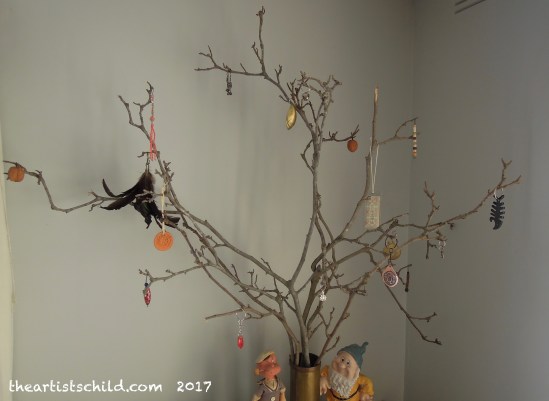
As a form of self-therapy I recently created a “Worry Tree.”  I figured I needed more than worry beads to relax me.  Using some pruned branches from our Magnolia, I hung up an object every time I felt anxious about something.  I even made some beaded ornaments from those left from broken necklaces.  By looking for or making something to hang on the tree I find that I completely forget about what is causing my worry and I can relax. This type of diversionary method works because I’m involving myself in a meditative process.

People have attached things to trees for millennia to ease their worries and ask for help. For example in Ireland, Cornwall and Scotland trees are often associated with sacred wells and petitioners attach pieces of cloth and other objects as a prayer or supplication. They are called Clootie wells in Scotland and cloutie wells in Cornwall.

To externalize your worries by attaching a symbolic or written item to a tree can be an effective remedy.  Then you can let it be.  I only wish my worry tree was a living one, although this would be a bit difficult to fit on my desktop.   My worries have now been turned into something fun and creative that makes me feel happy.

On a positive note, being worried has definitely inspired songwriters.  There is The Worried Man Blues, a traditional song that has been recorded by Woody Guthrie, Pete Seeger and many others.  I like Johnny Cash’s version.

Probably the most famous song that shows how stupid it is to worry is Bobby McFerrin’s Don’t Worry Be Happy .  It deservedly has had millions of views on You Tube.  I love to sing and play this on my ukulele and it always makes me feel good.  A less well-known song of the same title with a similar theme is by Australia’s Guy Sebastian.

Instead of worrying find something that you can do to ease these annoying and distracting thoughts.  Maybe a “Worry Tree” will work for you as well.

Kat

The Broken Club and the Half Eaten Atlas

Interesting tales attached to objects are for me what gives them value. The more bizarre the better. The following is a poem inspired by two items and a family story.

The Broken Club and the Half Eaten Atlas

Safely kept were the tribal club and atlas

Left behind by a missionary man

Some friend of an ancestor

Then the club was broken in two

By one boy who

Used it to strike the floor

And the book found under the house

Half eaten by a rat or mouse

Last possessions of Gottlob Rembold

A resident of Sydney

Who went off to New Guinea

Or so I’ve been told

In the late 19th century

And was eaten by cannibals

©Theartistschild.com 2017

There is a story in our family that a German missionary left some of his possessions in storage with a relative.  The Aboriginal war club (waddy) and Stieler’s Schul Atlas are all that remain.  He was supposedly eaten by one of the New Guinea tribes of headhunters and this was why he never returned to collect his things.  The war club (broken by an uncle when young and mended with some waxed flax by me) is the type of weapon used to attack enemies in tribal battles.

While I am usually dubious about the veracity of such sensationalist tales, I think that the story is most likely true because it came from a branch of the family that was quite reliable.  They were very honest and practical and not the types to make up fanciful stories.   Ellie and I thought that we would investigate this further to see if there was any actual documentary evidence available.

The name Gottlob Rembold and a Sydney address are hand written in the Atlas.  We Googled his name and this has made the story stranger and more complicated.  In Sydney in 1881, a Gottlob Rembold at the age of 27 was charged with shooting and wounding his uncle in the chest with intent to murder.  Apparently this Gottlob was a young man from Germany, who came out to Australia in 1880 to live with his aunt and uncle, a farmer, probably after the death of his father.  There was a dispute about a large sum of money in a will that he claimed was his, but his aunt said it was left to her.  Gottlob also claimed that he had been mistreated since his arrival from Germany ten months before.  Gottlob was found guilty but the sentence was remitted with no reason given.  There is a prison photo of Gottlob but we can’t show it as it is subject to copyright and  only available to view by Ancestry.com members.  It is not a mug shot, but a normal studio portrait and he was a good-looking young man.

His was not a common name in Sydney at the time so it is surely the same person.  The atlas has a date of 1876 and this is when this Gottlob was 22 years old and might have been contemplating travel.  After his release from prison he could have gained assistance from a religious organisation and then decided to become a missionary.  Gottlob had been employed as a gardener so this was a change of direction.  Not that it did him much good.

Gottlob’s story is part of the rampant Western Colonialism that took place around the world in the late 19th and early 20th centuries.  Probably if Rembold had been a medical missionary or an Anthropologist he would have survived.  As opposed to some of hardline missionaries of the period, they tended to respect the host culture and were not perceived as a threat so usually lived to write about their experiences.  Gottlob must have made enemies if he had such a nasty fate.

Not all family stories are sweetness and light and the sad and bad characters can be just as inspiring as the heroic figures.  Was Gottlob a naive young man mistreated by his aunt and uncle or was he an opportunistic, murderous fortune hunter who turned to religion?  We will never know the whole truth about his end unless we can find a death certificate.  Without more information one can only imagine the mysterious and violent demise of the unfortunate Gottlob Rembold.

Kat

To lift a rather dark story the following is a live version of Rage Against the Machine’s protest song Killing in the Name by my favorite string quartet, Sydney group “FourPlay String Quartet.” They can really rock the strings.  Ellie and I saw them perform this same piece in concert and it was electric.  The members of FourPlay are all fantastic musicians and composers and their own music, while influenced by the past, is of our time.   In recent years they have collaborated in performance with Neil Gaiman.  Check them out on YouTube.

Autumn in the Garden

Daylight saving has just ended and we have turned back our clocks, but nature does things to its own schedule.  Our garden is in transition.  It is still quite green but the autumn colours and flowers, fruit and seeds are becoming more prominent as the temperature cools.  Today I took some photos because I wanted to record the seasonal changes.

The Japanese Nandina is now a lovely shade of red.  This came from our grandparents and we have had it in a pot for years.  It is a slow grower and has remained this size for ages.  Maybe it is now like a bonsai because the roots have nowhere to go.

We have two varieties of Plumbago, blue and white, and the flowers are still hanging in there.  They are very delicate and have a sweet nectar.  Because the flowers are so sticky the sometimes get all over the dogs, over your pants and sleeves and anything else that comes in contact.

There is a last bud on the Iceberg rose.  These hardy white roses do well in pots.  Unfortunately there is no fragrance.  Our Elephant Ears are looking very lush and have spread to other parts of the garden.  As long as it is shady they survive the summer.  Because we have a mild climate they usually don’t completely die down in winter and bring a bit of the tropics down south.

The Clivia now has wonderful red seed pods (photo left).  We need to watch that our young dog does not eat these.  Ellie planted some in pots so it will be interesting to see if these shoot.

The Chinese walnut tree is also covered in green walnuts (photo right).  When they start to split and the nuts fall to the ground it is a battle to see who gets to them first.  The dogs love to crack open the hard shells and make a mess inside.  I’m constantly yelling at them to go “outside” with the nuts.  Last year the dogs ate more nuts than were saved to dry.

I love the spiky red flowers on the bromeliads.  I think that they look like some creature from another planet.  You can almost imagine that they will suddenly extend from the plant and try to whack you like a type of creepy carnivorous plant.  These flowers last for a long time.

Although Aralia plants are evergreen (photo top left), in autumn some leaves turn a bright yellow then to brown before they fall.  You can see the seasonal transitions on one plant.

Because we do not often get frosts, a long time ago we put our potted Maranta (prayer plant) outside in a very sheltered spot behind some large pots (above photos bottom).  It has thrived although sometimes the purple spots fade in the brighter light of summer.

We also have a Wollemi pine in a large terracotta pot (photo top right).  It is one of the most ancient species of evergreen trees on the planet.  It a pine that also has characteristics of a fern.  We call ours “Wolly” because it is so special.  We plan to plant it in the ground so that it will reach its full height and will be protected by a large Melaleuca tree.  At the moment the tree has bent a bit so will need to put a stake to straighten the trunk.

After I took these photos the sun disappeared and it is now quite gloomy.  I think there is rain on the way and it really feels like autumn.  I’m glad that I made the most of the sun while it lasted, something that we should always remember.

Kat
Away with the Fairies

Often when I am creating I go into another imaginative place. I feel that I am in a world of my own creation, the place of daydreams.  It is a great space to be in when you are writing or doing some visual art.  But at times this ability to put myself into a story or travel with my mind has not been appreciated by others.
As a child I became easily lost in the world of make-believe.  I remember going to a scary play when I was about 5 and became very distressed because one of the characters terrified me.  I thought it was real.  I had to be taken out of the theatre.  It was on a school excursion and the head teacher was not impressed. She obviously had no imagination and could not understand why a little child might be frightened.  I also found the MGM lion very terrifying because it was so big and loud. I thought he was going to eat me and hid behind my hands.

In kindergarten another girl and I were totally involved in a game we were playing and decided not to go inside when the bell rang.  We went to an area where there was an empty water feature with rock formations and continued our game.  Then the drama started.  The teacher started calling our names and we knew we were in trouble and hid behind the rocks and did not come out.  Things started to escalate and more people were looking for us.  Eventually we reluctantly decided to face the music and got into a whole lot of trouble.  Our mothers had been called and as punishment we had to spend the rest of the afternoon in the principle’s office nervously giggling.  We were only little kids acting out our fantasies but the reaction of the adults was totally out of proportion because of their fears.

As I became older I spent a lot of time in school daydreaming through classes or dreary assemblies.  I think that I missed lots of vital information by drifting off into my own little world.  Luckily there was always art class.  I could always concentrate on my artwork or a good book or anything that engaged me.  My early school reports often had remarks like needs to make more of an effort or would do better if she paid attention and concentrated on the work.  Any tendency to let your mind wander was to be discouraged.

All my day dreaming never did me any harm.  In fact without it I never would have persisted at any art form.  Ideas don’t just fall into your lap without time spent musing.  You can’t change reality without first imagining something different.  The world probably would not have many inventions or great works of art and literature without lots of daydreaming on the part of their creators.   Questions like “What if I do this? What would happen if? How can I do that?” are often answered by daydreaming.

Nowadays I tend to daydream in the garden, watching TV or gazing out the window when I’m in the studio.  For this reason it is good to have some kind of view, especially if there is a bit of nature.  It is also easy to daydream under the shower or in the bath because the hot water is very relaxing.  The only problem is that you can’t write anything down and have to quickly dry yourself and find a notebook before forgetting the idea.  Often when you are in this state your mind flits around from one topic to another so it can be difficult to keep track of your thoughts. If I am in that frame of mind I take a notebook into the bathroom just in case.

For those of us who have chosen to follow the creative path, daydreaming is an essential part of the creative process and losing oneself in some imaginative place is not something to discourage.  Being able to transport yourself somewhere else mentally or transform yourself into another character is really helpful.  A moment flight of fancy can develop into a story or a series of paintings.  Never stop your mind from wandering or as my parents used to say, being away with the fairies.

Version 2

Away with the Fairies

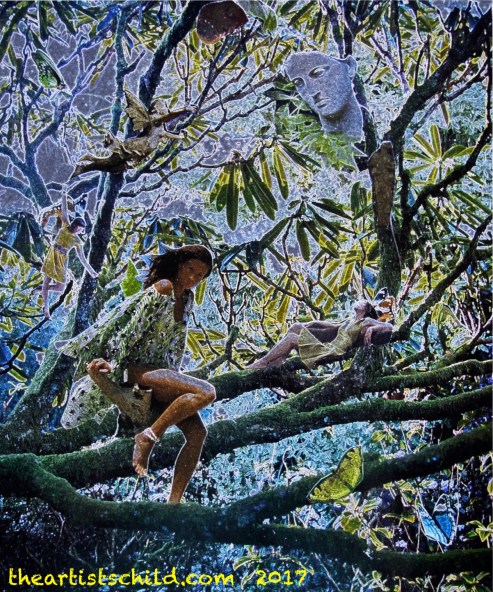
One midsummer night I dreamed

I’m in a tree far away

Visible in full moon light

I lie on branches with the fey

Faces glimpsed amongst the leaves

Figures hide behind the limbs

Bright beings with fragile wings

Stir the air and fan my skin

Some drift around me as I gaze

A whispered spell upon me cast

I finally slip out of the haze

To find my bliss at last

© theartistschild.com 2017

Daydreams can become reality so let yourself fly.

Kat

Here is one of my favorite day dreaming songs from the 70s.

Doodle All The Day

Recently I found some of my old doodles that I’d  done on odd bits of cartridge paper.  From a young age I used to doodle all the time.  In front of the TV, when sick in bed, in school books, on scrap paper, in magazines, then later in sketch books, in a doctor’s waiting room.  They tended to be random doodles and had nothing to do with my more developed artwork.  Usually of figures, animals, insects, pixies, fairy tale characters.  Just silly little things.  Amongst my rediscovered drawings there was also a coloured illustration that was developed from the little pixie doodles.  I stuck them all into a visual diary so that they won’t get lost or accidentally thrown out.

Throughout history people have doodled on different surfaces.  Apparently people did them on the edges of clay tablets in antiquity and who knows what can be found on the odd Egyptian papyrus.  Probably doodling became more common with the availability of paper, given that the earlier vellum, made from animal hides, was expensive and took a lot of effort to produce.  You don’t see many doodles on the pages of medieval manuscripts.

Often we discount little flights of fantasy like doodles, but they are a good way of getting ideas for a poem, a story, a larger work of art or illustrations.  I’d forgotten what fun you could have with a pen just aimlessly drawing.  I think I will put a sketchbook and pens in our family room out of the reach of the dogs so that I can doodle when I’m watching TV like I used to.  As long as it is not a foreign film with subtitles, then I won’t get too distracted.

Recent studies have discovered that doodling can aid memory and concentration.  Colouring books for adults have similar benefits and are very popular, but creating you own imagery is so much better.  You are not restricted by boundaries and can go all over the page wherever you like.  Even if you don’t think that you can draw anyone can doodle.  It could be patterns, little cartoons, or stick figures.  The whole point of doodling is to make a mark of some kind in a free manner.  You could start in the middle of the page, at the top or the bottom. There aren’t any rules.

Version 2

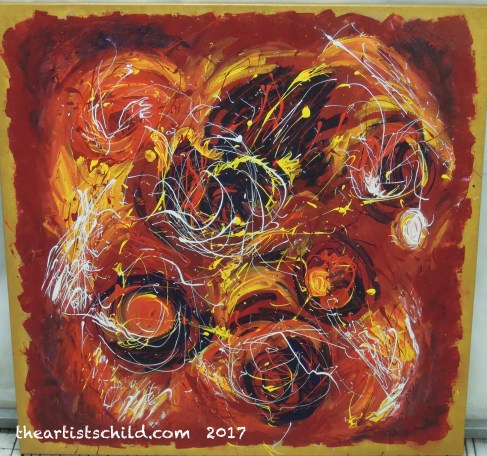
You can also use paint on canvas and just play around with the paint in a figurative or non-figurative manner.  This is just doodling on a larger scale and is a good way to stop getting precious about your work.  I did a painting like this not so long ago.  On a 30 x 30 inch canvas placed flat of the floor, I swirled around the paint with a brush or dripped it off a wooden chopstick.  This is not my normal way of working and it was fun be free and spontaneous.  I found it totally involving and the painting just evolved.  I still had to use my head and stopped before the paint became muddy and ended up with a painting I would be happy to hang on the wall.

Not everyone has a spare canvas lying around but if you want to use real paint without going to too much expense, you could use masonite board (a thin fibre board) as a surface.  I know there is suitable painting software for a tablet or a computer but it’s a more tactile experience working with real paint where you can create actual textures.  It’s also messier like a lot of things in life.  I had to cover the floor with plastic before I started and still managed to get it on my shoes but they were old ones. The dogs also wanted to help and nearly put their noses in the painting.  Many animals seem to like doodling with paint (chimpanzees, elephants).

Doodling can be an end in itself. Some artist’s have taken doodling to a whole new level, from pages in sketchbooks to huge artworks. Here is a link to some great examples.

creativebloq.com – Doodle Art

Doodling is a form of drawing that can be done anywhere and anytime.  From now on I will remember to doodle. When I’m on the phone, watching TV or when I just want the feel of a pen in my hand.  It’s good to remember that all art starts from making a mark.

Kat

Of Slaters, Microbes and Five-Headed Creatures


I was searching through a box of old papers when I came upon some very short stories that I wrote a long time ago.  I did these before we had a computer and the Internet.  I had typed them on an old manual Olivetti typewriter and had done some sketchy illustrations.  They are in a modern fairy tale style, with an absurd, macabre bent.


DSCN4070

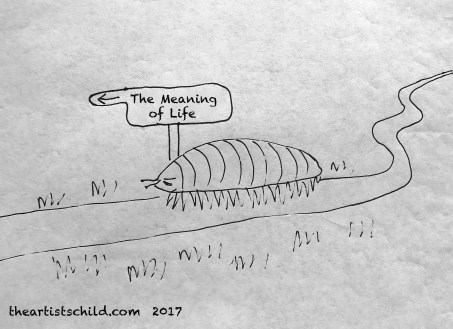
The Slater and the Meaning of Life (©theartistschild.com 2017)

Have you ever wondered about what also lives at the bottom of your garden besides fairies? What lives in those dark corners or under that rock?  Well, in one small garden rockery lived a slater named Wayne.

Wayne was a typical slater.  He liked to go out with the other slaters for a nice cool drink on a hot night or to lie under a damp rock and daydream.  Despite such an easy life Wayne was dissatisfied.  He wanted to know the meaning of life so he set out on his many slater legs to find it.

The first being he met in the grass beside the rock garden was a slug.  He asked the slug if he knew the meaning of life but the slug couldn’t speak “slater” and slithered on its way.

Next Wayne saw an ant scurrying along carrying the leg of some dead insect but he could not get its attention.  He became puffed trying to catch up and had to rest under a leaf.  Before he could move on a beautiful butterfly landed on the leaf.  Wayne looked up and asked it if it knew the meaning of life but the butterfly was more interested in enjoying the sunshine and told him to push-off.

Wayne plodded on through the grass until he came to a concrete plain and started across it.  At that moment the owner of the garden came driving in and ran over him.

The moral of this story is if you happen to be a slater, don’t become a philosopher.

The End.

DSCN4072

Microbes (©theartistschild.com 2017)

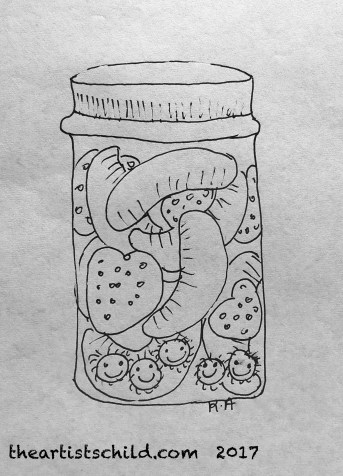
On a shelf in an old pickle jar lived a family of microbes.  They enjoyed feeding and doing microbe things in a sticky green residue of old gherkin.  This might sound quite boring but it was the ideal life for microbes and they were perfectly happy.

One day the person who owned the pickle jar decided to make some preserved fruit and she took the jar from the shelf and placed it in a vat of boiling water.  Of course the microbes were not particularly amused by this action so they put on their heat-resistant suits and went into suspended animation to await a time when it would be safe to enter the world again.

After what seems only a short time to us but an eternity to microbes, the jar was opened and its contents of preserved fruit poured into a bowl.  The temperature gauges on the microbe’s suits were activated and they awakened to find themselves floating in a fruit salad.

Now as this is not a television show or movie, no one came to rescue them and they became part of the dessert.  Unfortunately they were not exactly harmless either, and the poor people who ate them died a rather nasty death.  But the microbes lived happily every after.

The End.

DSCN4075

The Five-Headed Creature (©theartistschild.com 2017)

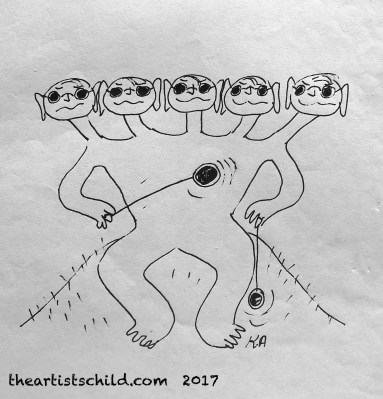
Once upon a time there lived a creature that had five heads so that it was always at odds with itself.  It would sit under a tree and discuss various things, like the theory of relativity and how to make a yo-yo spin.

One day it said to all of its selves that it would be nice to find a five-headed girlfriend.  It had no idea how to achieve this end so it wrote a letter to the local paper’s advice column and signed it five times just to make sure.

For a week the creature scanned the paper for an answer to the letter and finally it was rewarded for its efforts.  The columnist suggested that the writer of the letter needed his head examined and should visit a psychoanalyst as soon as possible.

The creature made an appointment with one found in the yellow pages after considerable argument with itself.  After a long period of treatment it was pronounced sound of minds if nothing else and was given a large bill, resulting in multiple headaches.

This story shows that while two heads may be better than one, five will mean more money spent on therapy, sunglasses and migraine tablets.

The End

It’s a good idea to keep all your early writing attempts, as it is fun to look back on what you have done and see how you have developed.  I’d forgotten how much I liked writing quirky little stories.  Life must have gotten in the way.

I also discovered a draft for a short story that I had left unfinished because I did not have enough confidence in my writing ability and started to doubt myself.  That old destructive self censor.  Reading it again I can see that there were some good things in that story so I think I will finish it.  I don’t like leaving anything uncompleted.

Don’t be afraid to go back to something that you have put aside in the past.  It might be better than you thought at the time.

Kat

The More You Know The Less You Know

dscn3987

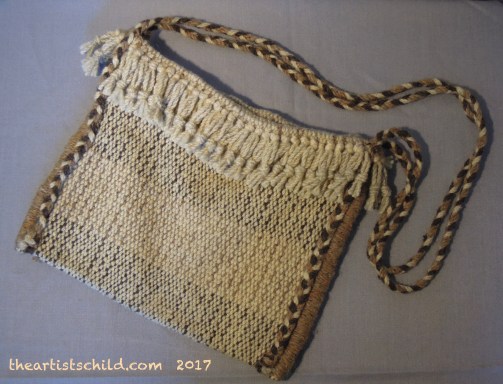
Woven bag: My first weaving project

You see an art or craft that looks relatively easy and fun to do so you give it a go.  Then you get into it and soon discover that there is so much more to learn and various avenues to pursue to gain more knowledge.   It’s a continual learning process and as with most art forms, it is usually a case of 10% inspiration and 90% perspiration to become really proficient at any creative discipline.

I was reminded of my creative journey into tapestry recently when I received a craft catalogue in the mail.  One of the products was an easy weaving kit.  This brought back the memory of how I started learning to weave that ultimately led me to study tapestry design.

In an old set of 1970s magazines called Golden Hands I saw instructions on how to make a frame loom to do simple weaving projects.  It peaked my interest enough to want to make the loom, which I did.  My fist project was a woolen Greek style bag, made by folding the woven fabric, sewing up the sides and knotting the warp threads to form a fringe at the top.  I attached plated shoulder straps.  It turned out quite well for a first project, but because I drew and painted, I wanted to learn how to do my own imagery in woven tapestries.

This involved more research and I bought a basic book to learn how to weave tapestries.  I modified the loom so that it was now a simple frame that I could use vertically with a clamp, rather than horizontally and bought a metal dog comb to beat down the weft threads, as recommended by the book.  At first my attempts were quite amateur because I was using a very basic technique and needed to learn more sophisticated methods if I was going to improve.

Luckily I saw an advertisement for classes at a local tapestry workshop and enrolled in a short course.  This was really helpful as it taught the methods used by the workshop and my weaving improved greatly.  I ended up doing a more advanced course there and I was hooked.  I was now able to weave from my own designs and the final results were much more proficient.

dscn3974

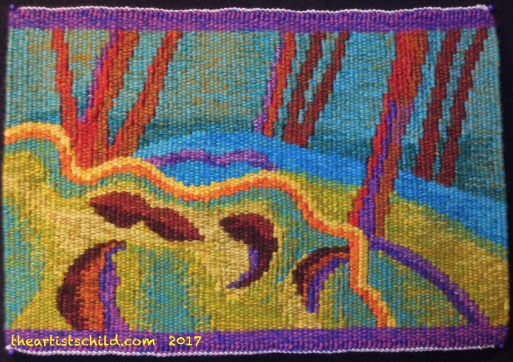
Tropical Rhythms: My first tapestry after completing the short courses

Ellie was also interested in textiles and I taught her what I had learned and she also got the tapestry bug.

But I still wasn’t satisfied and felt that I needed to learn much more to become highly skilled in tapestry design and production so, as previously mentioned in this blog, Ellie and I both enrolled in an Art course where we could major in tapestry.  It was a very practical course and we were constantly challenged to develop our skills and learn many new techniques.

From textures to interpreting complex designs, we had to continually stretch ourselves so that nothing was impossible to weave and were encouraged to develop as visual artists.  We took part in workshops with master tapestry weavers, both local and from overseas.  We learnt textile technology and how to dye wool, as well as occupational health and safety so that we did not poison or injure ourselves.  The only downside of doing a course is that sometimes you must do projects that do not always interest you creatively and this can take away some of the enjoyment.  But if you want to do this professionally you must learn that there are times when you might need to make compromises.

The course was quite intensive and after I graduated, I had to take a break from weaving. So did Ellie.  I have been doing other creative things, like drawing and painting, as well as music, but now I feel that I want to get back to creating small-scale woven tapestries and rediscover my love for the medium.  All because I received that catalogue in the mail.

What begins as a simple creative pastime can turn into a complex adventure.  To become really good at any creative discipline takes a lot of hard work and dedication.  It helps to have a never-ending thirst for knowledge, as there is always more to learn.  And even if, like me, you take a break and do other things, you can always return to your earlier passion with a fresh viewpoint.

Kat

Travel to the Past

dscn4027

When I need a holiday but haven’t the funds or enough time for a long trip, I like l to take a journey back to another time when life was slower and people enjoyed simple pleasures.  How to do this without a time machine?  Well I deploy our collection of vintage items and use them to create a fantasy of a long gone period.

As I have mentioned before in this blog, I love going on picnics.  But sitting on the uncomfortable ground fighting off ants is not always pleasant.  Why not go back to the mid 20th century, when you could sit in style anywhere with your folding picnic furniture to enjoy the great outdoors.  Back then a family or group of friends would load up the station wagon with all kinds of goodies and equipment and would go off to spend the day in the country.  It would have been a bit like a mini expedition without the dangers (if you exclude potential bushfires or snakes).

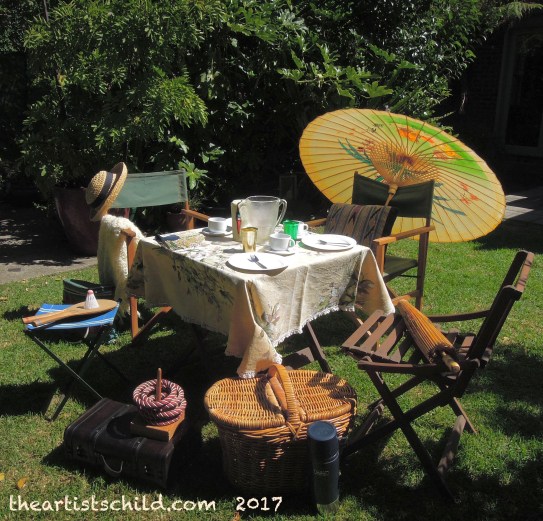
This type of picnic is something that I would like to recreate when the weather is not too hot.  Anyone can do this with a bit of imagination and not too much expense.  I set up our vintage picnic furniture and equipment on our back lawn to illustrate my idea for a mid 20th century picnic.  We have some old deck chairs, a folding stool; a folding wooden table and chair; a vintage linen table-cloth, old thermos and wine cooler; shuttlecock and quoits sets, all of which came from relatives.  The glass jug; aluminum beaker set; picnic basket and small wooden case were found at op shops (thrift or charity stores).  The umbrellas came from an Asian shop.

Just imagine a lovely country landscape with lots of trees (and nearby parking).  You set up your furniture and unpack your picnic basket in the shade.  It is a beautiful day with a slight breeze.  After a delicious lunch of gourmet sandwiches and salads served with cold wine or craft beer and delightful conversation with friends, you can indulge in a short walk or play a novel old-fashioned game of shuttlecock or quoits (or whatever game takes you fancy) or take a nap after reading a good book.  Then you have afternoon tea or coffee and cakes before you pack up for the journey home.

This is how I would like it to be, but it always pays to take the insect repellant, mobile phones and other mod cons just in case.  Resist the temptation to start Googling or checking your emails.  The whole point is to get away from 21st century stress and slow down a bit.

In Australia there are picnic race events in the country and you could attend one of these and have this type of picnic in style.  Appropriate clothing would complete the vintage feel.

There are even some people in Australia who live their whole lives in another era (Pia Anderson).  They dress in vintage clothes and live with objects and furniture from their favored period.  I think that this would take a lot of effort to do all the time and would not seem like a holiday after a while.  But whatever turns you on.

You could probably travel to other past times for a picnic theme.  Think medieval spit roast.  For this you would need a group of hungry people and no total fire bans.  A Roman banquet would be a bit more difficult.  Hard to find folding Roman couches but maybe a banana lounge would make a good substitute and there are always those portable shade cabanas or gazebos for a Roman tent if you have access to one.  These themes could be hilarious with a group of friends.

So next time you plan a picnic try something different.  Forget the modern minimalism of backpack convenience and go for a historical production for a fun way to visit the past.  There is nothing like a bit of escapist fantasy as a restorative.

Kat

The Garden Doll

dscn3965-1

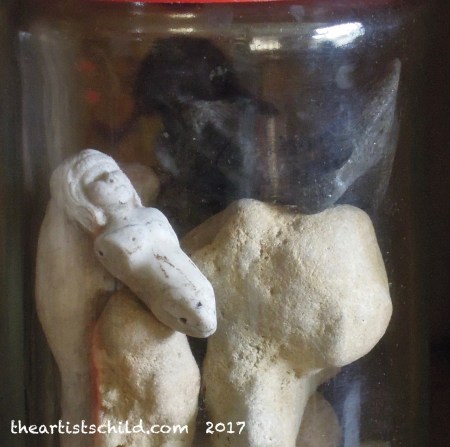
Sometimes inspiration can come from some object you have had hanging around your house for ages.  Suddenly you see it in a new way.  That is how I wrote this poem.

The Garden Doll

It was buried in our garden bed

A broken doll, no arms no legs

Ceramic torso, molded head

A cast-off toy, all that’s left


Some child’s treasure long ago

Now a relic, sad, alone

A doll’s house prop, without a home

Lost in the past, it’s owner gone


Once dressed and posed in make believe

It had a life, it talked, it breathed

Gave form to some girl’s fantasy

Her youthful hopes and joys to feed


It cannot speak, it cannot move

Story unknown, mystery imbued

Sits in a jar, a thing to view

The garden doll I never knew

(© The Artist’s Child, 2017)

Kat