The Broken Club and the Half Eaten Atlas

Interesting tales attached to objects are for me what gives them value. The more bizarre the better. The following is a poem inspired by two items and a family story.

The Broken Club and the Half Eaten Atlas

Safely kept were the tribal club and atlas

Left behind by a missionary man

Some friend of an ancestor

Then the club was broken in two

By one boy who

Used it to strike the floor

And the book found under the house

Half eaten by a rat or mouse

Last possessions of Gottlob Rembold

A resident of Sydney

Who went off to New Guinea

Or so I’ve been told

In the late 19th century

And was eaten by cannibals

©Theartistschild.com 2017

There is a story in our family that a German missionary left some of his possessions in storage with a relative.  The Aboriginal war club (waddy) and Stieler’s Schul Atlas are all that remain.  He was supposedly eaten by one of the New Guinea tribes of headhunters and this was why he never returned to collect his things.  The war club (broken by an uncle when young and mended with some waxed flax by me) is the type of weapon used to attack enemies in tribal battles.

While I am usually dubious about the veracity of such sensationalist tales, I think that the story is most likely true because it came from a branch of the family that was quite reliable.  They were very honest and practical and not the types to make up fanciful stories.   Ellie and I thought that we would investigate this further to see if there was any actual documentary evidence available.

The name Gottlob Rembold and a Sydney address are hand written in the Atlas.  We Googled his name and this has made the story stranger and more complicated.  In Sydney in 1881, a Gottlob Rembold at the age of 27 was charged with shooting and wounding his uncle in the chest with intent to murder.  Apparently this Gottlob was a young man from Germany, who came out to Australia in 1880 to live with his aunt and uncle, a farmer, probably after the death of his father.  There was a dispute about a large sum of money in a will that he claimed was his, but his aunt said it was left to her.  Gottlob also claimed that he had been mistreated since his arrival from Germany ten months before.  Gottlob was found guilty but the sentence was remitted with no reason given.  There is a prison photo of Gottlob but we can’t show it as it is subject to copyright and  only available to view by Ancestry.com members.  It is not a mug shot, but a normal studio portrait and he was a good-looking young man.

His was not a common name in Sydney at the time so it is surely the same person.  The atlas has a date of 1876 and this is when this Gottlob was 22 years old and might have been contemplating travel.  After his release from prison he could have gained assistance from a religious organisation and then decided to become a missionary.  Gottlob had been employed as a gardener so this was a change of direction.  Not that it did him much good.

Gottlob’s story is part of the rampant Western Colonialism that took place around the world in the late 19th and early 20th centuries.  Probably if Rembold had been a medical missionary or an Anthropologist he would have survived.  As opposed to some of hardline missionaries of the period, they tended to respect the host culture and were not perceived as a threat so usually lived to write about their experiences.  Gottlob must have made enemies if he had such a nasty fate.

Not all family stories are sweetness and light and the sad and bad characters can be just as inspiring as the heroic figures.  Was Gottlob a naive young man mistreated by his aunt and uncle or was he an opportunistic, murderous fortune hunter who turned to religion?  We will never know the whole truth about his end unless we can find a death certificate.  Without more information one can only imagine the mysterious and violent demise of the unfortunate Gottlob Rembold.

Kat

To lift a rather dark story the following is a live version of Rage Against the Machine’s protest song Killing in the Name by my favorite string quartet, Sydney group “FourPlay String Quartet.” They can really rock the strings.  Ellie and I saw them perform this same piece in concert and it was electric.  The members of FourPlay are all fantastic musicians and composers and their own music, while influenced by the past, is of our time.   In recent years they have collaborated in performance with Neil Gaiman.  Check them out on YouTube.
All Tied up in Knots

DSCN4266

Have you ever found yourself getting really angry at everything and everyone at the drop of a hat?  You bite people’s heads off for no apparent reason and completely overreact to the slightest provocation.  I find this happens to me when I am prevented from doing my creative work, either because there are other things that must be done or someone else is impinging upon my time and space.

Anger is not good for anyone’s wellbeing and can definitely affect you physically.  I get really tight muscles in the shoulders and neck when I’m tense and sitting at the computer for long periods does not help it.  If it gets too painful and I’m all tied up in knots I can’t work at all and painkillers are not something I want to take all the time.   Some people like to punch a bag and scream when they are angry but I find this just revs me up and makes me more agitated.  Trying to relax is more effective.  So is Arnica cream and a hot pack to stop the shoulder tension.

I read in Julia Cameron’s wonderful book The Artist’s Way that creative people who are blocked or prevented from doing what they love become very angry.  I have had periods when I have been unable do any creative work and was unbearable to live with.  I was doing a job to please others and not myself and it was making me miserable.  Luckily I realized that this was not where I wanted to be and did something to correct the situation.  I find that I am happiest when I am drawing or writing or singing and less likely to turn into the viper from hell.  The only downside is that it is harder to make a living in the creative fields, but that is my choice and I’d rather be happy and fulfilled than rich and grumpy.

Daily life can also lead to a lot of unnecessary angst. Some people just don’t get it when you are in your creative zone.  Lately I have been doing a lot of writing and have been working on a fantasy story and a science fiction story.  I find that I go off into another world while I am doing this and any interruptions are very annoying.  When you don’t live alone it can be difficult to get others to respect your space.  Although I have told members of the family that I’m am busy with my writing, they still seem to think because I am on the premises that it is OK to get me to respond to any questions or to interact with them.

I am at my creative peak in the afternoon and early evening and that is often when people want my attention. There is no door on the studio and anyone can yell up the stairs because they know I am there.  It drives me insane and breaks the flow of my writing.  I become extremely grouchy and have to resist the urge to throw something at the source of my irritation.  This is not great for the creative process or household harmony.  I’m afraid I am talking about sibling squabbles that can often become entirely unreasonable on both sides if not dealt with sensibly.

How to resolve this situation?  It is better if you can deal with the problem in a calm manner.  I do try to work when no one is around and then I can give others more time when I have finished my writing for the day.  This can be difficult because when I am are on a roll it is hard to stop.  Sometimes you just have to pace yourself and impose some kind of time restrictions. Stopping before meals is important to prevent family arguments.

It is often the case that the other person becomes angry because they are also feeling creatively frustrated and resentful when you are obviously getting on with your work.  It makes them feel left out as they wish they could be doing something similar themselves.  At these times it is not a good idea to go on about your work or they can be quite dismissive and not receptive to your thoughts.

The old “take some deep breaths and count to three before opening your mouth” is a very wise course of action when things become heated.  Just keeping your mouth shut can also diffuse a lot of explosive situations and walking outside is a good idea.  When I’m fuming I find the most effective method is giving my dog a cuddle because it is impossible to stay angry when you are being licked.

Anger is a destructive force and it does not pay to give it any energy.  It is better to put this energy into your creative pursuits.  Why waste time getting all worked up when you could be enjoying yourself doing what you love.  And remember that other people may also be creatively blocked which causes them to lash out at you when provoked.

It is not easy to stay calm when you are feeling harassed and being hindered from doing what you are passionate about but it is also important to live in harmony with others.  So next time you are about to explode because something or someone drives you crazy consciously stop yourself from going down the anger route.  Life will be so much more pleasant and productive.

Kat

Ecstatic about Eggs

DSCN4252

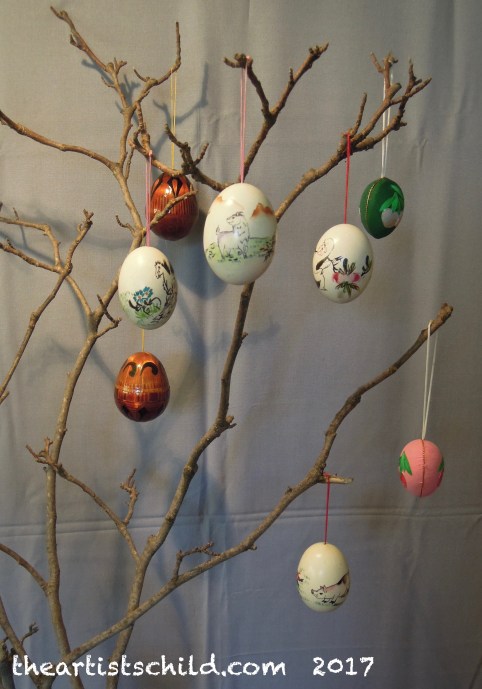
I love all types of decorative eggs.  You could say I’m eggstatic about them just like “Egghead” from Batman (aka Vincent Price) with all his bad puns.  Ellie and I have a small collection.  None of our eggs cost very much and many of them were gifts, as well as some being family heirlooms.  I have also decorated some and created one from scratch.

For many people the egg is a major symbol of Easter, of spring fertility and rebirth.  For kids it is about chocolate.  In many cultures it is also the cosmic egg in creation myths.  The egg is the ultimate symbol of creativity and has inspired many artist’s and crafts people to create beautiful objects.

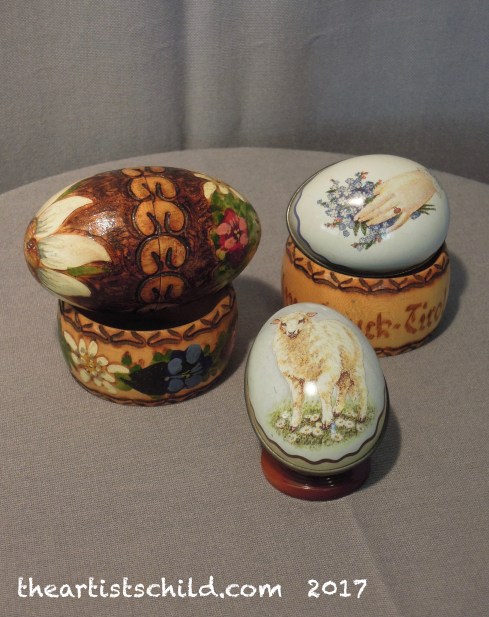
A collection usually begins with one object.  My parents had a Austrian poker work egg brought back from an overseas trip.  It opens up to form two egg cups and has matching napkins rings.  I was always fascinated by it’s decoration and shape so when I saw other interesting eggs on holiday or in op shops I would snap them up.

DSCN4216

Austrian poker work egg and Swiss tin eggs

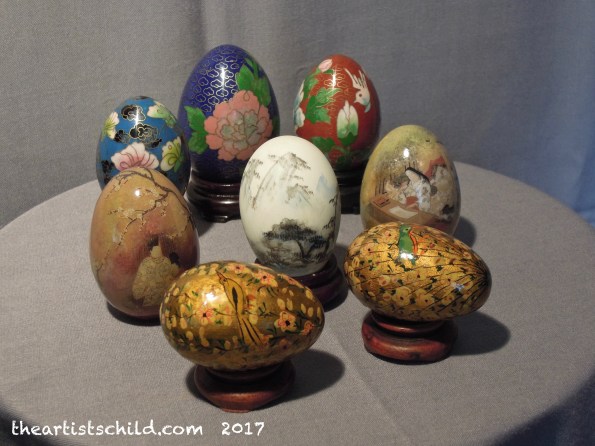
Some of our eggs have been brought back by family members from holidays overseas as gifts.  Our aunt gave us some cloisonné eggs from China and they came with little wooden stands.  I also had some old ones from a relative that are good for displaying eggs.  On a trip to Japan several years ago we also found some lovely decoupage eggs when visiting an exhibition at the Tokyo Museum that depict images from some medieval narrative scrolls.

DSCN4198

Chinese cloisonné eggs (back row),  Chinese painted real egg (centre),  Japanese decoupage eggs (left and right centre row) Chinese painted wooden eggs (front row).

Because Australia is so close to Asia it is easy to get Chinese eggs here.  Locally we found some real eggs that were painted with the Animals of the Chinese zodiac, like the horse and monkey.  These are quite fragile and need to be stored carefully.

There are also some Asian plant fibre eggs but I have forgotten where they come from as they were a gift.  Shows you should write things down at the time.

Old egg cups are good for displaying eggs.   We have a couple of vintage majolica ones from Italy: a turkey and a duck, as well as a later goose, all found at op shops.  These are quite fun and painted wooden eggs look great in them.

DSCN4213

Polish wooden eggs and Russian painted egg at back

DSCN4209

Russian wooden eggs

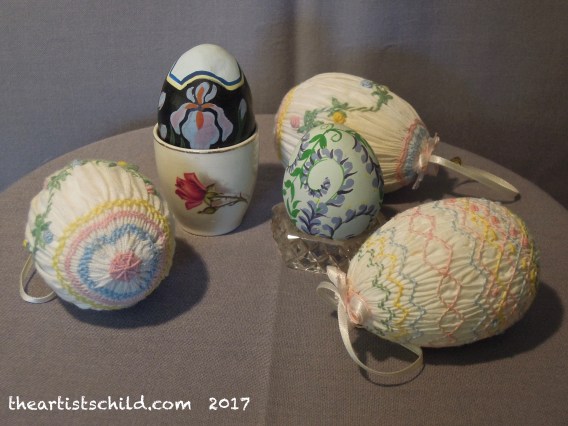
Old napkin rings are also good for displaying eggs.  They come in all sorts of shapes and materials and make an interesting collection of their own.  I also find large vintage buttons good for stopping eggs from rolling around.

Eggs come in so many different materials and can be an example of various crafts.  You can find interesting ones at local craft markets or specialist craft stores.

DSCN4224

Australian painted real eggs and Philippines embroidered fabric eggs

DSCN4231

Hand blown glass eggs

DSCN4206

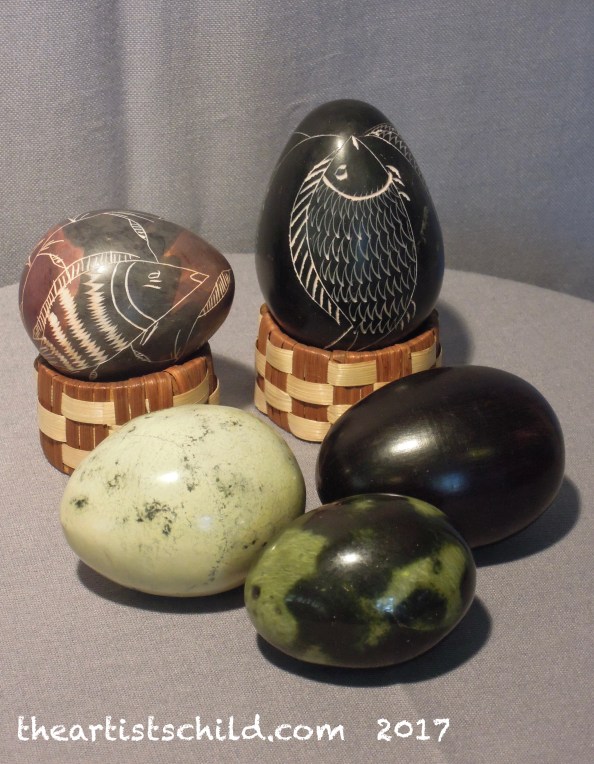
African stone eggs, two painted and hand engraved and a black wooden ebony egg

DSCN4227

Taiwanese Sodalite egg (left), orange simulated marble egg (centre back), Italian marble egg (right), my talc stone egg (front).

I had a go at sculpting my own talc stone egg.  This caused a great deal of dust and took a lot of sand paper to get the right shape.  I now appreciate how much effort it must take to shape and polish very hard stones.

One year I decided to paint some eggs as table decorations.  The most difficult part was blowing out the white and yolks.  Because I thought I would run out of breath, I used an air brush compressor with a syringe needle attached to the end of the tube.  With too much pressure the egg exploded so it was very tricky and messy.  The blown eggs were then coated with layers of acrylic paint and stippled with another colour to make a textured effect.  I added some gold dust left over from gold leaf that someone had given me and applied it with the varnish.  I think that the aqua ones look like real eggs.  The layers of paint has made them less fragile.

I have a real ostrich egg that I bought at the Melbourne Zoo shop ages ago.  There must have been an excess of eggs in their breeding programs.  Wonder if they made huge omelets.  There were holes in each end of the egg where they had blown out the innards.  These were rather large and not very attractive so I glued in some enamel flower earrings that I did not wear.  This is probably the closest I will get to anything like a Faberge enamel egg and the ostrich did most of the work.  It has such a beautiful creamy shell and is quite heavy.

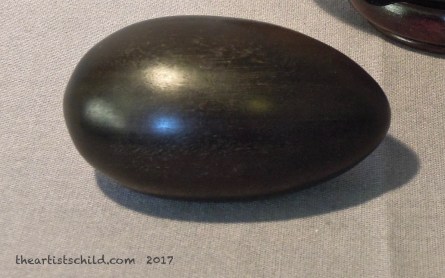
The following black egg is made from Australian post ice age river red gum found buried in the flood plains of the Murray River.  It is very much like Irish bog oak.  These ancient trees stopped growing about 5,000 years ago and the ancestors of todays indigenous Australians would have been around to see them growing.  This was a gift from a friend who knows the maker.

Version 2

The oldest manufactured egg in the collection is tiny.  It is a novelty made in Germany and sold in Melbourne in the late part of the 19th century.  The egg contains the “smallest doll in the world,” a little peg wooden doll that we inherited from a relative.  Unfortunately some long ago child had broken one of the arms because these are movable.  The limb was long gone.  I had to give it an arm transplant using a tiny piece of matchstick and glue (click on the pictures for detailed close ups).  This was really fiddly and I nearly glued it to my finger.  The doll looks a lot happier.

That’s our egg collection.  It is amazing how many creative ways there are to make decorative eggs and these are only a small sample.  It seems appropriate that a major symbol for creation should inspire all sorts of creative, eggceptional ideas.  Sorry, couldn’t help myself.

Kat

Autumn in the Garden

Daylight saving has just ended and we have turned back our clocks, but nature does things to its own schedule.  Our garden is in transition.  It is still quite green but the autumn colours and flowers, fruit and seeds are becoming more prominent as the temperature cools.  Today I took some photos because I wanted to record the seasonal changes.

The Japanese Nandina is now a lovely shade of red.  This came from our grandparents and we have had it in a pot for years.  It is a slow grower and has remained this size for ages.  Maybe it is now like a bonsai because the roots have nowhere to go.

We have two varieties of Plumbago, blue and white, and the flowers are still hanging in there.  They are very delicate and have a sweet nectar.  Because the flowers are so sticky the sometimes get all over the dogs, over your pants and sleeves and anything else that comes in contact.

There is a last bud on the Iceberg rose.  These hardy white roses do well in pots.  Unfortunately there is no fragrance.  Our Elephant Ears are looking very lush and have spread to other parts of the garden.  As long as it is shady they survive the summer.  Because we have a mild climate they usually don’t completely die down in winter and bring a bit of the tropics down south.

The Clivia now has wonderful red seed pods (photo left).  We need to watch that our young dog does not eat these.  Ellie planted some in pots so it will be interesting to see if these shoot.

The Chinese walnut tree is also covered in green walnuts (photo right).  When they start to split and the nuts fall to the ground it is a battle to see who gets to them first.  The dogs love to crack open the hard shells and make a mess inside.  I’m constantly yelling at them to go “outside” with the nuts.  Last year the dogs ate more nuts than were saved to dry.

I love the spiky red flowers on the bromeliads.  I think that they look like some creature from another planet.  You can almost imagine that they will suddenly extend from the plant and try to whack you like a type of creepy carnivorous plant.  These flowers last for a long time.

Although Aralia plants are evergreen (photo top left), in autumn some leaves turn a bright yellow then to brown before they fall.  You can see the seasonal transitions on one plant.

Because we do not often get frosts, a long time ago we put our potted Maranta (prayer plant) outside in a very sheltered spot behind some large pots (above photos bottom).  It has thrived although sometimes the purple spots fade in the brighter light of summer.

We also have a Wollemi pine in a large terracotta pot (photo top right).  It is one of the most ancient species of evergreen trees on the planet.  It a pine that also has characteristics of a fern.  We call ours “Wolly” because it is so special.  We plan to plant it in the ground so that it will reach its full height and will be protected by a large Melaleuca tree.  At the moment the tree has bent a bit so will need to put a stake to straighten the trunk.

After I took these photos the sun disappeared and it is now quite gloomy.  I think there is rain on the way and it really feels like autumn.  I’m glad that I made the most of the sun while it lasted, something that we should always remember.

Kat

Away with the Fairies

Often when I am creating I go into another imaginative place. I feel that I am in a world of my own creation, the place of daydreams.  It is a great space to be in when you are writing or doing some visual art.  But at times this ability to put myself into a story or travel with my mind has not been appreciated by others.

As a child I became easily lost in the world of make-believe.  I remember going to a scary play when I was about 5 and became very distressed because one of the characters terrified me.  I thought it was real.  I had to be taken out of the theatre.  It was on a school excursion and the head teacher was not impressed. She obviously had no imagination and could not understand why a little child might be frightened.  I also found the MGM lion very terrifying because it was so big and loud. I thought he was going to eat me and hid behind my hands.

In kindergarten another girl and I were totally involved in a game we were playing and decided not to go inside when the bell rang.  We went to an area where there was an empty water feature with rock formations and continued our game.  Then the drama started.  The teacher started calling our names and we knew we were in trouble and hid behind the rocks and did not come out.  Things started to escalate and more people were looking for us.  Eventually we reluctantly decided to face the music and got into a whole lot of trouble.  Our mothers had been called and as punishment we had to spend the rest of the afternoon in the principle’s office nervously giggling.  We were only little kids acting out our fantasies but the reaction of the adults was totally out of proportion because of their fears.

As I became older I spent a lot of time in school daydreaming through classes or dreary assemblies.  I think that I missed lots of vital information by drifting off into my own little world.  Luckily there was always art class.  I could always concentrate on my artwork or a good book or anything that engaged me.  My early school reports often had remarks like needs to make more of an effort or would do better if she paid attention and concentrated on the work.  Any tendency to let your mind wander was to be discouraged.

All my day dreaming never did me any harm.  In fact without it I never would have persisted at any art form.  Ideas don’t just fall into your lap without time spent musing.  You can’t change reality without first imagining something different.  The world probably would not have many inventions or great works of art and literature without lots of daydreaming on the part of their creators.   Questions like “What if I do this? What would happen if? How can I do that?” are often answered by daydreaming.

Nowadays I tend to daydream in the garden, watching TV or gazing out the window when I’m in the studio.  For this reason it is good to have some kind of view, especially if there is a bit of nature.  It is also easy to daydream under the shower or in the bath because the hot water is very relaxing.  The only problem is that you can’t write anything down and have to quickly dry yourself and find a notebook before forgetting the idea.  Often when you are in this state your mind flits around from one topic to another so it can be difficult to keep track of your thoughts. If I am in that frame of mind I take a notebook into the bathroom just in case.

For those of us who have chosen to follow the creative path, daydreaming is an essential part of the creative process and losing oneself in some imaginative place is not something to discourage.  Being able to transport yourself somewhere else mentally or transform yourself into another character is really helpful.  A moment flight of fancy can develop into a story or a series of paintings.  Never stop your mind from wandering or as my parents used to say, being away with the fairies.

Version 2

Away with the Fairies

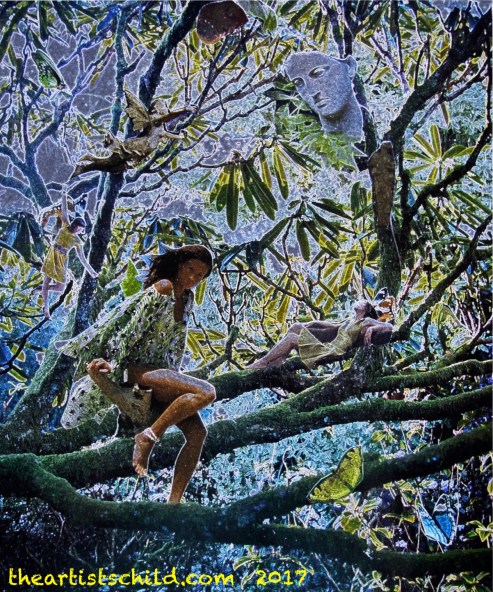
One midsummer night I dreamed

I’m in a tree far away

Visible in full moon light

I lie on branches with the fey

Faces glimpsed amongst the leaves

Figures hide behind the limbs

Bright beings with fragile wings

Stir the air and fan my skin

Some drift around me as I gaze

A whispered spell upon me cast

I finally slip out of the haze

To find my bliss at last

© theartistschild.com 2017

Daydreams can become reality so let yourself fly.

Kat

Here is one of my favorite day dreaming songs from the 70s.

Doodle All The Day

Recently I found some of my old doodles that I’d  done on odd bits of cartridge paper.  From a young age I used to doodle all the time.  In front of the TV, when sick in bed, in school books, on scrap paper, in magazines, then later in sketch books, in a doctor’s waiting room.  They tended to be random doodles and had nothing to do with my more developed artwork.  Usually of figures, animals, insects, pixies, fairy tale characters.  Just silly little things.  Amongst my rediscovered drawings there was also a coloured illustration that was developed from the little pixie doodles.  I stuck them all into a visual diary so that they won’t get lost or accidentally thrown out.

Throughout history people have doodled on different surfaces.  Apparently people did them on the edges of clay tablets in antiquity and who knows what can be found on the odd Egyptian papyrus.  Probably doodling became more common with the availability of paper, given that the earlier vellum, made from animal hides, was expensive and took a lot of effort to produce.  You don’t see many doodles on the pages of medieval manuscripts.

Often we discount little flights of fantasy like doodles, but they are a good way of getting ideas for a poem, a story, a larger work of art or illustrations.  I’d forgotten what fun you could have with a pen just aimlessly drawing.  I think I will put a sketchbook and pens in our family room out of the reach of the dogs so that I can doodle when I’m watching TV like I used to.  As long as it is not a foreign film with subtitles, then I won’t get too distracted.

Recent studies have discovered that doodling can aid memory and concentration.  Colouring books for adults have similar benefits and are very popular, but creating you own imagery is so much better.  You are not restricted by boundaries and can go all over the page wherever you like.  Even if you don’t think that you can draw anyone can doodle.  It could be patterns, little cartoons, or stick figures.  The whole point of doodling is to make a mark of some kind in a free manner.  You could start in the middle of the page, at the top or the bottom. There aren’t any rules.

Version 2

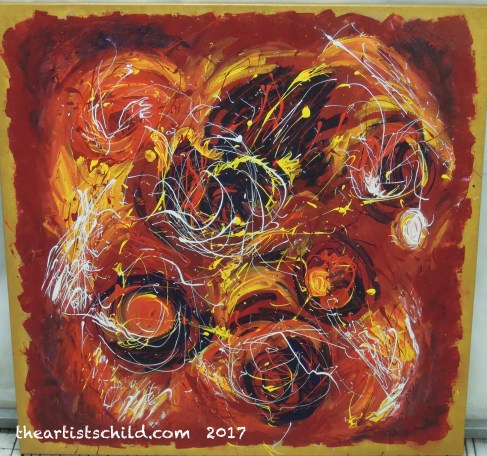
You can also use paint on canvas and just play around with the paint in a figurative or non-figurative manner.  This is just doodling on a larger scale and is a good way to stop getting precious about your work.  I did a painting like this not so long ago.  On a 30 x 30 inch canvas placed flat of the floor, I swirled around the paint with a brush or dripped it off a wooden chopstick.  This is not my normal way of working and it was fun be free and spontaneous.  I found it totally involving and the painting just evolved.  I still had to use my head and stopped before the paint became muddy and ended up with a painting I would be happy to hang on the wall.

Not everyone has a spare canvas lying around but if you want to use real paint without going to too much expense, you could use masonite board (a thin fibre board) as a surface.  I know there is suitable painting software for a tablet or a computer but it’s a more tactile experience working with real paint where you can create actual textures.  It’s also messier like a lot of things in life.  I had to cover the floor with plastic before I started and still managed to get it on my shoes but they were old ones. The dogs also wanted to help and nearly put their noses in the painting.  Many animals seem to like doodling with paint (chimpanzees, elephants).

Doodling can be an end in itself. Some artist’s have taken doodling to a whole new level, from pages in sketchbooks to huge artworks. Here is a link to some great examples.

creativebloq.com – Doodle Art

Doodling is a form of drawing that can be done anywhere and anytime.  From now on I will remember to doodle. When I’m on the phone, watching TV or when I just want the feel of a pen in my hand.  It’s good to remember that all art starts from making a mark.

Kat

Keys and Locks

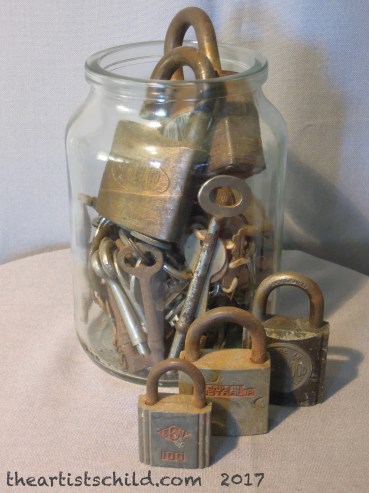
The world is full of keys and locks.  Having the right key is important if you want to be able to do something creative.   Without this key or keys you can find yourself locked out and unable to progress.  This can be very frustrating and not good for your creative spirit. Finding the key to achieving your aims is never easy.   I hope that the following suggestions may help.

Sometimes the key is learning a new skill.   If you don’t know how to do something that is vital to your creative area you will never progress.   I found this with tapestry weaving.  As I have mentioned in a previous post, there were certain tricks that had to be learned to be able to do weave anything I wanted so I did all I could to master these skills.  It always pays to keep acquiring knowledge in your field, as learning is a key to excellence.

Often the key is finding the right person or persons to help you and for joint or group collaborations.  It is often difficult to get anywhere without connections and support.  “No man (or woman) is an island”, as the saying goes so don’t isolate yourself.  In any creative field working with others can expand your opportunities and is much more enjoyable. With music Ellie and I belong to a ukulele group.  It is a place where we can play and learn together, as well to gain support for each other’s song writing and performance.  This type of help is very important for anyone working in a creative field and it is good to join industry support organizations where you can get advice and assistance.

Another key to doing well in your creative field is gaining experience.  There are many ways to do this.  Volunteering for a local community group.  This will probably mean working for free, but it also means that if you are new to the field, organizations are less likely to turn you away.  Our ukulele group has performed for community groups and at a festival for free and it has helped us gain experience with live performance. I also volunteered before getting a job in a creative field.  I paid my dues by working voluntarily for over a year in various organizations before I gained a full time job.  The work experience made the difference.

I think that a major key is to make sure that you enjoy what you are doing. Without that element of fun it is harder to be produce fresh and innovative work.  Maintaining enjoyment may sound easy but when you are doing something all the time it can sometimes become repetitive and lose the fun aspect that attracted you in the first place.  So you need a way to keep feeling excited.

In this regard other committed, enthusiastic people are invaluable.  Talking with your fellow creatives can give you more motivation. Looking at the work of creative bloggers is also very inspirational.  So is doing a blog of your own.  Taking some creative classes to get out and mix with others can revive your interest.  I have been thinking about doing some life drawing in the winter because I am a bit rusty in this area.  It is something I don’t do all the time and will improve my skills, as well as get me out with other artists and stop me from stagnating.

DSCN4092

So don’t feel like you’re stuck and getting nowhere. There is a key for every lock. You just need to find it.

Keys without locks

Locks without keys

Not meant to stay closed

Forever to freeze

Work out the secret

Find the right key

Open the door

A new world, a fresh breeze

(©theartistschild.com 2017)

Kat

Of Slaters, Microbes and Five-Headed Creatures


I was searching through a box of old papers when I came upon some very short stories that I wrote a long time ago.  I did these before we had a computer and the Internet.  I had typed them on an old manual Olivetti typewriter and had done some sketchy illustrations.  They are in a modern fairy tale style, with an absurd, macabre bent.


DSCN4070

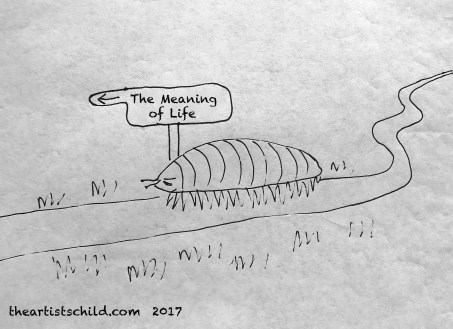
The Slater and the Meaning of Life (©theartistschild.com 2017)

Have you ever wondered about what also lives at the bottom of your garden besides fairies? What lives in those dark corners or under that rock?  Well, in one small garden rockery lived a slater named Wayne.

Wayne was a typical slater.  He liked to go out with the other slaters for a nice cool drink on a hot night or to lie under a damp rock and daydream.  Despite such an easy life Wayne was dissatisfied.  He wanted to know the meaning of life so he set out on his many slater legs to find it.

The first being he met in the grass beside the rock garden was a slug.  He asked the slug if he knew the meaning of life but the slug couldn’t speak “slater” and slithered on its way.

Next Wayne saw an ant scurrying along carrying the leg of some dead insect but he could not get its attention.  He became puffed trying to catch up and had to rest under a leaf.  Before he could move on a beautiful butterfly landed on the leaf.  Wayne looked up and asked it if it knew the meaning of life but the butterfly was more interested in enjoying the sunshine and told him to push-off.

Wayne plodded on through the grass until he came to a concrete plain and started across it.  At that moment the owner of the garden came driving in and ran over him.

The moral of this story is if you happen to be a slater, don’t become a philosopher.

The End.

DSCN4072

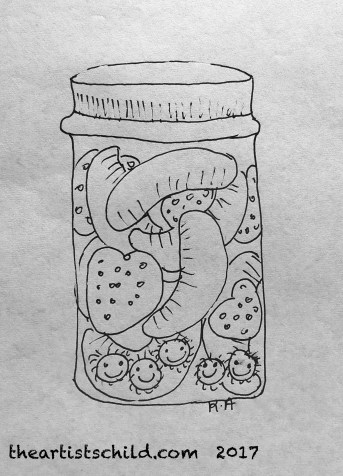
Microbes (©theartistschild.com 2017)

On a shelf in an old pickle jar lived a family of microbes.  They enjoyed feeding and doing microbe things in a sticky green residue of old gherkin.  This might sound quite boring but it was the ideal life for microbes and they were perfectly happy.

One day the person who owned the pickle jar decided to make some preserved fruit and she took the jar from the shelf and placed it in a vat of boiling water.  Of course the microbes were not particularly amused by this action so they put on their heat-resistant suits and went into suspended animation to await a time when it would be safe to enter the world again.

After what seems only a short time to us but an eternity to microbes, the jar was opened and its contents of preserved fruit poured into a bowl.  The temperature gauges on the microbe’s suits were activated and they awakened to find themselves floating in a fruit salad.

Now as this is not a television show or movie, no one came to rescue them and they became part of the dessert.  Unfortunately they were not exactly harmless either, and the poor people who ate them died a rather nasty death.  But the microbes lived happily every after.

The End.

DSCN4075

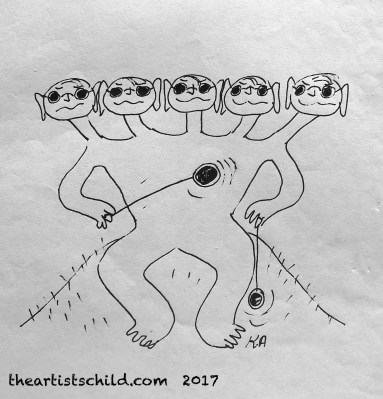
The Five-Headed Creature (©theartistschild.com 2017)

Once upon a time there lived a creature that had five heads so that it was always at odds with itself.  It would sit under a tree and discuss various things, like the theory of relativity and how to make a yo-yo spin.

One day it said to all of its selves that it would be nice to find a five-headed girlfriend.  It had no idea how to achieve this end so it wrote a letter to the local paper’s advice column and signed it five times just to make sure.

For a week the creature scanned the paper for an answer to the letter and finally it was rewarded for its efforts.  The columnist suggested that the writer of the letter needed his head examined and should visit a psychoanalyst as soon as possible.

The creature made an appointment with one found in the yellow pages after considerable argument with itself.  After a long period of treatment it was pronounced sound of minds if nothing else and was given a large bill, resulting in multiple headaches.

This story shows that while two heads may be better than one, five will mean more money spent on therapy, sunglasses and migraine tablets.

The End

It’s a good idea to keep all your early writing attempts, as it is fun to look back on what you have done and see how you have developed.  I’d forgotten how much I liked writing quirky little stories.  Life must have gotten in the way.

I also discovered a draft for a short story that I had left unfinished because I did not have enough confidence in my writing ability and started to doubt myself.  That old destructive self censor.  Reading it again I can see that there were some good things in that story so I think I will finish it.  I don’t like leaving anything uncompleted.

Don’t be afraid to go back to something that you have put aside in the past.  It might be better than you thought at the time.

Kat

Bags of Creativity

DSCN4035

In this world of mass production I love handmade things.  They tell the story of their creation and continue the skills and traditions valued by the people who made them.  I have a collection of handmade bags and purses from the past and the present.  They are examples of textile crafts that require time and effort to produce and reveal the various ways different cultures embellish utilitarian objects.

Some of my little bags came from ancestors and old family friends.  They were produced in the early part of the 20th century when ordinary women had more time to make their own clothes and accessories and they learnt various crafts that are now usually practiced by artisans and keen hobbyists.  Other more recent bags and purses in my collection are examples of the textile crafts of other countries that are still being created in villages and towns today.

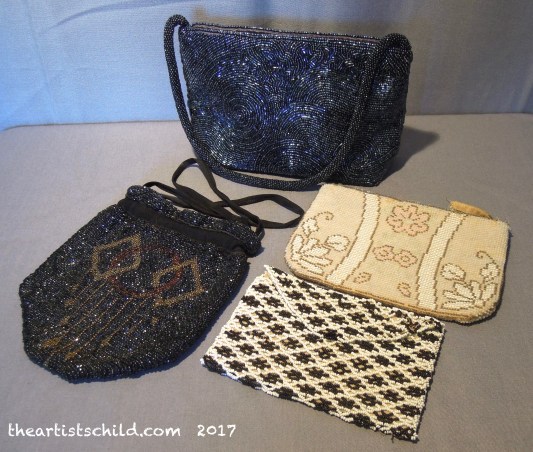
The black beaded evening bag and two rectangular purses were made in the 1920s and 30s by an old family friend.  She must have spent hours sewing or weaving the tiny beads into art deco style designs that were fixed to the fabric backing.  Women’s eveningwear would have been an added expense in those days, especially around the time of the Great Depression and many women made their own party clothes and accessories.  They probably got ideas from overseas fashion magazines.  When I look at these I can hear the sound of jazz bands and the clinking of martini glasses and see couples dancing in their finery.  Such objects remind us that the owners were once young and enjoyed going out to parties and other celebrations.

DSCN4061

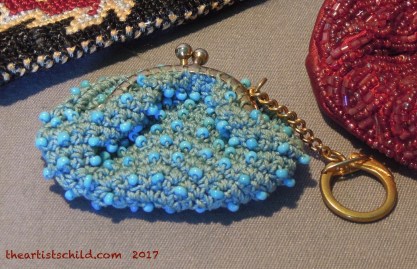
Japanese Crochet Beaded Purse, 1960s

I also have a small vintage 60s beaded crotchet purse from Japan.  This type of Japanese beadwork was popular in the 50s and 60s for bags and purses.  You can find lots of examples for sale on the web. It seems to have been a common Japanese style of beading and purse shape. These tiny purses were widely produced and are still being made today. I like its miniature size and design. It must take a lot of patience to do such fine, fiddly work and to fit on the small beads while working with a crotchet hook.

Beaded bags are still admired in the 21st century and new ones are readily available.   I have a grey beaded evening bag made in china and a small red beaded purse from India, where handicrafts are still common and are created for a wider market.  There are also many obsessed independent crafts people who create their own beaded purses for sale online.  It is good that this time-consuming craft has not disappeared.  There is something magical about the way light catches on the surface of the beads.  It is like miniature mosaic.

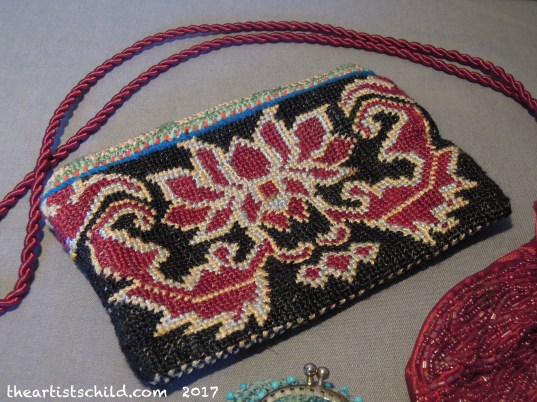
Another popular craft of the past and present is needlepoint.  I have had a go at this with cushion and picture kits and it is a slow and relaxing pastime.  Before these kits became commonplace women would use unmarked canvas to create their own designs or could purchase graph style patterns to copy.  Of the two bags that I possess one is a combination of petit point and standard needlepoint and the other consists entirely of petit point.  An ancestor created the former in the 1930s and the latter is an example of Austrian petit point, possibly from the 1950s.  One can only imagine the eyestrain caused in stitching such fine needlework, especially before the availability of magnifiers with lights.  Austrian bags like this are still made today but are extremely expensive because they are so detailed and slow to produce.  Anyone who does this painstaking work deserves to be paid well. Luckily there are still plenty of vintage bags available for a reasonable price for those of us with limited means.  I sometimes wonder where the owners took these bags; from the theatre in the 30s to concerts in Vienna in the 50s, it seems a world away from our modern life today.

DSCN4045

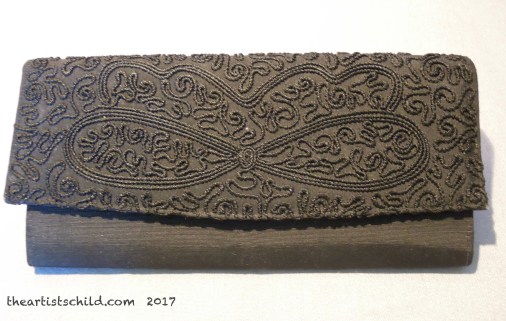
Hand Embroidered Silk Evening Bag, 1950s

Other types of embroidery were applied by hand to mid-century bags.  The stylish 1950s black silk clutch in my collection has very fine couching embroidery on the top flap. Nowadays a soulless machine would be employed do this type of detailed embroidery.  This purse reminds me of Audrey Hepburn’s elegant style in a Breakfast At Tiffany’s.

DSCN4051

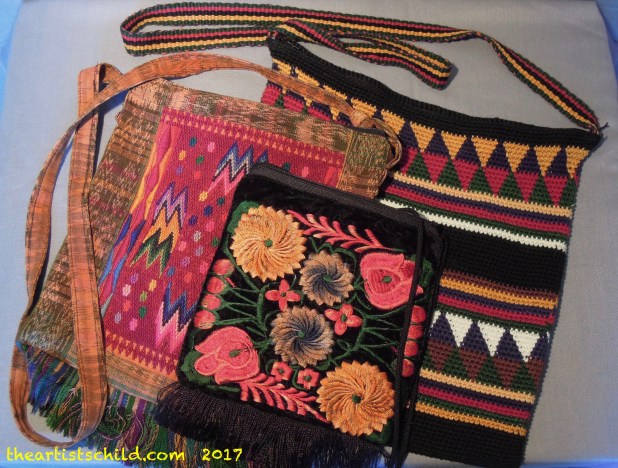
Embroidered and Crocheted Guatemalan Bags

Buying craft items made in another culture helps to keep the local textile traditions alive.  I have three bags from Guatemala that demonstrate examples of different textile crafts. From woven fabric and rich embroidery to crotchet, these decorative bags represent the work of individual Guatemalan women.  An ordinary bag is turned into a joyous expression of their creativity.  I love their use of color and texture and when I carry these bags, they make me feel happy.

DSCN4060

Iroqui Uzbek Cross Stitch, Uzbekistan

A small handmade cosmetic purse that I use all the time comes from Uzbekistan in central Asia.  It is an example of Iroqui cross stitch, a traditional craft of the Uzbek tribe which uses silk thread.  Equally colorful yet so different from the Guatemalan textiles, this purse belongs to the stylized aesthetic you associate with the central Asian communities along the legendary Silk Road.

At a time when computer technology is giving humans less to do manually in the workplace, it is good that there are still some things where a machine does not produce the best result.  Automated textiles just don’t have the same character as those created by hand.  It is the imperfections that make them unique and visually pleasing.  No wonder so many people are rediscovering old crafts for their own pleasure or to sell on-line.

My small collection of handmade bags and purses display craft traditions from several continents that span nearly a century.  It is wonderful to see the varied methods that have been employed in their creation and decoration. I really admire the patience and ability of the makers of these objects. They have transformed what is just a receptacle for carrying around ones possessions into expressions of their creativity and concepts of beauty.

Kat

Travel to the Past

dscn4027

When I need a holiday but haven’t the funds or enough time for a long trip, I like l to take a journey back to another time when life was slower and people enjoyed simple pleasures.  How to do this without a time machine?  Well I deploy our collection of vintage items and use them to create a fantasy of a long gone period.

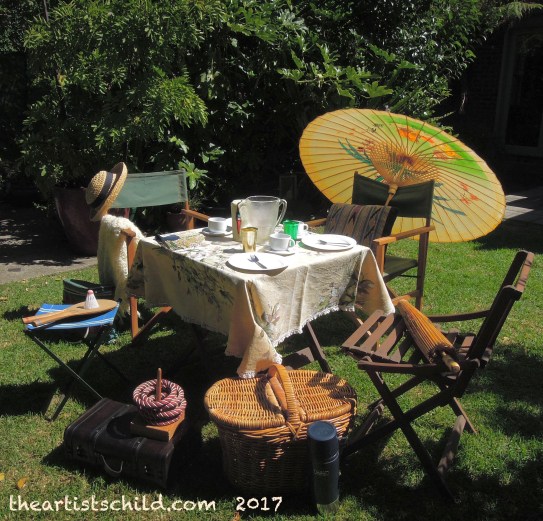
As I have mentioned before in this blog, I love going on picnics.  But sitting on the uncomfortable ground fighting off ants is not always pleasant.  Why not go back to the mid 20th century, when you could sit in style anywhere with your folding picnic furniture to enjoy the great outdoors.  Back then a family or group of friends would load up the station wagon with all kinds of goodies and equipment and would go off to spend the day in the country.  It would have been a bit like a mini expedition without the dangers (if you exclude potential bushfires or snakes).

This type of picnic is something that I would like to recreate when the weather is not too hot.  Anyone can do this with a bit of imagination and not too much expense.  I set up our vintage picnic furniture and equipment on our back lawn to illustrate my idea for a mid 20th century picnic.  We have some old deck chairs, a folding stool; a folding wooden table and chair; a vintage linen table-cloth, old thermos and wine cooler; shuttlecock and quoits sets, all of which came from relatives.  The glass jug; aluminum beaker set; picnic basket and small wooden case were found at op shops (thrift or charity stores).  The umbrellas came from an Asian shop.

Just imagine a lovely country landscape with lots of trees (and nearby parking).  You set up your furniture and unpack your picnic basket in the shade.  It is a beautiful day with a slight breeze.  After a delicious lunch of gourmet sandwiches and salads served with cold wine or craft beer and delightful conversation with friends, you can indulge in a short walk or play a novel old-fashioned game of shuttlecock or quoits (or whatever game takes you fancy) or take a nap after reading a good book.  Then you have afternoon tea or coffee and cakes before you pack up for the journey home.

This is how I would like it to be, but it always pays to take the insect repellant, mobile phones and other mod cons just in case.  Resist the temptation to start Googling or checking your emails.  The whole point is to get away from 21st century stress and slow down a bit.

In Australia there are picnic race events in the country and you could attend one of these and have this type of picnic in style.  Appropriate clothing would complete the vintage feel.

There are even some people in Australia who live their whole lives in another era (Pia Anderson).  They dress in vintage clothes and live with objects and furniture from their favored period.  I think that this would take a lot of effort to do all the time and would not seem like a holiday after a while.  But whatever turns you on.

You could probably travel to other past times for a picnic theme.  Think medieval spit roast.  For this you would need a group of hungry people and no total fire bans.  A Roman banquet would be a bit more difficult.  Hard to find folding Roman couches but maybe a banana lounge would make a good substitute and there are always those portable shade cabanas or gazebos for a Roman tent if you have access to one.  These themes could be hilarious with a group of friends.

So next time you plan a picnic try something different.  Forget the modern minimalism of backpack convenience and go for a historical production for a fun way to visit the past.  There is nothing like a bit of escapist fantasy as a restorative.

Kat