Memories: Your Own Creative Database

We all have memories of past experiences that give us pleasure or haunt our dreams.  Our memory is a wonderful resource that can inspire artwork.  It is a way to relive a happy moment in your life by transferring the feelings of joy and wonder into something new and tangible.  Or to use a bad experience and transform it into another form so it no longer has any power to cause too much grief, or at least lessens the impact.

Memories can provide inspiration for both realistic or fantasy works.  Some great literature and art has been created from artists and writers using memory as their starting point.  Just a few examples include Charles Dickens use of his early life as a basis for David Copperfield; Harper Lee’s To Kill a Mockingbird based upon her childhood experiences in a small southern town; and the painter Marc Chagall’s beautiful and dreamlike imagery inspired by the scenery of his childhood in Belarus, part of Russia at the time.  We all have our own memory vault full of unique episodes and images from life that can trigger the imagination and lead us in all kinds of directions.  You never know what will surface.

Sometimes unpleasant memories require a creative solution so that you can move on.  I had a bad experience with someone on a bushwalking trip who was a bully.  I effectively dealt with the situation at the time, but it still came back to give me some anxiety and put me off bushwalking with complete strangers.  I decided to turn the episode into a series of tapestry designs and have fun with my anxiety and fear.  I also wanted to create a sequence where the girl is no longer the victim, so I created a bogeyman who gets his comeuppance. My two favorite images of the series are where the girl is frozen with fear in a protective egg, while the masked bogeyman stands over her (Overcome by Fear) and then after he is reduced in size and she sprays him with insecticide (Overcoming Fear).  Creating these designs made me laugh and feel a lot better.  If you reduce you anxieties to a manageable size they can no longer affect you and you can stomp on them like a bug (that is in the series as well).

Happy memories are usually the ones you treasure the most, especially those relating to childhood.  When it is impossible to go back and visit people and places long gone, the only thing you can do is to recapture and bring them back to life through art or writing.  My grandparents lived on Melbourne’s Yarra River, with an orchard that stretched down to the river’s edge.  It was like visiting the bush with the eucalypts and wildlife, which were part of the river’s ecosystem.  Looking back with some nostalgia I wrote some short poems that try to capture a child’s uncomplicated memories of that place.
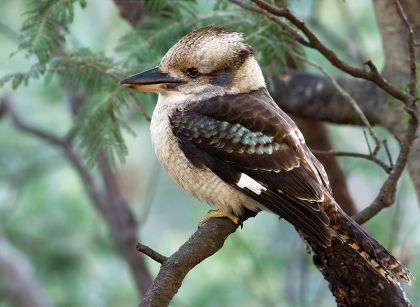
800px-dacelo_novaeguineae_waterworks

Kookaburra (photo by JJ Harrison, 2010,Wikimedia Commons )

By the River

Kingfisher by the Yarra

Watching the still water

Looking for fish

In a log by the river

Tiger snake likes to slither

Better not sit

© The Artist’s Child, 2017

800px-eastern_tiger_snake

Tiger Snake (photo by Teneche, 2010, Wikimedia Commons)

There were only two rules that Ellie and I had to obey when visiting our grandparents. Don’t go near the river’s edge and watch out for snakes.  A Tiger snake had been found asleep in the living room fireplace when my mother was a child. One was sleeping under a log near the river when we were children, and we were kept well away.  As these snakes are deadly, we did not ignore this rule, although I never actually saw one.  In fact I have never seen any snake in the bush at all, probably because I stomp and make some noise so they will hear me coming and disappear.  Or I have just been lucky.

The Laughing Kookaburra, a type of Kingfisher, would steal the goldfish from my grandfather’s fishpond, so he placed a removable steel grill over it.  We would hear them laughing in the trees and it always made you want to join in.
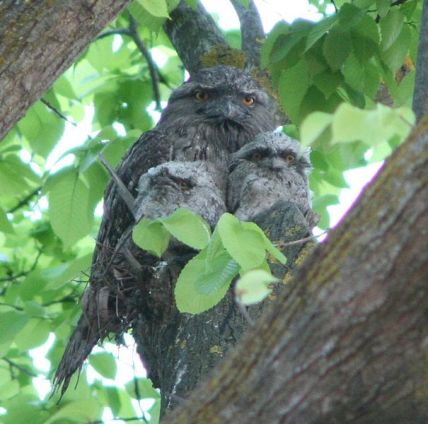
605px-tf_eos400_6318x800

Tawny Frogmouth Mother and Chicks  (photo by Alan U Kennington, 2011, Wikimedia Commons)

Frogmouths

Three baby Frogmouths

Small bumps in a gum tree

Impossible to see

Then one blinks

Illusion broken

Unlike mother, frozen totem

© The Artist’s Child, 2017

The Tawny Frogmouth is a member of the Nightjar family.  Their tawny feathers act as camouflage in trees.  In one of the orchard eucalypts grandfather pointed out a delightful family of Frogmouths to us as children.  The babies had yet to learn the art of staying completely still like their mother, and would move their heads to look at us.

Bellbirds

Bellbirds ringing, singing

In the river valley of childhood

How they echo in my memory

© The Artist’s Child, 2017

This is probably what I remember and miss most about being down by the Yarra.  The constant calls of the Bellbirds or Bell Minors. Some people find their calls annoying but I find them soothing.  It was hard to believe you were in the middle of a city.

Here is a You Tube video that will give anyone unfamiliar with these birds a sense what it is like to be in their environment.

Everyone has a fantastic database full of memories and it is good to get that retrieval system working.  Once you start delving you will remember all kinds of things that can inspire, disturb or make you laugh and these can feed your creative work.

Kat
Art Studios and Ordered Chaos

Version 2

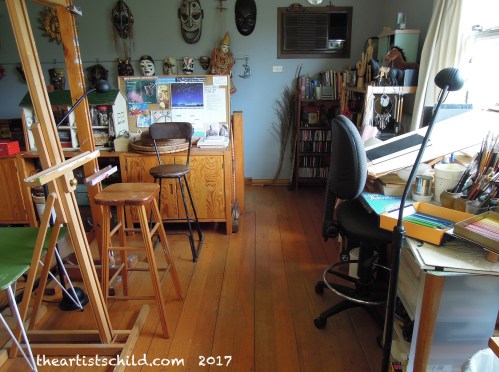
I love viewing images of Artist’s studios so I thought I would share ours as it might give others some ideas.  I follow the principle of “ordered chaos”(yeah I know this is an oxymoron), where in the studio I have a lot of tools, supplies and reference material and it is arranged so that I can find things when I need them.  This is not to say that the system is perfect, as sometimes I do forget where something is, but most of the time it works.  I could never be a minimalist and would find this too restricting, yet a complete mess would drive me insane.

Recent studies (Why Creative People Have Messy Homes ) have argued that messy people are more creative than the extremely tidy.  To a certain extent I would agree with this idea, but I also think that if you can’t find anything and have no space to work it just makes you stressed, which hinders creativity.  If you have to spend hours looking for something or continually moving things on a desk to make space, it is a waste of your precious time and energy.  As with all things it is good to have some balance.

The secret to ordered chaos is that you have close at hand things you use regularly and store those not used often in an accessible place.  I also keep related items together and this makes it easier to locate individual articles, as well as being more aesthetically pleasing.

The key to this system is that you need a lot of storage.  This way I can house a lot of stuff without going crazy and becoming buried like a chronic hoarder.  For this purpose the studio has a mixture of second-hand and modern furniture, the latter coming mainly from a chain store (and parents).  The largest pieces are high pine shelves and a bench with cupboards underneath.  Flat pack style shelving was necessary, as the studio is on the second story and you cannot fit large furniture up the stairs.  There are some smaller shelves, a bookcase and assorted trolleys and tables.

The large shelves hold lots of storage boxes, baskets and containers full of art materials, tapestry wools, weaving and sewing materials, tools and memorabilia.   As well as the doll’s house and toy wardrobe mentioned in previous posts (17 Oct and 21 Nov, 2016), there is also a toy dresser that houses a tin collection and several vintage suitcases and a hat tin to store items.  On the stairwell wall is a multi-cultural mask collection, with a couple we made ourselves (very difficult to hang as you teeter over the void).  A bamboo screen hides the narrow shelves used to store canvases and other artworks.  There is a roof storage area off the studio for extra equipment that is not used often.

On the large table is an easel with a drawing board and all the tools you would need, like brushes and pencils.  Under the table is a drawer unit that contains art materials.  Next to this is a wooden boot drying rack, found at an op shop, that now holds paper and folios. It’s fun to find a new use for something that no longer serves any purpose.  Plastic storage bins on wheels fit under the table and computer desk so no space is wasted.

The advantage of having a studio separated from the living area is that there is room to make a creative mess and you can leave project materials where they are until you are ready to work on them again.  Ellie has a small study for computer work and drawing and uses the studio for painting and textiles.  In the latter, areas are set aside for different types of work, from writing, drawing and painting to sewing and tapestry weaving.

In a studio you can store a lot of things that otherwise would be chucked out.  Things that are great for inspiration, like natural objects, old toys and items collected from op shops.  As a creative individual it is common to see potential for artistic applications in items others view as rubbish and there is a danger of becoming an obsessive hoarder.  It is important to be selective with what is kept otherwise it could become unmanageable, so every now and then redundant stuff needs to get thrown out to be recycled, if possible.  But I admit this can be difficult.

Due to lack of space in the house, an old exercise bike and some hand weights are kept in the studio, which is not ideal.  And there is a clothes drying rack used in colder months on the other side of the room, out of view in the photos.   Sometimes it can feel a bit like a laundry.  All the stuff in the room does takes up a lot of the floor space, but as most of the furniture is light or has wheels, it can be moved aside when necessary.  It’s just a case of being flexible.

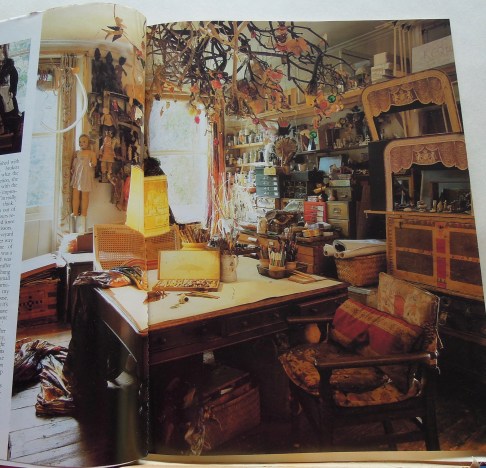
Storage seems to be a common problem for artists and some of those who I admire work in some sort of organized chaos.  In a thirty-year-old magazine I found an article about the brilliant London theatre designer and artist, Yolanda Sonnabend, who died in 2015.  Her studio was full of wonderful old distressed furniture and lots of fascinating and creative storage units.  It was cluttered, but not a chaotic mess and full of unusual and interesting objects.  There was even a dead tree hanging from the ceiling.  Here is a photo of the magazine page.

Version 2

Yolanda Sonnabend’s Studio, The World of Interiors, June 1984

Local Melbourne artist and living treasure,  Mirka Mora, also has a wonderfully cluttered studio with lots of interesting artifacts and furniture.  She wrote an inspiring book called Love and Clutter (Viking, 2003) about the memories associated with the various objects in her collection.   It is full of great photos of her studio.  Here is a link to an interview that she did about her life and work, with many pictures of her workspace:

thedesignfiles.net – interview with Mirka Mora

Everyone needs a place for creative play and if you don’t have a whole room that should not be a hindrance.  Even if you only have one living room you can create a corner workspace on a table or desk.  All is needed is a work surface and good lighting.  For really messy work there is nothing better than a car port or garage and if you live in an apartment you can drape a table with plastic sheeting.

With limited space you would probably need to be quite organized with the storage of materials otherwise it would be difficult to work effectively.  Because Ellie and I have several fields of interest this requires more storage space, but if you only use one or two mediums you would not need so much stuff and a simple shelving or drawer system might be all that is necessary.

It is possible to have a balance between order and chaos in your workspace without any extreme tidiness or messiness that could hamper creativity.  But that is just my opinion and it all comes down to what works for you.

Kat
For a further fix on creative people’s workspaces go to wheretheycreate.com

Creativity with Junk, Mallee Roots and Were-Rabbits

dscn3270

Everyone has broken or discarded stuff.  Sometimes these things are too interesting to throw away.  I turn metal, wooden, concrete or ceramic pieces of junk into unique assemblages for the garden.

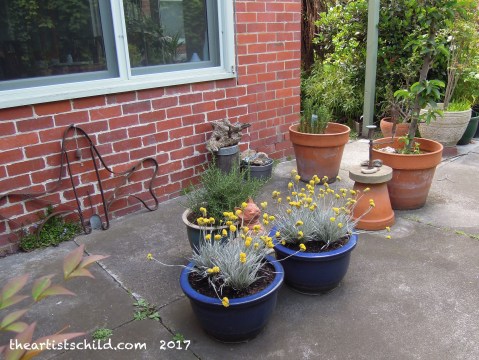
In the early spring, my sister Ellie and I decided to put some potted plants on the concrete area beside our rear driveway to dress up a bleak spot.  This made a difference, but the red brick wall under our family room windows looked too bare.  It needed something interesting to detract from the boring blank bricks, so I rummaged around our crowded shed and the hidden corners of the garden to find suitable objects.

First I discovered a pair of old forged iron chair frames that had lost the wooden seat slats years ago.  These were wonderfully rusty and when I placed them back to back against the wall, they formed the shape of a bizarre moth or strange old airplane.   From the top I hung an iron bell and in the gap at the bottom, an old brass fireplace shovel.  Instant wall decoration.

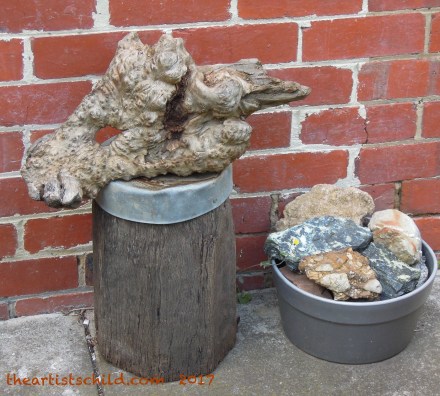
As the wall is quite long I thought it still needed some more visual interest, so from the back of the garden I moved a wooden power pole off-cut, left over from a community art project that Ellie had taken part in several years ago.  This still has its metal capping and makes a great stand for a sculpture.  We had kept a Mallee Root, too interesting to burn in the fireplace, that looks like the character of Bottom when he was transformed into an Ass in  A Midsummer Night’s Dream, complete with eye hole.  I placed  it on the stand at one end of the wall next to a pot of textured rocks.  Mallee Roots are really hard and don’t rot easily if kept off the ground so it should weather nicely.

dscn3259-1

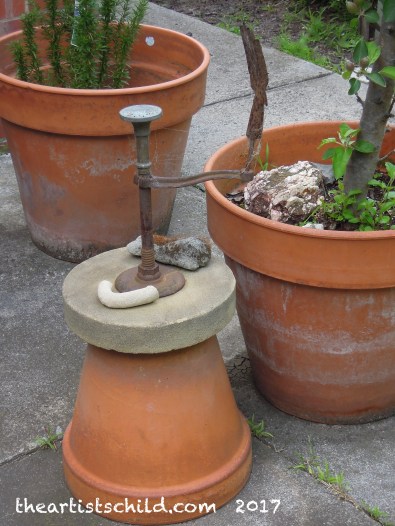
Now that I had begun, I kept finding other bits of junk to make assemblages.  We had an old iron and stone-grinding wheel for sharpening tools that had lost its base and wooden handle.  I thought that it would look good on its side to create a table-like structure, so I stuck one metal end into the bottom hole of an upended terracotta pot.  Onto the joint of the handle I attached an old brass hose fitting and to the handles end fitted a rusty garden fork.  I think it looks like a one-armed World War I helmeted soldier giving a cheeky salute.  There is a rock that is shaped like an elbow and another like a foot on the grinding wheel and it is a tribute to the spirit of the Australian Diggers who survived that awful war.  Probably my most serious assemblage.

dscn3258

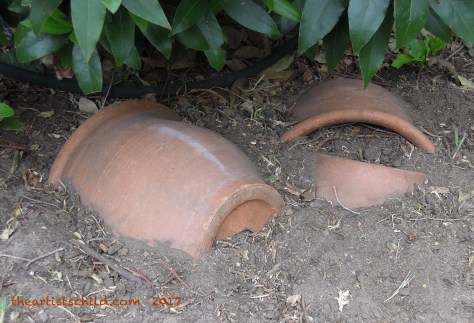
After a violent spring storm one of our terracotta pots was broken and the shards looked too good to throw away.  I half buried them in the earth under our Bay Laurel shrub where the dogs are always destroying the grass.  The broken pot pieces now form a bit of archeology in the garden as if they have been uncovered in a dig.  Circa Middle Suburban Period.

dscn3143

In the darkest corner of the shed, in a container filled with old junk, apart from the spiders, I discovered three cast iron metal shelf brackets.  Standing them together on their bases creates a decorative assemblage and I put these on the concrete ledge behind our rustic garden bench and table.  In the same junk container were a large rusty forged iron staple and an unusual square type of bolt fitting.  These  found objects were placed on the same ledge, next to a lucky horseshoe given to us by our grandfather.  I did not include my grandmother’s rusty secateurs in this or any grouping, because Ellie said it was a bad idea to put potential weapons near the back door.  I’m more worried about the thought of getting tetanus from a cut, than somebody going psycho with some rusty old garden tools, but better safe than sorry.

In front of this rustic collection was a pot that contained a shade loving Clivia given to us by our Aunt.  But our younger dog, who is only 15 months old, decided in a moment of naughtiness that this would be a great chew toy and dug it out of the pot.  Luckily Ellie caught her in the act and was able to replant the only slightly damaged Clivia.  But we decided not to put it back in the same place where it had attracted Destructor Dog’s attention.  I thought the now vacant spot needed a sculpture.  In our pile of Mallee roots was one that resembles a large rabbit’s head.  It fitted on top of a rounded rock and I sat these on a square section of broken concrete planter as a stand.  I call this piece The Were-Rabbit, because it looks slightly sinister and reminds me of the Wallace and Gromit animation that features a particularly nasty, but hilarious monster rabbit of the same name (Wallace and Gromit: The Curse of the Were-Rabbit).  Yes I know I have a weird imagination.  Anyway, it’s too big to use as a chew toy, we hope.

While I like to play around and have fun creating these objects I always try to make the most of a materials aesthetics and to put them in an appropriate position in the garden.  It often takes a lot trial and error.

At the moment I have run out of items to make assemblages and my creative burst has probably produced enough for now.  As we accumulate new junk, which is inevitable given that many things are not built to last these days, I will most likely find inspiration to create more, as it is such a constructive way to reuse broken stuff.

Kat
The following is a link to one of my favorite gardens surrounding a building that began construction in Victoria in 1855.  The historic Old Curiosity Shop in Ballarat has become a testament to giving new life to broken pottery and discarded objects and is still being added to by the present owner.  It just goes to show once you start along this path it is difficult to stop.

The Old Curiosity Shop Garden

Getting into the Goldilocks Zone

dscn3902

The Goldilocks Zone

We’re in the middle of a heat wave and it is affecting my ability to think.  For two days I have been trying to write a post but I keep getting bogged down with detail and too many facts.  Exactly what I want to avoid.  I am trying to write about how finding your creative outlet is not always a straightforward process.  You try an art form that looks appealing but, like Goldilocks first found, it is not quite right and you need to move on and find something that will give you enough enjoyment and passion to persist.  But our struggling old air conditioner is either not coping with the heat or making it too cold and it’s numbing my brain.  I am definitely not in the “Goldilocks Zone”.

The Goldilocks zone is a term used to signify the habitable region around a star where an orbiting planet can support life, that is, it is not too hot or too cold but just right.  Well I’d like to be in that zone because it is not “just right” at the moment.

But when is it ever “just right”.  Often we put off doing something because it is “not the right time” or “it will be better tomorrow” or “I must do this mundane thing now so I’ll put off what I’d love to be doing till later”.  Well maybe “just right” is “right now” and I should devote some time to drawing or playing the ukulele.   Yes, I don’t think that I have mentioned that I love the uke and it is one of my passions along with singing.  Its feel-good tone makes me happy and lifts my spirits and I love writing songs on the ukulele, even more than on the guitar.   It is definitely something to get me into the Goldilocks zone, along with using water-soluble pencils and pastels, creating assemblages in the garden or playing ball with our dogs before it gets too hot and they collapse from heat exhaustion.  There is no time like the present to get into that zone so don’t delay.

If you have not yet found your true passion, it pays to experiment with different art forms to find one that is “just right”.   Sometimes it takes time.  I have tried various forms of creative activities and not all of them have worked out as expected.  At art school I decided to do ceramics as an elective because my mother had once done this as a hobby and she still had the pottery wheel and small kiln.  I thought that this would be great to try.  But it wasn’t meant to be.  I found the process too time consuming and lost the desire to continue after a year of constant breakages.  Usually my best work was damaged during the drying stage and I was always redoing projects.  I was not cut out to be a potter.  Too stressful.  We ended up selling the wheel and kiln to someone who really loved the activity.

dscn3914

Japanese Garden 1: Tapestry Design and Sampler

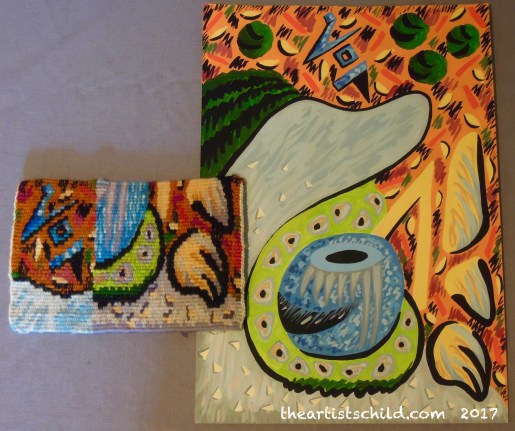
Sometimes you discover your true passion through doing some other art form.   From an interest in textiles I had taught myself tapestry weaving and did a short course to learn more.  I really enjoyed creating something out of thin air and decided to take it to the next level.  The Art School I attended offered this as a major and I was able to learn how to design and create woven tapestries in both small and large-scale format.  I became quite skilled at this process and always received good grades, with a distinction in my final year.  But I found the thing I liked the most was doing the drawings or painted designs for the tapestries and developing my own visual style.  While I still like tapestry, I prefer the immediacy of drawing and painting which were my first loves.  Getting experience in different creative areas will not only help you to find your bliss, but will give you insights into all kinds of art forms and it is never a waste of time to learn something new.

For me, playing music, as well as drawing and painting, get me into the Goldilocks zone.  If you haven’t already, it may take a while to discover what does this for you, but in your search you could find yourself taking interesting paths and deviations that is part of the joy of the creative journey.

Kat
There’s a Dragon At the Bottom of the Garden

dscn2671

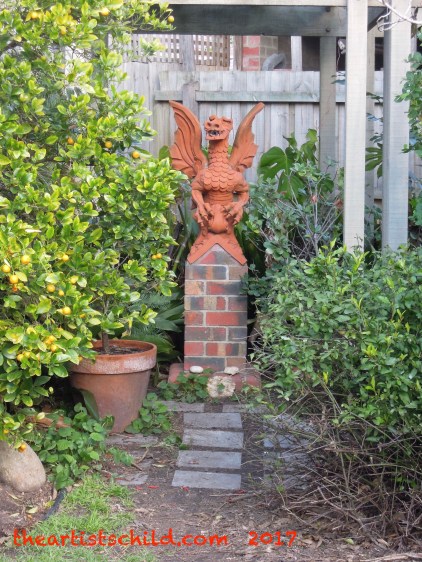
We have a dragon in our garden.  Not a real dragon like a type of frilled lizard, but the mythical kind found in old legends and fantasy tales.

Before we had any garden features our back yard looked rather boring.  Several years ago Ellie and I decided we needed some kind of focal point at the rear of the property.  We visited garden centres and couldn’t find anything we liked to suit our style of house.  It is a cross between the early 20th century Australian Federation and California bungalow styles with a modern red brick addition on the back.

Looking in some books on how to renovate houses of these eras, we saw some terracotta roof dragons hand-made by the local architectural pottery.  Our roof has a couple of original terracotta finials but is not high enough to take a large dragon, so we decided to get one of these beautifully modeled terracotta sculptures to put in the garden.  We went to the pottery and looked at all the designs, chose a large French style dragon (actually a two-legged Wyvern) and placed our order.  After several weeks it was delivered in separate pieces to its new home.

The dragon needed some kind of plinth on which to sit so we cleaned a lot of old bricks left over when a front verandah was enclosed.  With the help of a friend, the brick plinth was constructed under a wooden pergola needed to protect the dragon from falling branches. The tree next door is an African Coral tree that sheds limbs in storms.  This structure has proved very effective, as we often find fallen branches that have been deflected by the framework.

dscn3174

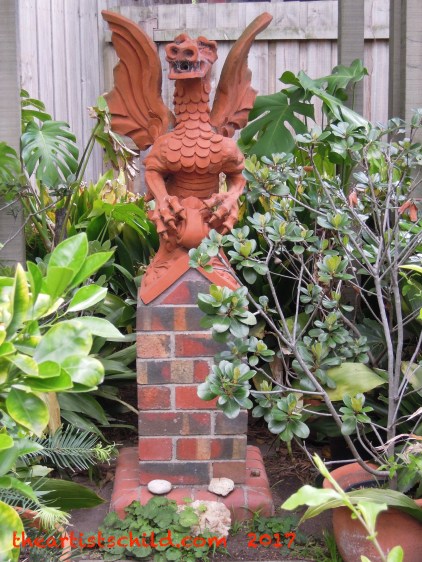
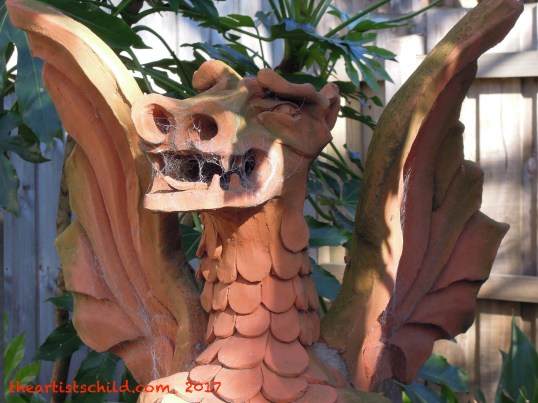
The foliage surrounding the dragon prevents it from being viewed from all parts of the garden, so it does not compete with other garden ornaments and retains its dramatic impact.  We named it after Ramoth, the dragon Queen in Anne McCaffrey’s wonderful books about the dragons of Pern.  Our dragon has gained a green patina of moss and lichens and has become a home for spiders, the kind that make interesting funnel like webs in the dragon’s mouth.  Every time I tried to remove the webs they kept returning because the spider lives inside the dragon.  Not a wise idea to put fingers into any crevices as I have since found Redback spiders in the garden so the webs can stay, no matter what made them.   For those unfamiliar with these spiders they are Australian native members of the deadly Black Widow family and like to live in damp and dark corners of the garden or shed.  Or maybe down a dragon’s throat.

dscn0576

The dragon is a wonderful symbol of both the creative and destructive forces of nature because it represents the four elements: earth, air, fire and water.  It lives in the earth, flies in the air, breathes fire and has the scales of a fish.  In western Myths and stories, dragons have often been seen as an evil serpent, like St George’s dragon and Tolkien’s cunning talking dragon, Smaug.  In Chinese culture usually they are lucky and are one of the 12 zodiac animals.  Also on the positive side, a dragon is the symbol of Wales and the magical friend of little Jackie Paper.   I was always sorry when Puff “sadly slipped into his cave”.  Dragons continue to inspire new works for children and adults, like the movie How to Train Your Dragon and the books and TV series of Game of Thrones, where they are dangerous but heroic creatures.  Never a wise idea to mock a Queen’s dragons.  Barbecue anyone?

It is great to have one of the architectural dragons at ground level because only birds would appreciate the sculptural detail when they are placed upon a roof.  To me Ramoth has a smiling face, but she looks quite powerful and ready to defend her territory so is a perfect garden guardian.

Kat

Costume Parties: One Person’s Heaven, Another Person’s Hell

dscn3744-1

It’s nearly New Year’s Eve Party time.  Some people spend weeks making costumes for such an event,  while others won’t even wear a silly hat.  It seems that while many party guests love to dress up and pretend to be someone or something else, there are those who refuse to make any effort at all.

I have noticed that those who do not attend in costume often end up feeling left out and don’t have as much fun as the party goers who have embraced the theme.  Maybe some people have a costume phobia because of some tortuous experience in childhood or early adulthood.  If you are going to a party this weekend, for the reluctant participant I have made the following list of recommendations that should help anyone survive an event that requires a costume.  Some of these things are from personal experience and I still like to dress up.

  1. Never wear anything that you cannot sit down in. Eg. A Christmas Bon Bon outfit made of cardboard and crepe paper is a bad idea.
  2. Following on from point 1, never wear anything made in one piece that requires removal to go to the bathroom.
  3. It is best to avoid costumes made from crepe paper altogether because, firstly, they are a fire hazard and secondly, if it is humid or wet this will become droopy and colors may run down your face.  Eg. when your mother made you a crepe paper flower costume and it wilted like a real flower in a heat wave.
  4. Never wear anything that you do not want to be caught in if your car breaks down or if you are locked out of your house. Any realistic characters with a fake gun are probably not a good idea.
  5. Never wear anything that blocks your vision, prevents you from eating and drinking, or is so hot that you can only have your underwear underneath and cannot take it off when you go into a melt down. Even if they look cute, full furry animal costumes are a big mistake and should be left well alone.
  6. Never substitute indelible felt pen for make-up or use red or black grease paint. These will require industrial strength cold cream to remove.
  7. Never wear anything that is a hazardous to others.  Eg. Pipi Longstockings style plaits with a wire core can be dangerous for anyone sitting next to you.  Unless it’s someone in a Captain Hook costume.  They’re already wearing an eye patch. But the damage you could do on the dance floor does not bear thinking about.
  8. If you travel to a summertime party and it is still daylight, never drive through the city centre wearing an 18th century style wig and dress. You will cause a spectacle when stopped at traffic lights and it is impossible to hide.  Maximum embarrassment will result.
  9. Clown costumes were never a good idea, even before the creepy clown epidemic.
  10. If you disregard the above points, you are probably a masochist or an extreme exhibitionist.  So no sympathy when it all goes pear-shaped.

Now that you are aware of the pitfalls, it is possible to come up with some reliable costume ideas.  What follows are some costume suggestions for both those who love to dress up and for those who are more hesitant.

If you cannot sew like me, collect clothes that can be turned into a character just by using a bit of imagination (Op shops and weekend markets are good sources).  You can then reuse or reinterpret favourite costumes and keep them stored away in a wardrobe or vac-packed, so that it is never difficult to find something at short notice.  For example, my several long velvet dresses have been used to create Queens, Medieval ladies and witches, depending on the occasion.  One of my favorite characters from both film and TV versions, is the evil Queen in Snow White and the Seven Dwarfs.  She is just so nasty, has all the best lines and is a perfect character for a party costume.  Much more fun than dressing up as Miss goody two shoes Snow White.   I have a blue velvet kaftan dress that looks quite medieval and very “Evil Queen”.  All I have to do is put a glittery black knit top underneath, add some gold chains and a fake jewel, a black veil and a (cardboard) jewel encrusted crown and I have a great costume for colder weather. “An Apple, my pretty?”

The Crown was created by cutting out the shape from a cardboard base.  This was covered with fabric and was then covered with gold paper that had cutouts left to reveal the underlying material.   Stick on Velcro was used to fasten the ends of the crown together, and it was decorated with glass gems. Took a bit of work but I think that it looks very regal and can be used more than once.

You could make a King costume using the same principles.  A turtle neck top worn with slim black pants (tights if you dare) under some kind of robe or cape, with a similar crown, some chains around the neck and a prop sword and you could be King Arthur, Aragorn or if you like the dark side, the horrible King Joffrey from Game of Thrones, who has some great lines and an over the top death scene as inspiration.

For a warm weather costume the versatile standby is a fairy outfit, which has endless permutations.  All you need is a light party top, a skirt made from transparent or flowing material and some wings, which can easily be found at a $2 shop.  I have some glittery white ones.  I put these over a red, white and black chiffon style top that has long flowing sleeves.  For a skirt I use a couple of white half-slips, the top one being made of transparent net.  In my hair I put some cerise artificial flowers that I sewed to a large hair clip.  Attached to the flowers is a copper-colored butterfly for a bit of whimsy (for the purpose of the photos I have used a particularly itchy wig mistakenly bought from a party shop. This type of thing should have been on my warning list, along with feathered masks that make you sneeze).

With such a costume, you can be the Fairy Godmother from Cinderella, the Good Fairy from Sleeping Beauty or if you like, the Bad Fairy.  Just do everything in black.  And as for you men out there, I have seen many a brave male in a fairy costume.  But if this is not your thing, there are always wizards or elves, the main requirements being a pointed hat and staff for the former and pointy ear attachments for the latter (and a loud voice and predilection for poetry).

If you can, it is also fun to create your own costume character.  Ellie and I are sci-fi fans and for a local art group’s New Year’s Party we designed and made Space Alien costumes.  Ellie, who can sew, used metallic gold fabric to make tabards (medieval term for open sided tunic) with art deco inspired padded shoulder extensions, requiring a lot of polyester stuffing material.  We made black satin belts that fasten with Velcro and attached a gold painted cassette tape to each to simulate some kind of power pack.  The tabard was worn over black cotton camisoles and black leggings (I had to use a long skirt in the photos as the dummy does not have legs).  We carried plastic ray guns that made a whirring noise.  On our heads we wore sparkly gold wigs from a $2 shop.  These don’t itch.  We both won a prize for our costumes and had a lot of fun being silly and quoting clichéd lines from sci-fi movies, Star Trek and Dr Who.

These types of sci-fi costumes work well for both men and women. They can also be adapted for colder weather with a long-sleeved top underneath and warmer pants and boots.  Also good outfits for a group.  You can pretend it is an Alien invasion.

There are plenty of costume ideas that are imaginative and comfortable to wear, so you should be able to find or make something that will ensure that you have lots of fun, without any major costume malfunctions.

If you are going to a New Year’s Eve party I hope that you have a wonderful time.  I think that we all want to say goodbye to 2016.

Happy 2017

Kat

When We Believed in Fairies

fairy-card-design

Fairy Design

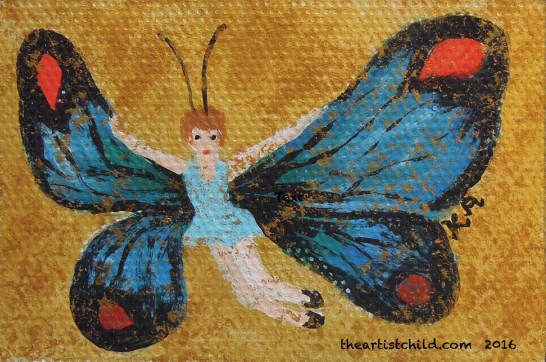
Watching colourful butterflies in our garden the other day reminded me of our childhood obsession with fairies.  Ellie and I listened with fascination when our parents read stories from illustrated fairy tale books and we played make-believe fairy games in the garden.  In December we had the lovely, paradoxical combination of both the summer fairy world and the winter wonderland of Santa.  The belief in an enchanted world of fairies, elves and a magical being who brought gifts on Christmas night, helped to develop my love of imaginative imagery and fantasy.

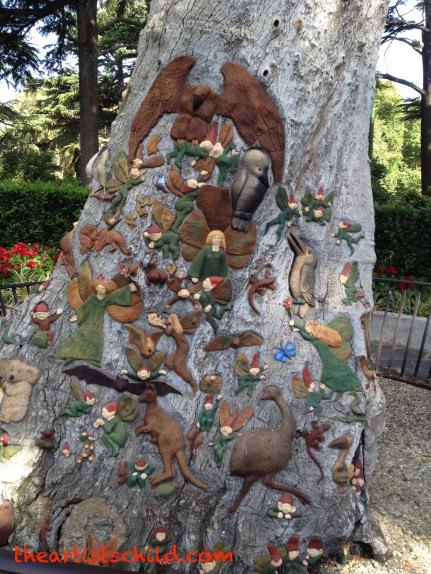
Fairies bring magic to the world of children and no wonder they are as popular as ever.  I remember visiting the Ola Cohn Fairy Tree in Melbourne’s Fitzroy gardens as a child and being fascinated by the carved fairies, elves and animals that I thought would move when no one was watching.  Our grandfather would take Ellie and I to the fern gully at the Royal Botanic Gardens.  We called it the Fairy Dell and grandfather would point out the fairies floating under the fronds.  We would see them because our belief was so strong.  Another time he gave us a rock that had a mushroom growing out of the moss on top and told us that this was a fairy house.  The mushroom and moss are long gone but I still have that rock. It was special.

ola-cohn-fairy-tree

The Ola Cohn Fairy Tree

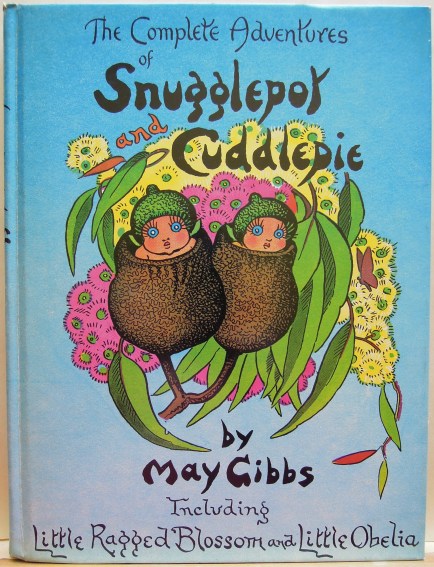
In my room hung a print of fairies trooping in a forest (The Fairy Way by Margaret Winifred Tarrant).  I loved that picture and I have it stored away as a memory of childhood.  One summer holiday Mum made us some wings out of wire coat hangers and pantyhose and we would dance around in our ballet leotards or swimsuits pretending we could fly.  I don’t know what happened to those wings.  They probably fell apart from repeated flapping.  If it were too hot outside we would create a fairy house by covering a table with a sheet and play underneath.  We found inspiration for our make-believe games in books.  My favorite Australian fairy books were about the gumnut babies, Snugglepot and Cuddlepie, by May Gibbs and The Little Green Road To Fairyland, beautifully illustrated by Ida Rentoul Outhwaite.  I loved the fact that the fairies were depicted in the Australian landscape with native animals and gum trees so it was easy to imagine them in our own environment.  The fantastic fairy tale illustrations by Arthur Rackham were other favorites.  We still have these books because they are timeless.

snugglepot-cuddlepie

It was fun being allowed to stay up late to watch the old 1930s version of A Midsummer Night’s Dream starring Mickey Rooney as Puck on TV.  Although it was in black & white, the film captured the dreamlike world of the fairies and brought Shakespeare alive.  I saw it again recently and it is both an ethereal and humorous version of Shakespeare’s play, despite the basic special effects.  We also enjoyed the 1951 British movie version of Dickens’s A Christmas Carol staring Alastair Sim as Scrooge, which usually screens around this time of the year.  The jovial “Ghost of Christmas Present” was a version of Santa Claus.

Like many children, we would visit Santa’s Grotto at a city department store, make our gift wishes and have our photo taken with a perspiring Santa, who always looked like they were about to collapse from heat exhaustion.  It can’t have been an easy summer job even with air-conditioning.  On Christmas night we would leave out a drink and a snack near the fireplace despite the fact it was unlit.  Because it was summer, dad said that Santa would prefer a beer, not milk, as delivering presents was thirsty work.  We were innocent children and it never occurred to us that if everyone did this Santa would have become inebriated.  He always drank his beer.  Waking up at 4 am to the presents hanging on the end post of the bed was always exciting.  We could never wait till daylight.  Ellie would come into my room and we’d unwrap everything together as this was much more fun.

santa-xmas-cards

Santa Xmas Cards

I think I was in the fourth grade at school and mentioned what I wanted from Father Christmas and another girl said, “you don’t still believe in Santa, it’s your parents”.  I was shocked and devastated.   She was not one of my friends and probably said it to be superior.  Because I did not want Ellie to have the same bad experience, I decided to let her down gently and told her that our parents handed out the presents on Santa’s behalf, because he could not get all the way to Australia in one night.  I wish that our parents had told us the truth rather than leaving it to chance.  It is always sad when childhood beliefs are destroyed by some unkind, thoughtless person.  I bet that girl is still a sourpuss.  But the world did not end and it was just a part of growing up.

I don’t remember when my belief in fairies ceased.  I think that it just gradually faded away.  Probably the Santa incident was the beginning of the end.  The tooth fairy vanished after I gained my second set of teeth.  Without that cash incentive she became redundant.  Maybe fairies start to disappear as we learn to cope with the realities of life, but it is hard to forget their magic.

As an adult Myths and Folklore are still important.  I find modern fantasy artists who depict the fairy realm very inspiring.  One of my favorite painters is the British artist Josephine Wall, who produces beautiful, incredibly detailed paintings of the world of fairies and other mythical creatures.  I also love to read fantasy novels and watch films that are based on old fairy tales.  Probably the first book that I read on this subject and still one of my favorites is Faerie Tale by Raymond E Feist, with its references to Celtic mythology.  Quite scary and definitely not a bedtime story for little children.  A masterpiece of the fairy tale genre is the 1940s French film La Belle et la Bete (Beauty and the Beast) directed by Jean Cocteau.  With its living statues, the Beast’s palace is deliciously creepy and surreal.

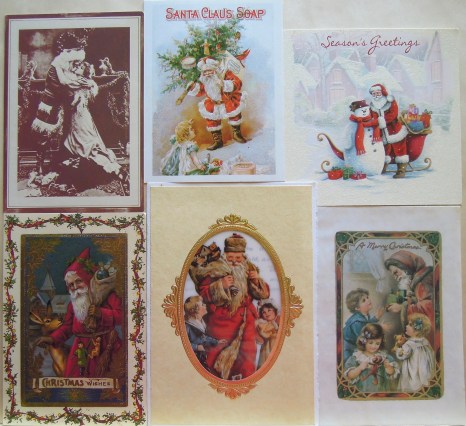
Fairy tales still capture my imagination and have been an inspiration for my songs and art.  I have made cards with fairy and Santa images to accompany gifts for friends and relatives and will continue to be influenced by these mythical beings and will try to bring them alive.

And hey, if the Irish and the Icelanders will not harm a fairy tree or move an elven rock because this will affect the fairies and elves who dwell there, who’s to say they are wrong. The natural world needs all the help it can get.

So if anyone asks, “do you still believe in fairies?” I will answer’ “Yes, I believe in the idea of Fairies” and that will be the truth.   And as for Santa, he is everywhere whether you believe in him or not.

Happy Holidays.

Kat

(There is a lot more to read and view if you click on the text links in this post, including the full version of the movie, A Christmas Carol).

Creative Blockages: Beginning Something New

For me the hardest part of a new project is beginning.  A blank page or canvas, a pile of new materials waiting to be transformed can sometimes be daunting.  Once I am over this hurdle and have begun I find it much easier to get on with my work, but making the first step is always the most difficult part of the process.  There is the danger of using delaying tactics, like spending time setting up the equipment and art materials so that everything is easy to reach, then being confronted by the task in hand and becoming paralysed.  So it is good to have several strategies that help get you going and the following have worked for me when I have become blocked.

You need to loosen up if you want to create freely and begin something new.  A few years ago I did some creativity classes at a local art group and learnt some helpful techniques. One method is to do a drawing based on how you are feeling at that particular moment. You take a large sheet of paper and some pastels and immediately draw on the paper without thinking about what you are doing, just how you feel.  It is not about creating a finished artwork but about freeing up your mind.  That said, it is never a good idea to use newsprint paper for drawings because if you do one that you want to keep it will disintegrate over time.

dscn3623

Free Spirits

The same freeing up method can be done with modeling clay, words, singing vowel sounds or losing yourself in dance movements.  Beat a drum and howl like a wolf if you wish. Whatever releases your ability to create.  Once you are feeling less constrained then it is easier to tackle a new project.

Sometimes a blank white page or canvas can put you off beginning a new work.  The solution is to use coloured paper or paint a coloured ground that harmonizes with your subject.  A mid range colour is good because you can add the highlights and shadows over this base.  Once the white blankness is gone you have already begun.

But what if your canvas is a blank screen.  Well the same system applies.  Write something, anything, even if it is just headings or ideas.  Get rid of that empty screen. Think while you write or write without thinking.  Whichever works at the time.  With the latter, I find that the words seem to appear out of nowhere and that my thoughts start to make sense on the page.  The subconscious often works things out before you are consciously aware of an idea.  Then the momentum carries you along.

It is difficult to start something new if you think you need to produce the whole work in one session.  Visualise where you are going but concentrate on what you are doing at that moment and take a break when you are starting to get bogged down with detail.  Agonising over every pencil mark, brush stroke or word never helps.  It will turn the whole thing into a chore and this will show in the final result.  You want you work to look effortless no matter how much time and energy went into its production.

Probably one of the most important things is to make what you are doing fun, then you will be raring to get on with your work.  I like to put on some music while I am working. Sometimes I need relaxing music, at other times good old stimulating rock and roll.  I find this gets you into the flow and also cuts outside distractions.  Music can give you energy and take you out of your everyday state of mind that makes creating easier and that much more enjoyable.

On my pin board is a cutting from an old calendar that says “all glory comes from daring to begin” (Eugene F Ware, “Ironquill”).  How true.  Without taking that first leap you will never get anywhere.

Kat

Making and Remaking Necklaces

In the summer I find I am more creative.  It is so much easier to get out of bed in the morning when you are greeted by sunshine and beautiful blue skies.  It is the time when I like to work on new projects or just sit back and soak in the loveliness of nature while I think about new creative ideas.  If it is hot I do not want to do anything too energetic, so sitting around making a small item is a great thing to do.  Some of my summer projects have included creating necklaces out of found objects or remaking broken ones.  Then I can wear them when going out to summer gatherings.

The first one that I made was from some old beads and mother of pearl buttons that I had collected.  The necklace is quite chunky and looks equally great on a plain T Shirt or on knitwear in winter.  I just threaded the beads and buttons onto some fishing line to make an interesting pattern.  Not hard at all.

Another necklace was made from shells and coral that I had found on trips to beaches both near and far.  The organisms were all long dead.  These were easy to knot onto black cord because there were holes in the coral and shells.  I like to wear these with a light black or white top and they are particularly appropriate for the seaside.

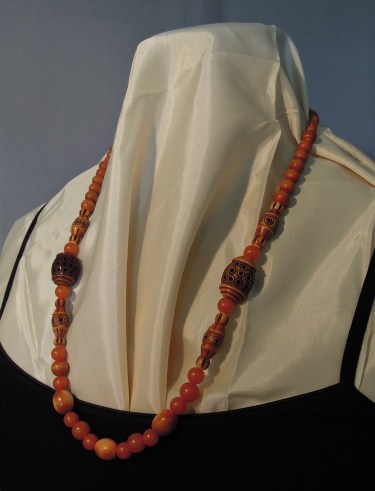
It is also good to repair old vintage necklaces that are made from interesting or rare beads. I inherited an old carved bone necklace from a relative.  I think that it was originally a single long strand of beads, but it had been converted to a double strand necklace that did not look very attractive.  The flower shaped beads were dirty and I did not want them to deteriorate further, so I cleaned them gently using a weak solution of methylated spirits and water, applied with a soft toothbrush. Once they had dried I threaded them onto strong linen thread.   The necklace looks much cleaner and better as a single strand.  A redesign can make all the difference.


I also restrung a broken vintage plastic necklace, possibly from the 1950s, that had been given to me by a family friend.  It simulated orange amber beads and some were missing but this did not matter.  A few looked like Chinese carved bone beads and I was able to reassemble the necklace to make the most of these in the design.  It did not have a clasp and fitted over my head.  It is one of my favorite pieces.

dscn3572

Vintage buckles and dress clips can be turned into interesting necklaces.  I have a few diamanté ones.  The easiest way to wear these is to attach them to a velvet ribbon to make a choker for some old world elegance.  I cut some black velvet ribbon to fit around my neck and sewed a press-stud in the appropriate place at each end.  I can slip on the buckles or put on a dress clip and wear a different one to suit my mood or outfit.  Thinner, longer velvet ribbon can be used to hang pendants, like lockets, instead of on a chain.  Simple.

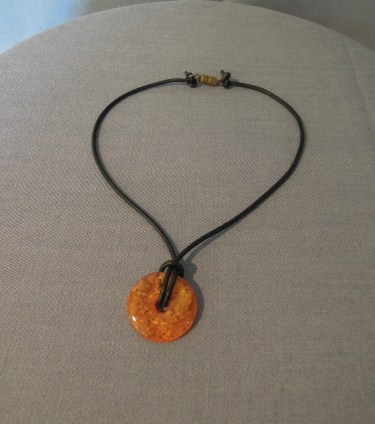
It is good to have some black leather cord for making necklaces.  I have a round amber disc with a centre hole that needs to be looped around a cord to wear as a pendant.  This is easy if your want to wear it long because it will fit over your head.  But I like to wear it as a short pendant at the throat.  The solution was to tie some old necklace clasps that I had to the ends of a shorter length of the leather, which was looped through the centre of the amber disc to hold it in place.  I can do this up without any trouble and it is now the length that I prefer.

dscn3592

None of these necklaces required any special equipment to make, only some basic materials.  Just a matter of using attractive or old items to create a new wearable object.

Kat

12 Reasons Why Dogs Make Us More Creative


dscn3562dscn3559

  1. Dog’s adventures are an endless source of inspiration
  2. Dogs love to watch you work so you are never lonely
  3. Dogs know how to pose for a portrait so you always have a subject
  4. Dogs never criticize your work
  5. Dogs let you take them for a walk when you have a creative block
  6. Dogs jump on and lick annoying people who interrupt your work
  7. Dogs know when your pencil or brush needs replacing – they eat it
  8. Dogs know when you should finish a drawing – they eat it
  9. Dogs like to taste Still Life subjects so you learn how to work quickly
  10. Dogs show you how to paint with nose and paw – on the floor and on the walls
  11. Dogs show you how to select found objects from the beach, the park, the bedroom, your friends’ handbags …
  12. Dogs make you laugh and are an artist’s best friend

Kat