The Nature of Things: Texture

IMG_0421

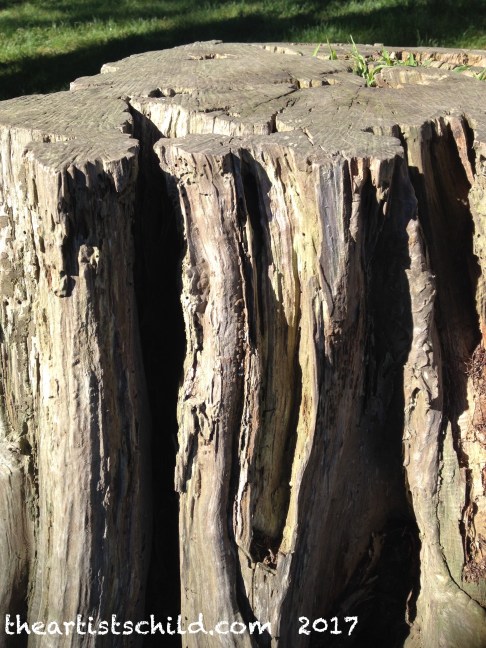
Ellie’s photo of a Cyprus Pine stump

Everything has a texture. Part of the essence of a life form, natural or manmade object and substance relates to its texture. This can be silky, smooth, rough, spiky, sticky and so forth. There are so many words just to describe how something feels, that one could go on and on. Even sounds and music can be referred to in a textural manner such as abrasive, soft, fuzzy, scratchy or sharp.  Textures are very inspiring to visual artists, writers and musicians because they can be used realistically and metaphorically.

DSCN3256DSCN4633

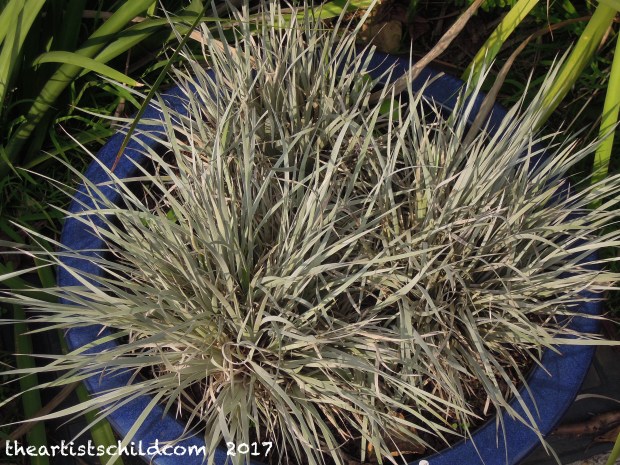
When I learnt basic photography as part of an art course, one of the first exercises given was to photograph patterns and textures. This has stayed with me and I still like to take photos of something just for its texture. These photos can be used as inspiration for an artwork or an end in themselves. The textures of plants create interesting photographs. The spiky native “Silver Sunrise” grasses with or without their yellow flowers; shiny yellow grapefruits against intense green foliage and rough tree-fern trunks all make tactile looking subjects.

I don’t have a SLR camera and it is difficult to get really close to an object so I must use iPhoto to crop the images and zoom in on a particular area. I find that you can do a lot with a basic photographic program to enhance and manipulate an image. For example I added definition to a yellow rose and increased the color, zoomed in on a sculptural rock to emphasize its soft green mossy texture and enhanced the shine on a rock with quartz crystals to make it more crystalline. The inherent characteristics were stressed for their own sake.

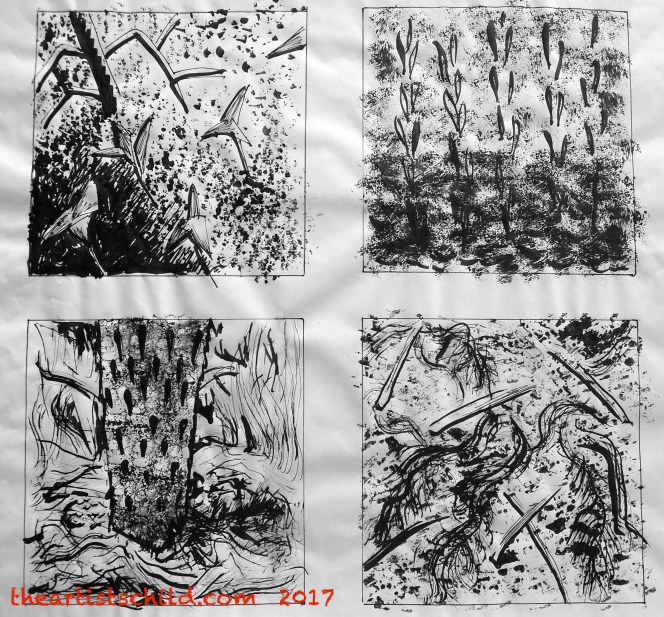
Sketching textures provides inspiration for visual art. With black ink, pens, stippling sponges, corks and brushes it is possible to get a variety of textural effects. I used some of these techniques in drawings for tapestry designs. They were worked up in a series of gouache vignettes, components of which were used in a final design. There are many other ways to use textures in art, from realistic oil painting, textured materials to simulated surfaces in computer graphics and is just a matter of personal preference.
Version 2

Version 2

Our personal experiences give us an understanding of texture. It is difficult to forget the experience of a sweaty handshake, a lumpy mattress, or the soft, velvety feel of a puppy. Words relating to texture often describe a person. Someone can be prickly, slick, oily, sleek, bristly, slimy, cuddly, hard etc. We associate touch with human characteristics and using these types of words can sum up and individual’s attributes without the need for a long explanation and are very useful for writers. When the sense of touch is engaged with words our minds conjure all kinds of feelings that can either repel or bring us closer to the subject.

Texture in music is often very involving for the listener. Layered music that creates sound textures can take you to real or imaginary places. The contrasts between different types of instruments like strings, electric guitar and drums, melody, rhythm and harmonies makes for rich, complex and emotional pieces. The Australian band, The Dirty Three, play imaginative textural compositions. This band of Victorians was formed in 1992 with members Warren Ellis on violin, Jim White on drums and Mick Turner, who is also an artist and designer of their album covers, on guitar. They often collaborate with Nick Cave. The following is a piece from their album, Ocean Songs (1998)

When considering a creative idea, don’t forget texture. It will add another dimension to your work, whether it is visual, written or auditory.

Kat

Inspiration from the Sea

Version 2

Physalia Utriculus (from The Ocean World by Louis Figurier, 1872 Edition)

The natural world is full of many bizarre and fascinating creatures, especially the sea. For us land lovers who do not venture far out beyond the sand, anything living in the ocean seem most mysterious and more alien than a science fiction monster. One such life form is the “The Pacific Man of War” (physalia utriculus), cousin to the larger “Portuguese Man of War,” that inspired the following poem:

Physalia

Floating, bloated Physalia

Sails the waters of Australia

Buoyant, Blue Bottle, bather’s hell

Weapons submerged in ocean swell

Tentacles, twisting, clutching bite

Stun the prey of hermaphrodites

Stealthy, Pacific Man of War

Stingers loaded, washed ashore

A stranded, congealed, deflated mess

No armistice with final rest

©Theartistschild.com 2017.

Version 2

Illustration by F Seth from A Sketch of the Natural History of Australia by Frederick G Aflalo, 1896

Lately I have been looking at some 19th century natural history books that came from relatives. I was particularly taken by a couple of illustrations of “The Pacific Man Of War,” and its scientific name.  Not many words rhyme with Australia.

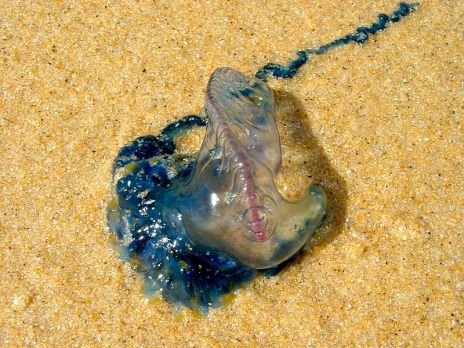
These are commonly known as “Blue Bottle” jellyfish in Australia, although they are not a type of jellyfish. In fact they are related to corals. The Physalia are actually a large colony of separate polyps carried under the floatation bag, itself an individual life form. The polyps perform various functions such as catching prey (the tentacles), waste disposal and reproduction.

800px-Physalia-utriculus

Stranded Physalia Utriculus (Wikimedia Commons)

Blue Bottles can become stranded on ocean facing beaches along the east coast of Australia. They are more common the further north you travel and are considered a hazard when they wash up in large numbers. Physalia can give a very painful sting to any swimmer who bumps into their tentacles, which also remain active when lying on the beach.

Although not a frequent visitor to Victorian beaches the occasional individual can drop in as the following video demonstrates. Despite their bad reputation, seen in close-up physalia are beautiful and mesmerizing creatures.

Kat

Winter Creativity: Escape the Cold Weather Blues

Version 2

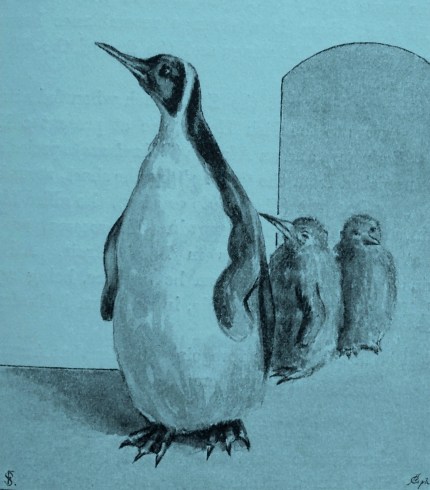
Penguin illustration from A Sketch of The Natural History of Australia by Frederick G Aflalo, 1896.

The weather in Melbourne has turned cold. For those of us who can’t leave town during the winter months it is good to find creative solutions to keeping warm and feeling invigorated. I’d rather feel like a butterfly happily searching for nectar, than a penguin sitting on a nest during a snowstorm. I’m not talking about pumping up the heating but tricking yourself into forgetting about the cold, dark days and taking a summer holiday in your mind.

I know compared with other countries our winter is relatively mild. You need to go up into the hills and mountainous regions to experience snow. But in Melbourne we do have icy southerly and southwesterly winds that blow straight from the Antarctic and the wind chill can be very unpleasant in the winter months.   I once heard a frequent British visitor say that he felt colder here than in an English winter. That’s why many retired people head north to escape. I could write a whole post about the peculiarities of Melbourne weather but I won’t. Instead here is a video taken by a drone of a snow-covered landscape near Ballarat, Victoria last year.

A good way to deal with the winter blues that can sometimes affect anyone is to involve your imagination and use all your senses. Begin with sight and surround yourself with images of summer: Flowers, the beach, out-door activities, whatever reminds you of the warmer months. When you need a boost watching movies that are set in the spring or summertime help to shut out the cold. Unfortunately we will view the new series of Game of Thrones in the middle of winter and all those snow scenes always make me feel really frozen. It will be a case of a fleece blanket, warm dog on lap and spicy curry on these days. So if possible avoid films and TV programs about snow (unless you are mad about snow sports) and find something with a sunny theme. Here’s a list of 100 Summer, Vacation and Beach Movies. You can also search for videos on You Tube with tropical related themes. Films of butterflies make me think of a past trip to North Queensland and the rain forests.

If you are lucky enough to have a spa pool, access to a local heated pool or volcanic hot springs you can still enjoy water activities in the winter, like the snow monkeys in Japan. A nice hot relaxing bath warms you up for ages, especially before you go to bed. If you have some type of bath, treat it like a holiday spa, with bath oil or bath salts. A few drops of essential oil will make it luxurious and smell wonderful.

On the subject of smell, fresh flowers with a lovely scent can lift your spirits when it is icy outside. Plants like Daphne and Winter Sweet give out a lovely fragrance in the cold weather and it is worth planting these in your garden to bring some flowers inside. Pine tree cuttings can do the same. Your home will smell wonderfully fresh. If you do not have access to any flowers you can always use fragrance diffusers or scented candles. The smell of lemon in a hot drink is most refreshing; in fact any citrus fruit brings in the sun so use oranges and limes in cooking.

Version 2

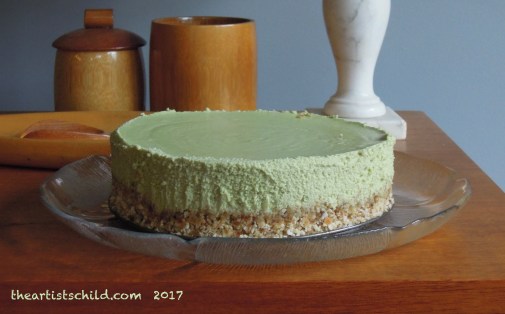
With the sense of taste you can relive summer memories and the right food will make you feel better. Nowadays we can obtain various summer fruits and vegetables all year round so put salads with your pasta dishes and make fruit pies. Curries, chilies and Asian style rice and noodle dishes are warming in winter but also a reminder of holidays in hot climes so tuck into these at any opportunity. Put pieces of fruit in drinks and stick in some cocktail umbrellas and imagine you are in the tropics. There are many more ideas for comforting food. My favorite dessert treat is Macha (Japanese powdered green tea) Key Lime Pie that requires no cooking just chopping, mixing and refrigeration (Recipe).

DSCN2432

Macha Key Lime Pie

Sound will take you to a warmer place. In a world full of music there is something for everyone to evoke the summer. It could be from a particular culture or from time spent in the sun. This is bound to be quite personal and there is no standard set list. When you are feeling sick of the cold play your favorite summer music and revel in the heat. Dance and sing to the music to elevate those endorphins. That’ll take away the winter blues.

When the cold weather is getting you down with a bit of creative thinking there are obviously plenty of ways to bring back that summer warmth and energy.

Kat

Here is a quirky indie pop song done by Melbourne band, The Lucksmiths, called T-Shirt Weather. I could not find a video version with good sound but the lyrics paint a sunny picture.

Creative Versatility: Having several Strings to your Bow

Version 2

Having Several Strings To Your Bow

Some days it is easy to write, other days it isn’t. You know, when you have other things on your mind that are taking up time. At the moment I am trying to work on a song for a ukulele group performance and need to practice. Music is something that is really important for my creativity and I have not being doing enough lately.  Having more than one creative passion is stimulating but also means that you often neglect one to concentrate on another and can feel torn.

When you work at one thing for a long time you will become really skilled in that area but you can also at times get bogged down and lose your freshness and inspiration. When this happens it can be very disheartening.  That is the moment to switch and take a new direction or work on another creative activity that you love.  Versatility can be an asset.

If you like to pursue several art forms it is fulfilling to be able to devote time to each and not feel that you must give one up.  When I was at art school I can remember a teacher saying that he had to choose between a career as a classical violinist or a painter.  He chose the latter.  Maybe he thought that he was not good enough to become a violin soloist.  Seems like he was only looking at a narrow field and could still have performed on a smaller scale while pursuing painting.  I wonder if he ever regretted the decision. Not everyone needs or wants to be a “star” and there are other ways to pursue a passion. I play the ukulele and perform at a grass-roots level for the joy of making music and that is enough reason to give my time to this medium.

Having more than one string to your bow is definitely advantageous.  Being able to use another medium as your circumstances change can lead to new opportunities.  There are many musicians who initially went to art school then returned to their art after a music career (e.g. Reg Mombassa [Chris O’Doherty] from the Aussie band Mental As Anything). Or writers who do spoken word performances as another way to showcase their poetry (Melbourne Spoken Word).  You can be an artist–writer-musician-actor-juggler all at the same time, whatever you want if this makes you happy.


The ability to adapt to an ever-changing art scene is also an essential survival skill.  Last week I read a newspaper article that really made me think about how important it is for an artist to be versatile.  The article spoke of how musicians are now performing at private house parties as a way to increase their income in an industry where most struggle because of dwindling CD sales with the increase in Internet streaming services and high performance costs at venues.  Websites (like Parlour Gigs) have popped up to make it possible to book well-known musicians for home performances and to sell tickets to your friends.  Venues are no longer confined to the local Theatre or Pub so performers must be prepared for all types of locations. There are now many new ways to find an audience and while modern technology has led to some areas drying up it has also opened up inspiring new avenues.

I realize that dividing your attention between different creative activities can be rather distracting at times and does not work for everyone.  But if you are the type of person who needs variety there is no need to feel guilty when you jump between areas.  It will keep you creatively stimulated and adaptable.

Kat

I have linked a couple of videos : one of a local house party performance by The Grapes (Ashley Naylor and Sherry Rich) and the other of Melbourne’s Vance Joy playing his hit Riptide on a Melbourne tram as part of a program (Tram Sessions) that puts local and visiting performers on trams to promote their music.  Travellers suddenly find themselves sitting or standing beside a well-known musician or small band.  How great to have such terrific acts in you living room and tram journeys would be much more enjoyable if they were always like this.

Visual Inspiration: When it is OK to Hoard

Version 2

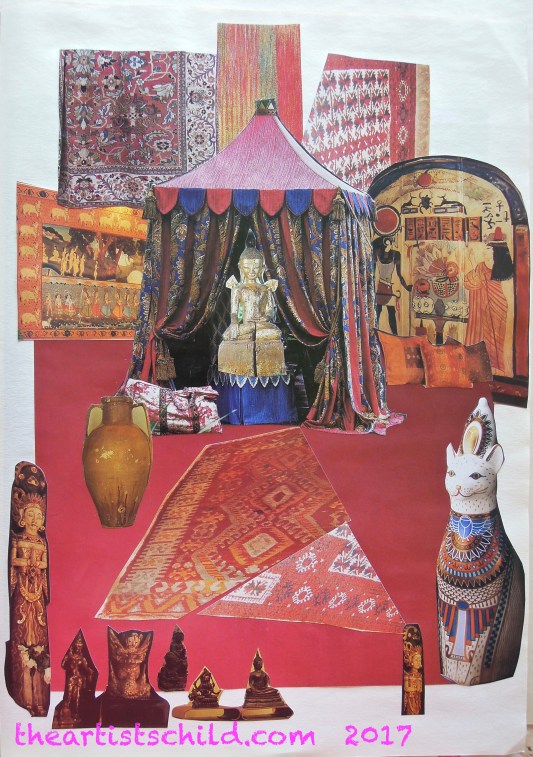
Shrine, Collage from Magazine Images by Kat

As artists and writers we get inspiration from many sources.  Being a visual person I find that I often need pictures, not to copy, but to stimulate my imagination for painting, drawing, poems or blogging.  I collect different types of images for this purpose and have amassed quite a collection.  To avoid hoarder chaos I have organized these so that they are easy to find.

Images of artworks, figures, nature, patterns and textures are all helpful resources and are good things for the creative person to have at hand when a bit of inspiration is needed.  It can be quite expensive to buy art and illustrated books, especially those that contain a lot of colour reproductions.  Ellie and I do have quite a good library but if we do not have a particular image it is easy to find an example on the Internet.  I download those that I like into my computer’s photo library so that I can refer to it at any time.

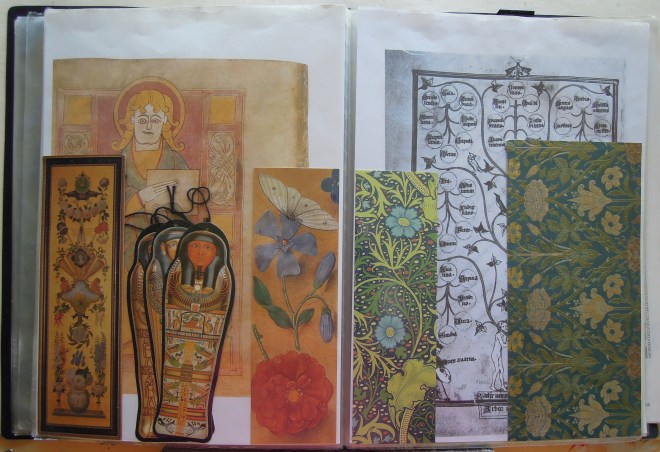
Many designers and artists pin paper copies of all kinds of images on pin boards in their workrooms for visual stimulus.  Printing out copies from the computer can use a lot of costly ink so for this purpose I have a large collection of postcards and greeting cards, either bought on holidays or from friends and relatives.  These are less expensive than buying books and are easy to find when travelling.  Advertising cards that are free in your letterbox, found at movie theatres, art galleries, museums and other public venues often have interesting depictions and are worth grabbing.  So that I can easily access these individual images I have put them into photo and postcard albums, display books, plastic pockets in ring binders and small boxes.  If you keep your reference material organized it is less likely to be accidentally thrown out by someone else.

Version 4DSCN3069

Version 2

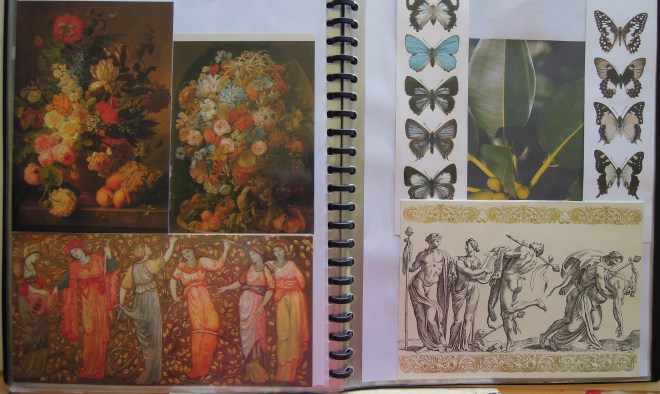
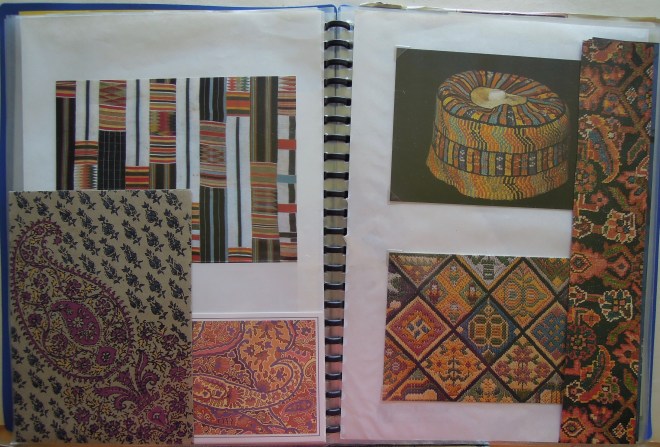
Display Books with Paintings, Decorative Arts, Nature and Textile Images

Inexpensive visual reference books can be found at op shops, garage sales, and markets. Vintage books that were designed for children often have clear, simple images of nature, science and other subjects that can be really helpful for creative work.  Second hand magazines are also invaluable for doing collages and for pin boards.   If you had to buy these new it would cost a fortune.  It also pays to ask your friends and relatives to pass any old magazines in your direction.  Good quality advertising catalogues can be used as well.

A creative person needs to learn to be a scrounger but be selective.  I do have favorite subjects and have quite a collection of the works of Australian women artists for motivation.  I love paintings from the Medieval to contemporary, all kinds of textile works and fairy tale illustrations and have a bit of an obsession with butterflies so will keep any image that possesses these.  Only store what really grabs you so that you do not end up suffocating under piles of paper.  You can add new images and discard others as your library evolves.

Version 2

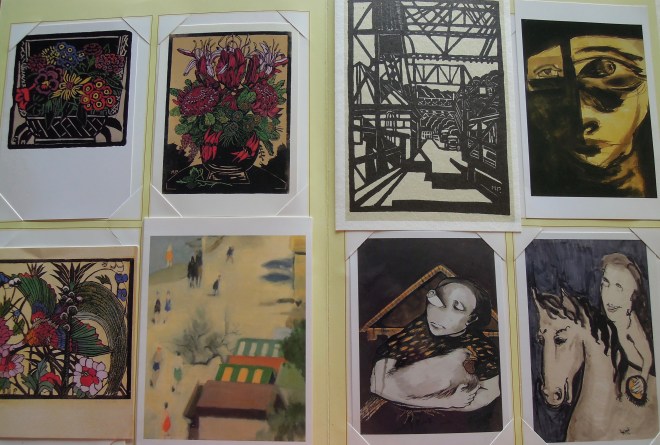
Post card Album with Australian Women Artist Cards (Margaret Preston Prints, Clarice Beckett Oil Painting and three Joy Hester Water Colour Paintings).

You will be surprised at how often you refer to these visual resources once you have your own personal collection. You can use them in many ways to trigger all kinds of original ideas and images.

Kat

I’ve been on a bit of a Paul Kelly binge lately.  He is such a great songwriter and I have his Memoir How To Make Gravy that is an inspirational book with all its helpful advice to songwriters.  The following live performance of his beautiful ballad Midnight Rain was recorded on his Stolen Apples Tour in 2007.  His nephew Dan Kelly (on the left of screen), a terrific guitarist and performer, plays lead guitar on this song.

May in the Garden: Autumn Creativity

In Melbourne, the month of May means late autumn when much of nature is starting to shut down and winter plants are awakening.  With the chilly mornings and shorter periods of sunshine it is good to make the most of any opportunities to spend time outdoors.  Walking around our garden I noticed some small details that I thought showed the seasonal changes and delights of the colder weather and decided to record them with my camera.

Autumn has often been seen as a season devoted to loss, remembrance and regret.   Memorial services for war casualties are held in the Autumn months.  It has also inspired many creative works of art and literature such as O. Henry’s short story, The Last Leaf (1907), Emily Bronte’s poem Fall, Leaf, Fall and the classic jazz song Autumn Leaves (Joseph Kosma/Johnny Mercer).  I particularly like Eva Cassidy’s version.  There is so much that is beautiful about this time of year that it is not hard to find inspiration in nature.

In Autumn you never know when a mushroom will suddenly appear.  I saw some small mushrooms (probably toxic) coming up between the concrete and the lawn.  I was surprised that they had survived because of our dog’s tendency to flatten anything.  The next day they had fully opened and were showing signs of damage and by the third they were withered and black.  This cycle gives a good lesson in living life to the fullest before you exit like a dried up mushroom.

DSCN4599

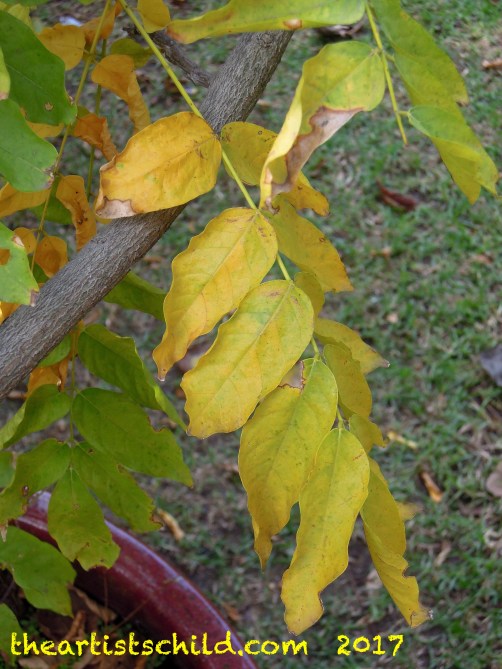
More plants are displaying the wonderful colour of autumn leaves.  Rather than looking at the whole shrub I focused in on one segment of wisteria leaves, with the golden colour spreading into the green.  Soon the whole plant will be yellow and the leaves will quickly fall and cover the surrounding ground.  Once bare the twisting structure of the trunk will be revealed.

I photographed a curly leafed variety of Nandina (sacred bamboo) in early April.  Now the other Japanese Nandinas bear lots of red foliage as well as some small red berries.  The nandina does not lose all its leaves and fruits in autumn, but the old leaves turn red before they fall.  Interestingly the berries and leaves are highly poisonous, except to some birds.  The delicate red leaves and shiny berries look very dramatic in close-up, especially against green foliage, complementary colours that stand out in the soft light of autumn.

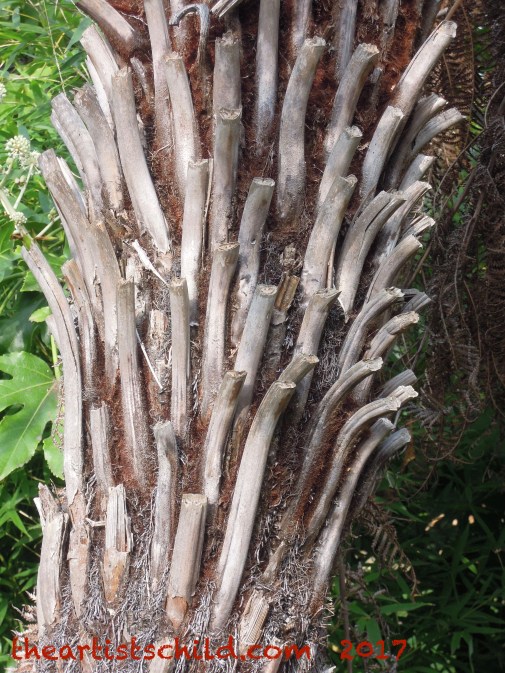
DSCN4638The weaker sunshine highlights the wonderful texture of a tree-fern trunk.  The stumps of the pruned dead fronds create a sculptural pattern that is not always noticed when hidden under the shade cloth needed for summer sun protection.  During the colder months trees may be stripped bare but you can enjoy details that are exposed when dense foliage disappears.
DSCN4537

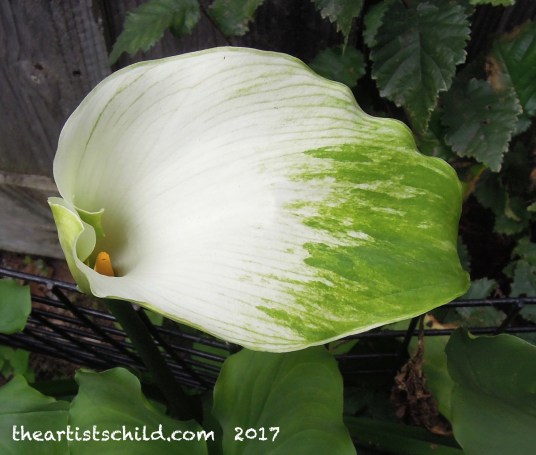
While some plants are starting to go dormant others are blooming.  An interesting lily popped up in a neglected corner of our garden.  We did not plant it so it must have come from a neighbor’s place.  It is now has a white flower with a green tip that looks like it has been painted on with a small brush.  We used to have some pure white Arum lilies and it is another variety.  Lilies are often used as symbols of death so it is an appropriate that it flowers at this time of the year.  I think that they are poisonous as well and this may be one of the reasons for their somber associations.

Along our drive is a hardy creeping plant that has tiny pink flowers (Polygonum Capitatum, Pinkhead Knotweed).  It came from our grand parents garden.  Looking closely the ball-shaped flowers are actually made up of multiple delicate flowers.  They maybe small but the flowers are prolific.  Nothing will kill this plant.  It has tenacity and even spreads over the concrete if there is a small amount of soil.  Apparently it is a Himalayan plant.  No wonder it is a hardy survivor.

DSCN4562

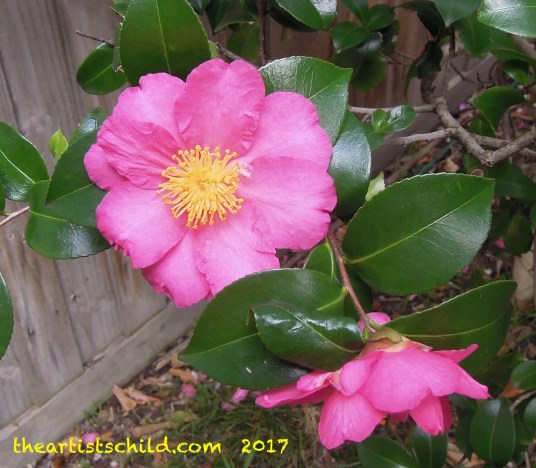
The glamour plant of our garden in the cold months is the camellia.  We have several in the front garden although there have been some losses due to drought over the years.  Only the hardy ones have survived.  Most of the camellias now have buds but the first to flower are the sasanqua varieties.  I zoomed in on a lovely pink flower with yellow stamens.  The flamboyant camellia is to winter what the rose is to summer.  Full of the colour and energy of life despite the darker days.

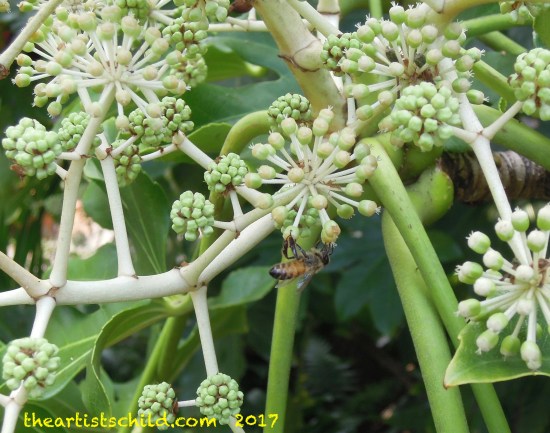
This energy can be also seen in the activity of the bees while they collect pollen from our Japanese Aralia flowers.  These are white and grow in groups (umbrels).  The bees love these autumn flowers and many are attracted to them.  It drives our dogs crazy and while I was taking the photos, they jumped up and tried to catch the bees.  Not a great idea if you don’t want to be stung.  I managed to get some close-ups of the industrious insects, who always manage to find some type of pollen bearing plant in the autumn.  We should be like bees.  No matter how bleak we may feel there is always something that will generate our creativity.

Version 2

Life is still all around us in autumn.  Sometimes you will see it in the life cycle of a mushroom or the activity of a bee.  At others it is a splashy bright camellia flower.  Plants that are losing their leaves are just having a respite.  Nature makes the most of this time and so should we to recharge our batteries.  It is a good time to be contemplative and concentrate on creative projects when there are no distractions from summer activities.   There is still plenty to keep you active, motivated and inspired as the days grow shorter and remember, spring is only four months away.

Kat

I wanted to include a song about May in Australia and remembered local legend and singer/songwriter Paul Kelly’s Leaps and Bounds (1986).  This song has become something of an anthem for Melbourne.  It mentions two iconic buildings.  The most famous is the M.C.G (Melbourne Cricket ground) with its “fly swatter” lighting towers, venue for the 56 Olympics, Aussie Rules football and local and international cricket.  He also sings about the “the clock on the silo” which is the neon light clock on the old Nylex factory that can be seen from the Punt Road hill on the other side of the Yarra River.  The video shows Kelly and his band playing on top of the silos in 1986.  Pay attention to the skyline of the city, the lone Arts Centre spire and the surroundings.

In the following short video the same area of Melbourne was filmed by a drone last year. A lot has changed in 30 years. (The Nylex factory is to be converted into apartments and there was a fight to preserve the silos and the clock after the developer was going to destroy them. After a lot of protest, assisted by the video of this song, it was announced in March this year that the silos and the clock will be incorporated into the design).

An Artist’s Best Friend

Version 2

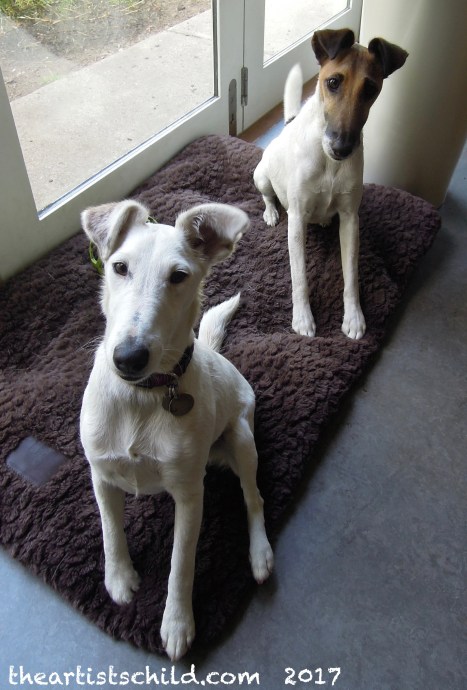
Our Two Fox Terriers

I had just written the first draft of this post and showed it to Ellie.  She read it and said, “no one wants to read about someone’s dog. It is too personal and boring.”  Of course she is right.  Anyone who has a dog thinks that theirs is the smartest, funniest dog in the world and they don’t want to hear about other people’s dogs unless it is an interesting story.  Taking on board what Ellie said I had a rethink and decided to write about dogs as a source of inspiration for artists and writers and how they have influenced my own creativity.

Dogs have inspired many works of fiction.  For example Jack London’s The Call of The Wild (1916), about the adventures of the Alaskan Klondike sled dog, Buck, Eric Knight’s 1940 novel, Lassie Come Home and Dodie Smith’s 1956 novel the 101 Dalmatians to name a few.  And who can forget one dog’s life story in Marley and Me (2005) by John Grogan.  These books were all made into popular and enjoyable movies.

Dogs as companions have produced entertaining characters like Scooby Doo from the cartoon TV series and Snowy in The Adventures of Tintin by Belgium cartoonist George Remi (Herge).  Generations of children have loved reading about the dog Timmy in Edith Blyton’s Famous Five books.  The French movie The Artist  (2011) benefited from the wonderful antics of the Jack Russell, Uggie and Eddie (Butch) provided many hilarious scenarios in the TV series, Frazier.

True stories about the incredible feats of dogs are also inspirational.  The Maremma Sheepdog used to trial their use for guarding Fairy Penguins against predatory foxes on the coast of the Victorian town of Warnambool, inspired the Australian film Oddball (2015).  There is also the successful Australian movie Red Dog (2011) based on a true story with a sequel in production.

Google songs about dogs and there is a long list.  Often they are used as metaphors that are not always flattering to dogs but more about human nature.  From old classics like Hound Dog (Elvis Presley) to anthems like Who Let the Dogs Out (Baha Men), these songs have kept our feet tapping.  Some beautiful songs have been written about dogs.  Cat Steven’s I Love My Dog, and Nick Drake’s Black Eyed Dog from the 1970s are just some of the many.  I have written a couple of songs about my dogs.  They are very personal and were a way of dealing with their loss.

There are so many stories, television shows, movies, songs and about dogs I could go on for pages and I have only mentioned a few.  But you get the point.  Dogs are popular subjects because they trigger strong emotions, whether in a story or as a symbol, that can generate creativity.

Our connections with dogs makes it hard to resist drawing and painting them.  Visual artists have created wonderful depictions of dogs to illustrate books.  I have a couple of early twentieth century children’s books with some lovely illustrations of dogs.  Tattine by Ruth Ogden (circa 1901) is full of sweet black and white paintings of a little girl, many with her puppy.  The frontispiece has a lovely watercolour of some puppies pulling at her night-clothes that has used typical behavior.  In Country Favorites (circa 1901) is a charming colour picture of two terriers watching a hedgehog.  As the owner of a terrier, I know this is in the realm of fantasy as they are hunting dogs and would not be leaving the poor thing alone.  But then again the hedgehog’s spines could be a deterrent and a realistic image would not be great in a children’s book.

DSCN4351

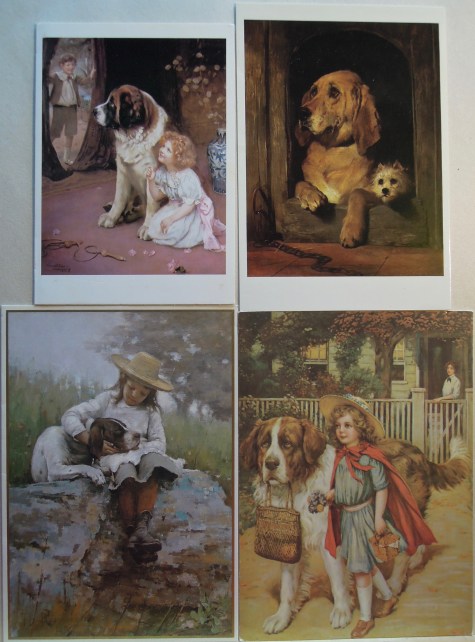
Greeting Cards Clockwise from top: Hide and Seek by Arthur Elsley (1869-1952); Dignity and Impudence by Edwin Landseer (1839); To School Well Fed on Grape Nuts, advertisement lithographed on tin (1917); The Girl With the Dog, Theodore Robinson (1852-1896).

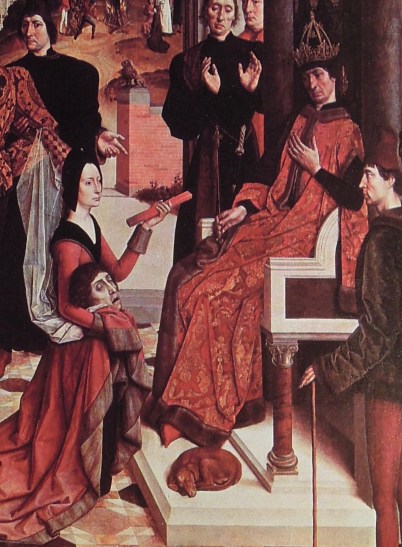
Amongst my greeting card collection, I have several with images of children and dogs from the nineteenth and early twentieth centuries.  A dog is a popular subject because anyone who has owned or loved dogs can relate to these works.  There is nothing like having the devotion and loyalty of a dog.  In fact in Medieval Flemish paintings dogs were included as symbols of faithfulness.

DSCN4370

Detail Justice of Emperor Otto III (1470-75) by Dirk Bouts

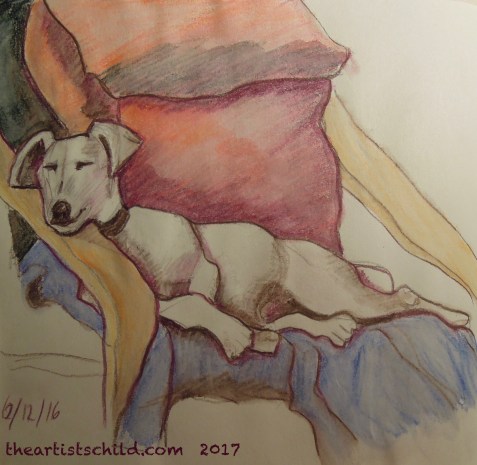
The actions of our own dogs have given both Ellie and me ideas for artworks.  We both like to do drawings of our two Fox Terriers.  Usually you can only get them to pose when they are asleep as they are in constant motion.  Ellie did a watercolour pencil sketch of her current dog that I really like and have included it below.

DSCN4378

Ellie’s Watercolour Pencil Sketch

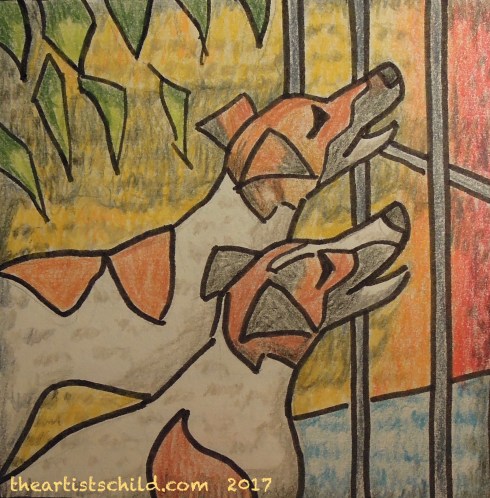
You hear all kinds of stories about dogs rescuing people from dangerous situations.  One day when I was upstairs, our previous two Foxies started barking furiously at the side gate.  I went down to have a look and got to the front of the house only to see that someone had broken a window and the door was ajar.  The intruder must have heard me coming.  I saw a leg disappearing around the corner and yelled some rather strong language before calling the police.  I had not heard the door knocker and if the dogs had not barked so loudly and in such an agitated manner I would not have known there someone was breaking in to our house.  This episode became a tapestry design and I have included one of the working drawings in this post.

DSCN4374

Drawing for Tapestry Design by Kat

It is obvious that I love dogs.  Dogs have always been important in my life and I could not be without one.  I think it is essential to have a dog (or cat) if you work at home. Talking to your pet is a good way to work through an idea.  Better than talking to yourself which can look strange if someone catches you doing this.  But with a dog it is perfectly normal because they listen intently. You just know when they think your idea is rubbish.  Dogs do sneering well.  But when your enthusiasm for something is conveyed to them they take up the good feelings and go with it.  You know you are on a winner when your dog smiles and wags his tail like crazy.

Dogs can be heroes, counsellors, entertainers and best friends amongst their many traits and this makes them perfect subject matter for creative work.  If you work at home and spend a lot of time on your own it is so easy to get caught up in your work and a dog keeps you connected to reality.  We benefit in so many ways from our relationship with our dogs and should never take them for granted.  Dogs are always an inspiration.

Kat

The following video shows a compilation of clips from 1930s films starring the wired-hair fox terrier Skippy.  Skippy starred as “Asta” in The Thin Man films with William Powell and Myrna Loy, as “George” in Bringing Up Baby with Cary Grant and Katherine Hepburn and as “Mr. Smith” in The Awful Truth with Cary Grant and Irene Dunne.  This delightful dog’s actions are put to the song Who Let the Dogs Out performed by Baha Men.

The Art of the Squiggle

A great way to free up your drawing and to think in an imaginative way is to do squiggles.  A squiggle is a random set of various lines drawn onto a page.  Either oneself or someone else then connects these lines to create an imaginative image.  This type of squiggle drawing originated in the Australian children’s Television program, Mr. Squiggle, which ran from 1959 to 1999 and was beloved by several generations.

Mr. Squiggle was a marionette with a pencil for a nose.  He came from the moon in a rocket and with the help of a grumpy blackboard and a presenter, created his drawings using the squiggles sent in by the child viewers.  It was a form of interactive drawing long before children had access to computer drawing programs.  Mr. Squiggle was the brainchild of puppeteer, Norman Hetherington.  He usually did the drawings upside down from the viewer’s perspective because that is the way he would see the page while operating Mr. Squiggle.  Then the finished drawing would be turned right side up and the image revealed.  Here is a five-minute episode of the program found on You Tube.  It is still delightful to watch.

As children, Mr. Squiggle and his clever drawings fascinated Ellie and me.  No squiggle was too difficult for him to transform.  It seemed like magic when the random lines became something recognizable and usually whimsical.  He must have done thousands of drawings over the 40 years that the show ran.

This drawing concept was so simple yet so inspiring for children.  It taught us how to use our imaginations with just a pencil and an eye for the image long before we learnt about great artists and their techniques.  There was no pressure to produce a great work of art. It was about the pure joy of the act of drawing.  And it was something you could do yourself.  We never sent in a drawing to the show but Ellie and I would do this type of drawing together, each transforming the other’s squiggles into a fun image.  It was a great game to play on rainy days.

I still like to do squiggles.  This type of drawing makes you come up with creative and often amusing ideas because you must use all the lines.  You can do it with someone else but usually I do these drawings for myself.  To make sure that the lines are completely random, I close my eyes and scribble on the page.  Then I look at what I have done and turn the drawing around and view it from different angles.  Sometimes it is possible to see an image immediately but at others it takes longer.  It is good to consider all the shapes and their relationship in space from various perspectives.  But eventually something is revealed.

It is not so much about doing a perfect drawing but more about stimulating the imagination and having fun.  If it turns out a bit wonky that does not matter.  And you can always do another one.  That is what is great about squiggles.  They are endless and you can use the simplest of drawing materials.

All drawing should be as enjoyable as a squiggle and it is a way of restoring your childhood creative spirit.

Happy squiggling.

Kat

The Worry Tree

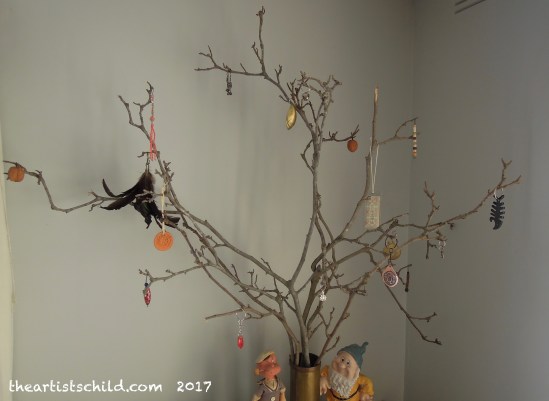
DSCN4298

I’m a worrier.  Always have been since I was a child.  I’d worry about my schoolwork, passing tests, my health, anything and everything.  I still worry about things and I know it’s a waste of energy.  These types of bad thoughts can sometimes get blown out of proportion so that they interfere with your creativity and stop you from getting things done.  You need to put them into perspective.

The song I’m So Worried by Terry Jones of Monty Python fame sums up this type of worrying.  It’s just ridiculous and you will always find something to worry about if you let everything get to you.  Although I did have a bag damaged by the “baggage retrieval system they’ve got at Heathrow” so maybe that is something to worry about.

As a form of self-therapy I recently created a “Worry Tree.”  I figured I needed more than worry beads to relax me.  Using some pruned branches from our Magnolia, I hung up an object every time I felt anxious about something.  I even made some beaded ornaments from those left from broken necklaces.  By looking for or making something to hang on the tree I find that I completely forget about what is causing my worry and I can relax. This type of diversionary method works because I’m involving myself in a meditative process.

People have attached things to trees for millennia to ease their worries and ask for help. For example in Ireland, Cornwall and Scotland trees are often associated with sacred wells and petitioners attach pieces of cloth and other objects as a prayer or supplication. They are called Clootie wells in Scotland and cloutie wells in Cornwall.

To externalize your worries by attaching a symbolic or written item to a tree can be an effective remedy.  Then you can let it be.  I only wish my worry tree was a living one, although this would be a bit difficult to fit on my desktop.   My worries have now been turned into something fun and creative that makes me feel happy.

On a positive note, being worried has definitely inspired songwriters.  There is The Worried Man Blues, a traditional song that has been recorded by Woody Guthrie, Pete Seeger and many others.  I like Johnny Cash’s version.

Probably the most famous song that shows how stupid it is to worry is Bobby McFerrin’s Don’t Worry Be Happy .  It deservedly has had millions of views on You Tube.  I love to sing and play this on my ukulele and it always makes me feel good.  A less well-known song of the same title with a similar theme is by Australia’s Guy Sebastian.

Instead of worrying find something that you can do to ease these annoying and distracting thoughts.  Maybe a “Worry Tree” will work for you as well.

Kat

The Broken Club and the Half Eaten Atlas

Interesting tales attached to objects are for me what gives them value. The more bizarre the better. The following is a poem inspired by two items and a family story.

The Broken Club and the Half Eaten Atlas

Safely kept were the tribal club and atlas

Left behind by a missionary man

Some friend of an ancestor

Then the club was broken in two

By one boy who

Used it to strike the floor

And the book found under the house

Half eaten by a rat or mouse

Last possessions of Gottlob Rembold

A resident of Sydney

Who went off to New Guinea

Or so I’ve been told

In the late 19th century

And was eaten by cannibals

©Theartistschild.com 2017

There is a story in our family that a German missionary left some of his possessions in storage with a relative.  The Aboriginal war club (waddy) and Stieler’s Schul Atlas are all that remain.  He was supposedly eaten by one of the New Guinea tribes of headhunters and this was why he never returned to collect his things.  The war club (broken by an uncle when young and mended with some waxed flax by me) is the type of weapon used to attack enemies in tribal battles.

While I am usually dubious about the veracity of such sensationalist tales, I think that the story is most likely true because it came from a branch of the family that was quite reliable.  They were very honest and practical and not the types to make up fanciful stories.   Ellie and I thought that we would investigate this further to see if there was any actual documentary evidence available.

The name Gottlob Rembold and a Sydney address are hand written in the Atlas.  We Googled his name and this has made the story stranger and more complicated.  In Sydney in 1881, a Gottlob Rembold at the age of 27 was charged with shooting and wounding his uncle in the chest with intent to murder.  Apparently this Gottlob was a young man from Germany, who came out to Australia in 1880 to live with his aunt and uncle, a farmer, probably after the death of his father.  There was a dispute about a large sum of money in a will that he claimed was his, but his aunt said it was left to her.  Gottlob also claimed that he had been mistreated since his arrival from Germany ten months before.  Gottlob was found guilty but the sentence was remitted with no reason given.  There is a prison photo of Gottlob but we can’t show it as it is subject to copyright and  only available to view by Ancestry.com members.  It is not a mug shot, but a normal studio portrait and he was a good-looking young man.

His was not a common name in Sydney at the time so it is surely the same person.  The atlas has a date of 1876 and this is when this Gottlob was 22 years old and might have been contemplating travel.  After his release from prison he could have gained assistance from a religious organisation and then decided to become a missionary.  Gottlob had been employed as a gardener so this was a change of direction.  Not that it did him much good.

Gottlob’s story is part of the rampant Western Colonialism that took place around the world in the late 19th and early 20th centuries.  Probably if Rembold had been a medical missionary or an Anthropologist he would have survived.  As opposed to some of hardline missionaries of the period, they tended to respect the host culture and were not perceived as a threat so usually lived to write about their experiences.  Gottlob must have made enemies if he had such a nasty fate.

Not all family stories are sweetness and light and the sad and bad characters can be just as inspiring as the heroic figures.  Was Gottlob a naive young man mistreated by his aunt and uncle or was he an opportunistic, murderous fortune hunter who turned to religion?  We will never know the whole truth about his end unless we can find a death certificate.  Without more information one can only imagine the mysterious and violent demise of the unfortunate Gottlob Rembold.

Kat

To lift a rather dark story the following is a live version of Rage Against the Machine’s protest song Killing in the Name by my favorite string quartet, Sydney group “FourPlay String Quartet.” They can really rock the strings.  Ellie and I saw them perform this same piece in concert and it was electric.  The members of FourPlay are all fantastic musicians and composers and their own music, while influenced by the past, is of our time.   In recent years they have collaborated in performance with Neil Gaiman.  Check them out on YouTube.